(First published in Issue 106 of Electronic Sound magazine, October 2023)
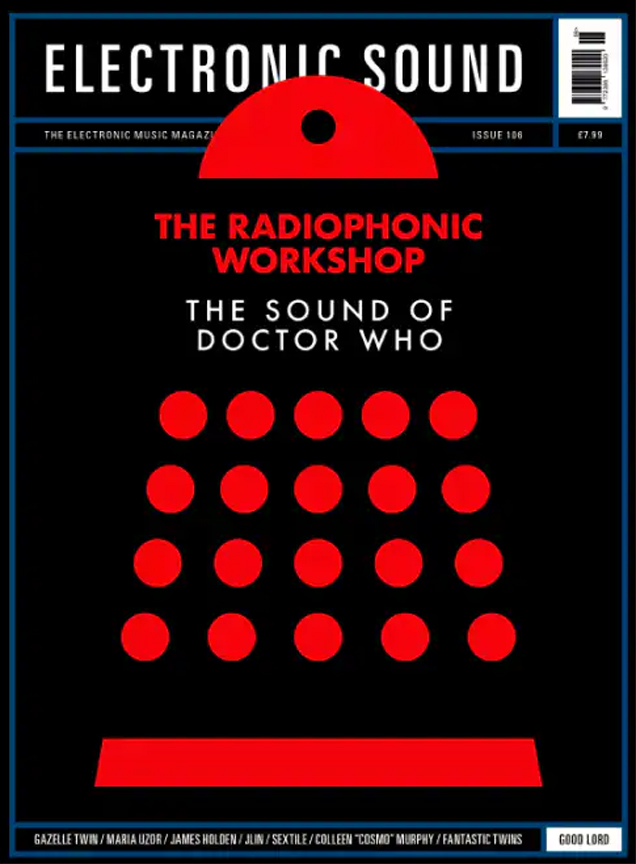
ADVENTURES IN TIME AND SPACE
With the sixtieth anniversary of Doctor Who on the horizon, what better time to celebrate the work of an equally eccentric British institution? One with inextricable links to the cosmos’ favourite Time Lord. In a new interview, Dick Mills, Brian Hodgson, Paddy Kingsland, Roger Limb, Peter Howell and Mark Ayres travel back in time through the strange history of the BBC Radiophonic Workshop
Words: Bob Fischer
“I first came across Desmond Briscoe on the moon!” laughs Dick Mills. “Plot On The Moon was a radio serial about two mad scientists who went to the moon and – as you do – fell in love with a Moon Maiden. Nature took its course, and one of the scientists came back to Earth pregnant. And I thought ‘This is a slice of everyday future life!’ So I fitted in quite well when I went to the Radiophonic Workshop.”
The story of the BBC Radiophonic Workshop? Surely one of the greatest artistic sagas of the 20th century. And, for that matter, the 21st century. And probably beyond. As fans worldwide celebrate the sixtieth anniversary of Doctor Who, it feels entirely appropriate to also raise a hearty modulated cheer for the strange, beautiful corner of the BBC whose adventures still feel inextricably linked to those of a certain eccentrically-dressed Time Lord. Both institutions share a gloriously cranky ethos: idiosyncratic, groundbreaking, relentlessly inventive, even gently anti-establishment. But the Radiophonic Workshop got there first, founded in 1958 by Desmond Briscoe and Daphne Oram to produce delightfully strange noises for a whole range of BBC radio and television programmes.
Dick Mills wasn’t quite there at the start, but he wasn’t far off. He has fond memories of his one-time boss.
“Desmond was a man of many surprises,” recalls Dick. “When he was in the army, he managed to get himself excused parades on account of there being something wrong with his feet. Flat feet or ingrowing toenails, or whatever. He never wore regulation shoes, he always wore black sandals. Ceremonial sandals, highly polished! Rumour had it that he’d been a member of the Household Cavalry and was based in Windsor Castle with Her Majesty, who he claimed had her own pet name for him. And so, we suspect, did the rest of the castle! He actually inferred that he’d taught Her Majesty how to ride a horse…”
It was a period when the exciting potential of new technology went hand-in-hand with the growing optimism of a Britain rapidly emerging from post-war austerity. Young people across the country were becoming entranced by the availability of tape machines – including Hertfordshire-born Roger Limb.
“It was about 1957, and there was a school tape recorder being used for language lessons,” remembers Roger. “I thought it was a wonderful piece of equipment. And my father was a radio amateur, so there were all sorts of old microphones lying around. I managed to persuade the language master to let me take the tape recorder home, and I borrowed one of my father’s microphones and did all kinds of evil experiments with sound. So, probably around the very time that Desmond Briscoe and Daphne Oram were starting the Radiophonic Workshop, I was doing my own little bit, aged 16 or 17.”
In Liverpool, a young Brian Hodgson was also experimenting with his own reel-to-reel tape machine (“it weighed half a hundredweight”), and his interest in sound manipulation was leading him to soundtrack his National Service in the RAF with some decidedly offbeat BBC radio broadcasts. In particular Private Dreams And Public Nightmares, a 1957 “radiophonic poem” boasting soundscapes created by both Daphne Oram and Desmond Briscoe.
“I heard an experimental unit was being set up, so I deliberately turned the radio on to listen,” says Brian. “I never thought for a minute that I’d eventually work there, but it was interesting…”
The Radiophonic Workshop officially formed on 1st April 1958, earning a modest home in the BBC’s Maida Vale studio. Only months later, however, Daphne Oram resigned to pursue her own singular career in electronic sound. She was accompanied by engineer Jeannie MacDowell, whose departure created a vacancy filled by the fresh-faced Dick Mills.
Dick’s earliest jobs boasted a distinctly otherworldly feel. Shortly after wheeling a portable tape machine (“like a trolley with a ferrograph on top”) to the broadcast of Plot On The Moon, he was despatched to play in the tape effects created by Desmond Briscoe for Nigel Kneale’s notoriously unsettling 1958 TV serial, Quatermass And The Pit. But even the Workshop’s more terrestrial commissions were riddled with a delicious streak of oddness.
“Desmond made us promise that we wouldn’t allow anyone connected to The Goon Show into the Workshop!” laughs Dick. “Then he went on leave, and the phone rang, and they said ‘We’d like ‘Major Bloodnok’s Stomach’, please..’”
This 1959 composition, an explosive sound collage of burps, pops and peptic blasts, was designed to accompany the alarming gastro-intestinal issues faced on a weekly basis by Peter Sellers’ blustering military man.
“Jimmy Burnett, who was recording manager for the Melos Ensemble and Julian Bream, let his proverbial hair down,” recalls Dick. “And we made a wonderful montage of disgusting sounds which we then played to the producer. He said ‘Absolutely magnificent, but… The Goon Show is half an hour long. We can’t afford to play your cue every time Major Bloodnok twitches!’. So Jimmy and I had to take a severe razor blade to it, and we got it down to ten seconds instead of thirty…”
Meanwhile, those tape-obsessed youngsters dotted around the country were beginning to drift inexorably towards the BBC. After a spell in repertory theatre, Brian Hodgson was accepted for a position within the corporation’s drama department. Here, he was further impressed by the work of a new Radiophonic Workshop recruit: composer Maddalena Fagandini.
“I was working in radio drama, and they were doing an Adamov play called Living Time,” explains Brian. “Maddalena had done all the radiophonic sounds for it, and I was totally blown out of my mind. I then got sent to an engineering indoctrination school, where they tried to pump you full of things like hysteresis and magnetic flux – a complete waste of time, you never needed to know things like that! But when I came back, we went on a tour of all the different departments of the BBC, including the Radiophonic Workshop. And I applied for an attachment. In those days, you’d usually do three months then get sent back, and the reason it was so short was because a brain surgeon friend of a senior BBC engineer had said ‘If you expose people to these strange sounds, they’ll probably get mental illnesses’!”
The Workshop was already evolving. Brian and fellow engineering inductee John Baker joined in late 1962, shortly after the arrival of a trainee assistant studio manager who had also decided her future lay along a different path: Delia Derbyshire. The events that followed have become the stuff of cosmic legend. When a commission arrived to arrange the theme tune of a vaguely educational science fiction show for children, Derbyshire – with the assistance of Dick Mills – set to work, creating an extraordinary radiophonic interpretation of Ron Grainer’s traditional musical score. History records that, on returning from a sun-soaked holiday, Grainer was flabbergasted to hear the resulting arrangement.
“At that time, Ron was Mr Signature Tune,” says Dick. “He’d done Comedy Playhouse, Steptoe And Son, Maigret… he was terrific. But with Delia and me, there was a very high resistance to making anything that might be recognisable. However you press regular instruments into action, they just haven’t got the ‘What on earth is that?’ factor. So we got the Workshop engineer to stretch a steel wire the length of a 19-inch blank plate, and that became the thing we twanged. Which then had to be manipulated to form the notes. And the ‘Ooo-we-ooo’ machine was a Wobbulator that Delia managed to play like this… hang on, let me put my hand up…”
He wiggles two fingers with impressive dexterity.
“So there was nothing that forced regular tonal qualities or interludes onto us”.
The show’s earliest musical soundtracks generally bypassed the Workshop, featuring a mix of work by traditional TV composers, stock music (including, on two occasions, pieces by French brothers Les Structures Sonores, producer Verity Lambert’s original choice to arrange the theme) and – most strikingly – an array of alarming scores by musique concrète pioneer Tristram Cary.
Brian Hodgson, however, became the producer of the show’s distinctive ‘Special Sound’. In the Workshop’s pre-synthesizer days of experimental tape manipulation, when lampshades and hot water tanks were regular instruments of choice, Brian took the Heath Robinson approach to heart. The infamous TARDIS materialisation sound? The sound of his mother’s house key, scraped along a bass piano string. The voices of the Daleks, meanwhile, had their origins in a robotic character from a 1963 radio play.
“Jones the Robot in Sword From The Stars!” laughs Brian. “He was a butler. A bit like C3PO in Star Wars, but he rather pre-dated that. I used my own voice and modulated it, but not very deeply. So when the Daleks came along, I thought ‘I’ll see what happens if I modulate it deeper’. Then [voice actor] Peter Hawkins arrived, and he was just brilliant. We did some tests with a ring modulator and the old BBC commentator’s mic that covers your mouth, and I said ‘You’re going to have to elongate the vowels, so you can hear the modulation – it doesn’t work on consonants’. The Dalek voice just appeared out of nowhere. That was it.
“Oh, and my boyfriend had a corgi dog that we used to play fight with. She became a monster on several Doctor Who stories…”
With Doctor Who now eliciting waves of “Dalekmania” in hundreds of school playgrounds, the Workshop’s future stalwarts were beginning to find their musical feet in an eclectic array of bands. For Roger Limb, this meant a burgeoning career as a jazz bassist and keyboard player. And, indeed, an encounter with an alternative pioneer of recorded sound.
“I left college in 1963, and joined a band in Cheltenham,” says Roger. “The bandleader, Bill Nile, somehow got in touch with Joe Meek – who was a Gloucestershire boy as well. We went off to Holloway Road and did some recordings for him. I don’t think he was really interested in our music, but he was very friendly. He showed us how he’d made ‘Telstar’, and the bathroom in which he’d invented a new way of creating reverb! I was temporarily living in London at the time, and on a couple of occasions I went back and had an interesting half hour with him, talking about music. And then he gave me a disc, and said ‘Take this back to the boys, learn this tune and come back and play it for me’.”
So, in an alternate universe, you could have been the new Tornadoes?
“We listened to it, and it was a load of rubbish,” shrugs Roger. “So we never followed it up.”
Meanwhile, in rural Hampshire, a young Paddy Kingsland was becoming oddly passionate about the art of creative dismantling.
“I’d go to jumble sales and pick up old valve radio sets, then I’d take them to bits,” recalls Paddy. “There were lots of elderly people in my village who didn’t have much money, and when they took their radios to be repaired, the shop would say ‘Oh no, it’s too old, you need a new one – which we’ll gladly sell to you!’ But I could always find a valve to plug in and keep them going a bit longer. It was also quite funny to put on the BBC News, with its pompous voice, and at a particularly pompous moment my friend and I would blow up the radio with the rather dodgy chemicals we’d put together…”
Paddy’s musical passions were being sparked by the chart success of The Shadows. Inspired to play guitar, he formed a band with a decidedly similar moniker: The Strangers.
“Fender guitars looked great and sounded completely different to the guitars all the jazz people were using,” smiles Paddy. “They were really twangy and echoey. The jazz thing… they were interested in the notes and the music, but we were interested in what it sounded like. Which, in many ways, is what electronic music is about. But the stuff I was doing had great simplicity compared to what Roger was up to.”
Nevertheless, early links were being forged between the Radiophonic Workshop and the burgeoning 1960s pop scene. By the middle of the decade, Paul McCartney was discussing an (ultimately fruitless) re-working of ‘Yesterday’ with Delia Derbyshire. And in 1966, together with Brian Hodgson and early synth pioneer Peter Zinovieff, Derbyshire formed Unit Delta Plus, an independent outfit intended to produce their own brand of electronic music.
On 28th January 1967, the work of the Radiophonic Workshop and The Beatles finally collided. The Million Volt Light And Sound Rave was a multi-media event at London’s Roundhouse, showcasing the work of Unit Delta Plus… as well as boasting the only public airing of a 14-minute sound collage produced by all four members of The Beatles. In the intervening 53 years, it has remained resolutely unreleased and unbootlegged. So is Brian Hodgson one of the few people in the world to have heard ‘Carnival Of Light’? The answer… sort of.
“We were asked if we could take the tape along to the Roundhouse,” remembers Brian. “It was delivered to the Workshop with no leaders on it, so we didn’t know if it was forwards or backwards. We had a listen, and we still didn’t know! But we took it along – and it was utter fucking chaos at the Roundhouse that night. You wouldn’t believe it. People were screaming and shouting, running in all directions, and nobody really knew what was going on.
“So I’m afraid Delia and I handed over the tape and pissed off to the pub.”
By the late 1960s, Paddy Kingsland had given up a career as a BBC studio manager to join the next generation of Radiophonic Workshop recruits. A chance encounter with Roger Limb – also now a BBC studio manager – led to a friendship that has flourished for over five decades. Where did they first meet?
“My memory is Bush House Overseas Services in about 1968,” says Roger. “We bumped into each other, and mentioned that we both had an interest in music. From time to time, we’d meet in a studio with our guitars – together with one or two other bodies – and we’d have a jam session. I think Paddy enjoyed it as much as I did.”
“In those days, the hierarchy actually thought it was rather a good thing for people to experiment in studios,” adds Paddy. “I remember there being a version of the comedy record ‘They’re Coming to Take Me Away, Ha-Haaa!’, with the lyrics based around Bush House and how it drove you nuts to work there. And another bit of editing, where a pompous announcer saying ‘The British Broadcasting Corporation’ was made to say ‘The British Broadcorping Castration’…”
Supplementing this new influx of Workshop inductees was musique concrète enthusiast (and yet another former studio manager) Malcolm Clarke. For two Workshop stalwarts, however, the passion was beginning to wane. Brian Hodgson and Delia Derbyshire had continued to explore outside musical interests – including creating 1969’s classic White Noise album, An Electric Storm – but both were now feeling decidedly jaded. By early 1973, they had left the BBC. Brian recalls, during his final days at Maida Vale, arduous shifts lasting long into the night.
“We only had two studios, so that was the only way you could get anything done,” he explains. “I got to the point where I thought if I hang around here, I’m going to end up as a piss artist. If I was working at night and Delia was there, there’d always be bottles of wine passed backwards and forwards. Delia was becoming more and more disillusioned with the Workshop, and I think the final straw came when the Tutankhamun thing happened. She’d planned a whole progression, then was suddenly told that Episode 10 was now Episode One, and Episode Six was… you know. So she was pissed off as well.”
BBC2’s 13-part documentary series Tutankhamen’s Egypt was broadcast in Spring 1972. Despite her frustrations, Derbyshire’s theme music is a haunting piece of work, incorporating a 1939 recording of a silver trumpet recovered from the legendary pharoah’s excavated burial chamber. She was assisted by Roger Limb, freshly arrived in the department after a stint as an on-air continuity announcer.
“I think she’d reached the stage of her career where she was finding it difficult to find new ways of approaching projects,” says Roger. “When I arrived at the Workshop, I sat in with all the producers, and Delia and I hit it off. That wonderful evocation of Tutankhamen’s trumpet still gives me a little frisson when I hear it. But she was probably past her most creative spell by then. What do you think, Paddy?”
“By that time, she was – let’s be honest – drinking too much,” agrees Paddy. “Plus… there were lots of very keen young people who were very good at fiddling around with synthesizers. I think Delia was quite daunted by the synthesizers, she didn’t like them very much. It took an awful lot of effort to get good at them, and she saw the limitations – and they were very limited at the time.”
It was, they agree, a period of changing culture at the Radiophonic Workshop, with traditional tape manipulation techniques giving way to newer technology.
“Delia didn’t take to the new breed of synths, like the VCS3,” nods Roger. “She was a tape manipulation person. I only arrived at the end of that era, and I did it with a certain amount of interest. But the VCS3 was on the horizon… and the EMS Synthi 100, which was remarkable. The VSC3 was almost handheld, but the Synthi 100 had its own room and I don’t remember Delia ever working on it.”
Meanwhile, in rural Sussex, another musically-minded youngster had already teamed up with schoolfriend John Ferdinando to record a string of rather splendid DIY folk-rock albums. Unfamiliar with the work of Agincourt and Ithaca? Check out Cherry Red’s excellent CD compilation A Game For All Who Know… not least because the original 50-year-old vinyl now goes for the price of a decent second-hand car. Much to the surprise of the man behind it all: Peter Howell.
“My father, who was a solicitor in Hove, had a handyman – Mr Davies – who did everything for him,” remembers Peter. “There was a gap of six weeks when he didn’t have much to do, so he came up and turned the spare bedroom into a studio for me! We made five LPs and pressed 50 copies of each, because that was the minimum they would do. We actually wanted 30, because we could only think of 30 people who’d want to buy them.”
Joining the BBC in 1970, Peter quickly became a member of the in-house BBC amateur dramatics society, Ariel. After providing the music for Seaplay, a stage production telling the story of a Cold War-obsessed fish called Solomenti, he was persuaded to apply for an attachment to the Radiophonic Workshop.
“I absolutely loved it, and the first person I met was John Baker… and his puppy, which he wasn’t allowed to have in the building!” laughs Peter. “Then I went down the corridor and met Dick. Dick was ever-present in Room 12, in amongst more jack leads than I’d ever seen in my life. It looked like a telephonist’s nightmare.
“It was regarded as a bit of ‘Loony Bin’ by a lot of people in Broadcasting House. Some of the studio manager friends I’d left behind were genuinely surprised I could stand it. To me it was a dream come true, but to them it was the weirdest thing – ‘He’s lost it!’”
Throughout the 1970s, Doctor Who was not – amazingly – the most prolific client of the Radiophonic Workshop. That honour fell to the BBC’s array of daytime educational programmes, from early literacy shows like Look And Read to issue-based teenage dramas like Scene. For a whole generation of 1970s children, the sound of the Synthi 100 and VSC3 is inextricably linked to the taste of Lucozade and the interminable itching of chickenpox scabs.
“We did no end of music for those shows,” says Paddy Kingsland. “Little dramas like Joe And the Sheep Rustlers… these things were often produced by Andrée Molyneux, who was a very forward-thinking and committed producer. I think the BBC wanted to instil a few values into children and teenagers: being positive, being good to other people. Showing children who maybe didn’t have that input from home what it was like to have relationships.”
Roger Limb was an equally enthusiastic composer for BBC Schools.
“As soon I joined the Workshop, I launched into Look And Read,” says Roger. “And I was learning on the job how to do incidental music. I think one of the reasons it was put into my in-tray was that I’d proved to Delia and perhaps Desmond that I could write a tuneful song or two. And a lot of the songs in these shows were teaching songs – showing how letters leap in and out of words and change the sound of those words.”
And what of the kids? The new generation of tank-top wearing 1970s youngsters rapt in front of their new colour tellies? In Tunbridge Wells, 11-year-old Doctor Who fan Mark Ayres found the music from Jon Pertwee’s 1972 series making a life-changing impression on him – in particular Malcolm Clarke’s abrasive Synthi 100 score for the ‘The Sea Devils’.
“I had an epiphany moment,” remembers Mark. “‘The Sea Devils’ was a ‘bloody hell!’ moment for me. I loved everything that people hate about it now. The fact that, half the time, you can’t tell the sound effects from the music. The fact that it’s completely batshit insane. It’s the sound of a complete anarchist maverick fighting with a piece of technology that doesn’t really work properly. All of that stuff, I adored. And, at that point, I decided it was what I’d quite like to do.”
“Then in 1977, when I was 16, I went to the first ‘Doctor Who’ convention, in a church hall in Battersea. And I met Dick Mills and [special effects designer] Mat Irvine. Mat immediately offered me and my mate Steve Ocock a chance to see the visual effects department, so we blagged a day off school. Afterwards, Mat sat us in his office with a cup of tea and asked what we were interested in. I said ‘I like the Radiophonic Workshop’ and he said ‘Hang on…’ and rang Dick Mills. ‘Dick, remember that lad Mark we met at the convention? He’d like to come and have a look…’ So the following week I went back, and there was Dick Mills with a VCS3. These were just lovely people.”
Following Malcolm Clarke’s controversial score for ‘The Sea Devils’, 1970s Doctor Who settled into a more conventional musical groove. The overwhelming bulk of the decade’s scores were provided by Australian composer Dudley Simpson, with Dick Mills taking over Brian Hodgson’s responsibilities as purveyor of the show’s otherworldly ‘Special Sound’. And while Simpson was no stranger to the occasional synth flourish, the traditional brass and timpani he chose to accompany Tom Baker’s adventures became the defining sound of 1970s TARDIS travel.
Until, that is, incoming producer John Nathan-Turner decided to freshen up the show’s music. It was a revolution that swiftly followed the unexpected return of Brian Hodgson, this time as the Radiophonic Workshop’s official Organiser. Brian had spent the intervening years running his own independent studio, Electrophon, and had formed – alongside musician friend John Lewis – a melodic synth outfit named Wavemaker.
“Paddy Kingsland came to see me,” remembers Brian. “He said ‘Desmond wants to know if you’d ever consider going back to the Workshop’. I said ‘Yeah, but it would have to be on my own terms’. I went along wearing very casual clothes, I literally turned up for the interview not really giving a fuck whether I got the job or not. And I said if I came back, I wanted a free hand to reorganise the place. I wanted to have it equipped properly, because I had better equipment than they had at the Radiophonic Workshop.”
Pressing into service a generation of new ARP Odyssey synths, the Workshop were tasked with giving Doctor Who a shimmering musical makeover for Tom Baker’s swansong 1980 series. The show’s theme had remained largely unchanged since 1963 and – in 1972 – an attempted EMS Synthi 100 reworking had even been nixed by then-producer Barry Letts. This time, the task of attempting a shiny, synth-heavy reworking was handed to Peter Howell. No pressure then, Peter?
“I did feel the pressure,” nods Peter. “But Paddy was extremely helpful, he was my go-to pair of ears. I’d play bits to him and say ‘If this isn’t going anywhere, let’s stop now and not waste any more time’. But he kept on nodding, so that was alright. And, as with Delia’s version, I didn’t want to make anything where people could sit in the pub and say ‘Ah, I know how he did that, he used a Casio Thingummybob’. So I made it an amalgam of various techniques.”
While the new synths gave the theme a contemporary sheen, Peter still employed some old-school Radiophonic Workshop tape manipulation, incorporating the gentle flutters of a freshly-struck match.
“I was imagining a Catherine wheel, and I wanted it to be an ever-increasing Catherine wheel,” he explains. “Which made me think of fire, and of striking a match. So it’s a match strike with multiple echoes and build-ups.”
“I remember being amazed by it all!” beams Paddy Kingsland. “Peter really did make a good job of it, and it still stands up now.”
“I was bowled over by it too,” agrees Roger Limb. “I thought it was wonderful.”
The early 1980s became the Radiophonic Workshop’s second Doctor Who heyday. Peter, Paddy and Roger were handed the lion’s share of scores, each bringing their own distinct musical backgrounds to the show: folk-tinged elegance, melodic rock invention and stately ambient atmosphere respectively. They remain characteristically modest about their contributions.
“I enjoyed working on Doctor Who,” says Roger. “I was flattered to be part of the team. If you have a good director, it helps a lot with the process – and I had some good directors. My favourite was Graeme Harper, with whom I did ‘The Caves of Androzani’ and ‘Revelation of the Daleks’.
“The directors usually had an idea of where they wanted music and why, and very often it was to paper over a crack where something hadn’t worked!” smiles Paddy. “They all wanted different approaches. Peter Grimwade liked stings, which I hated. You can’t get going with them. Although I did manage to get going on the final Tom Baker story, ‘Logopolis’. At the end, there was a long cue. But up to that moment it was all ‘Pa-dong! Diddly-dong!’”
For Peter Howell, particular pleasure was found in scoring the show’s 1983 twentieth anniversary feature-length special.
“I loved ‘The Five Doctors’,” he says. “There was more new technology coming along by that time, and I was able to use a Fairlight on it. And working with Dick was great.”
So with Dick Mills and the show’s regular composers now based in adjacent rooms, did meshing the music of Doctor Who with the show’s unique sound effects become an easier process?
“We just banged on the walls!” smiles Peter. “I think all of us just got used to the way Dick worked and looked at a scene. I’d go into the studio and say ‘What are you doing, Dick? Oh, you’re doing that… OK, I’ll go back and do this…”
“It was more difficult when the incidental music composers were outside the building,” nods Dick. “There was no way I could say ‘You know when the Doctor’s got his unmentionables in the mangle again? What are you doing for that?’ Whereas Peter would say ‘I don’t really want to do this scene for twenty minutes… could you come up with a hum and give me a breather?”
“A lot of that went on with ‘The Five Doctors’,” laughs Peter.
With Malcolm Clarke also returning to provide slightly more accessible scores than his opinion-splitting soundtrack to ‘The Sea Devils’, links between the Radiophonic Workshop and Doctor Who seemed stronger than ever. Further sterling contributions came from more recent Workshop recruits, Jonathan Gibbs and Elizabeth Parker. Even outside the TARDIS, the department’s work was producing music liable to reduce 1980s children to shivering, moist-eyed husks: Paddy Kingsland’s 1981 score for The Hitchhiker’s Guide To The Galaxy and Roger Limb’s 1984 soundtrack to magical children’s drama The Box Of Delights (“a privilege”, he says) remain totemic slices of the 1980s childhood.
Brian Hodgson, now Head of Department following Desmond Briscoe’s 1983 retirement, succeeded in his ambitions to secure extra funding and resources. And a fresh generation of composers were arriving, too. By the mid-1980s, Mark Ayres was employed as a sound engineer for TV-AM, the company behind ITV’s wildly mercurial breakfast show, Good Morning Britain. Narrowly missing out on the opportunity to produce Roland Rat’s 1983 hit single ‘Rat Rapping’, he was quick to seize other opportunities when they arose.
“I’d met John Nathan-Turner at conventions,” recalls Mark. “And then – in 1987 – my union at TV-AM fell out with management, and we all got locked out. And, a few months later, sacked. I wrote to everybody I’d ever met in television, and said ‘Gissa job’. Genuinely, it wasn’t my plan to work on Doctor Who – it was the Radiophonic Workshop’s gig, and I didn’t feel that was something I could tread on. But John, bless him, said ‘Come and see me’.”
Sixteen years after Malcolm Clarke’s score for ‘The Sea Devils’ had fired his imagination, Mark composed his debut Doctor Who soundtrack. The music for the 1988 Sylvester McCoy story ‘The Greatest Show In The Galaxy’ was the first of three stylish, elegiac scores created by Mark for the classic series’ final throes.
“It was daunting, taking on something that I loved so much,” says Mark. “I thought ‘I’ve really got to up my game here’.”
Freelancer Keff McCulloch gave the Doctor Who theme another fresh, synth-heavy reworking, but the writing was on the TARDIS wall. The show’s original run ended in 1989, and – by 1992 – the BBC had a new Director General. The John Birt regime brought sweeping changes, including a new policy of ‘Producer Choice’. In-house BBC services were now charged for between departments, and programme-makers were given the freedom to select cheaper options from outside the corporation. It was a tactic, says Brian Hodgson, that spelled the end for the Radiophonic Workshop.
“We’d expanded in Maida Vale, taking over many more square feet than we’d originally had, but now we were being charged for that at West End rates,” recalls Brian. “We were given two years to break even, but nobody could afford to use us. It got to a point where I’d had to get rid of the engineers, and I thought the only people not producing any revenue were myself and my secretary. So I applied for early retirement… which I got.”
Paddy Kingsland had already departed to run his own studio. For Roger Limb, however, the decision was taken out of his hands.
“A manager came in and said ‘Would you like to leave?’,” explains Roger. “And she said it in such a way that the answer was ‘Yes, I would like to leave’. I’d already heard on the intercom that ‘So-and-so is coming along to have a word with you’, and I thought ‘I bet I know what she’s going to say…’. I left on the same day as Malcolm Clarke and we had a bit of a party in the canteen. There was a cake, with the two of us holding the knife together and cutting it – it looked like a wedding!”
With the Workshop officially disbanded in 1996, ultra-fan Mark Ayres became the saviour of an incredible archive of electronic music – one that was very nearly lost forever.
“I got three phone calls in one day, from Brian, Peter and Paddy,” explains Mark. “All saying ‘There are three rooms of tapes that are not properly catalogued, they need saving and we’ve put your name forward. You’re the only person we can think of who knows what’s there’. But, when I was about a third of the way through the cataloguing, I was running out of tapes. Things like Paddy’s soundtrack for [1975 children’s drama] The Changes weren’t there… I said ‘This is ridiculous, where have all the tapes gone?’ I was told ‘We’ve already binned them…’
“Eventually, I was tipped off that I should try the band store, where all the instruments for the BBC Symphony Orchestra were kept. I opened the door, and all the missing tapes were there. I later found out that one of the engineers had deliberately not ordered the skip, and he’d hidden these tapes where he thought nobody would spot them. So, thank God, we got everything back.”
The story, of course, has a happy ending. Since a “one-off” reunion performance at The Roundhouse in 2009, a live version of the Radiophonic Workshop – including Mark, Peter, Roger, Paddy and Dick – has performed over fifty shows, bringing their childhood-defining music from Doctor Who and beyond to huge and frequently weepy-eyed audiences. But it’s not all nostalgia. New 2017 album Burials In Several Earths was a hauntingly ambient collection, and their soundtrack to Matthew Holness’ disturbing 2018 horror film Possum was appropriately chilling.
There are recent books, too: Peter Howell’s Radiophonic Times and Paddy Kingsland’s Rocking At The BBC are both delightful reads. This unlikely collection of genial eccentrics – all unwaveringly charming and modest – have achieved the almost impossible: they’ve combined cutting-edge musical and sound experimentation with a popular appeal that has lasted for over half a century.
Back in those cramped studios in Maida Vale all those decades ago, did they have any idea of the impact they were making?
“If we had, we’d have frozen and been unable to do anything!” laughs Paddy Kingsland. “In the nicest possible way, we just made it up as we went along. One episode of Doctor Who was a week of my life, including the briefing, doing the music and going to the dubbing session to put the episode together. It wasn’t a huge chunk of time.”
“We never thought about posterity for one second,” agrees Roger Limb. “We did the music, it was dubbed, and if worked – hooray. Onto the next one. I never thought that, forty years on, I’d be still getting letters about particular phrases I’d used.”
For Dick Mills, the greatest source of pride comes from bringing avant-garde music and sound design into a nation’s living rooms at Saturday teatimes.
“At conventions you get people who say ‘What do you think is the Radiophonic Workshop’s greatest contribution to the world?’” he smiles. “And really, I find the Workshop’s legacy – for which I’m very grateful – is that it forced audiences, of whatever age, to listen to and accept new artforms. If you throw enough randomness at people, they’ll seize on something.”
The randomness continues. In November this year, the sixtieth anniversary episodes of Doctor Who will almost certainly feature noises created by Brian Hodgson back in 1963. When the TARDIS materialises at the beginning of these celebratory new adventures, we’ll still hear the manipulated sound of his mother’s house key being scraped along a bass piano wire exactly six decades ago.
“I donated that piano to Children In Need, and it was bought by a farmer who didn’t realise it was only the frame!” smiles Brian. “But we screwed my mother’s door key to the wooden part of it. It’s probably still mouldering away in one of his barns. I’d love to find out where it is now.”
The legacy of Desmond Briscoe – ceremonial sandals and all – lives on. Desmond died in 2006, and Paddy Kingsland has one final, touching coda to recount.
“We all went to Desmond’s funeral,” explains Paddy. “And of course it was a very sad occasion. But at the very end, Brian Hodgson said ‘And now, wherever his journey in time and space takes him, we wish Desmond well’. Then the crematorium curtains opened, and they played the TARDIS sound effect.
“And of course it was a very moving thing, but at the same time… it reflected the madness of the Radiophonic Workshop.”
Electronic Sound – “the house magazine for plugged in people everywhere” – is published monthly, and available here:
https://electronicsound.co.uk/
Support the Haunted Generation website with a Ko-fi donation… thanks!
https://ko-fi.com/hauntedgen

