(First published in Issue 101 of Electronic Sound magazine, May 2023)
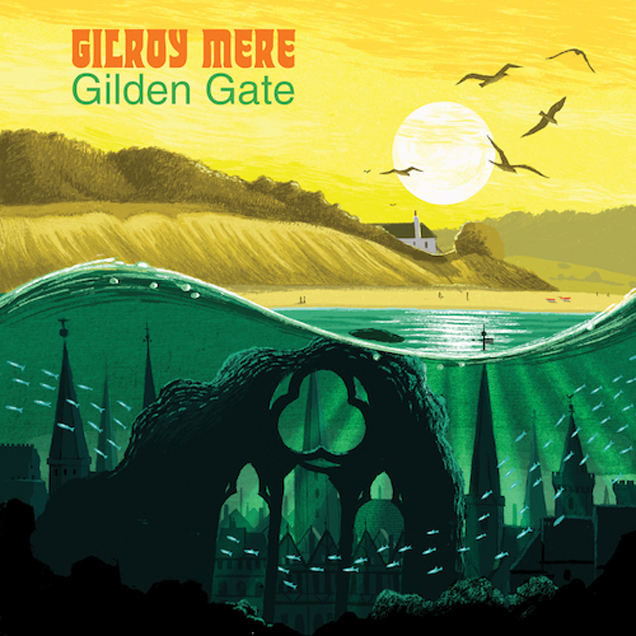
WHAT LIES BENEATH
Oliver Cherer IS Gilroy Mere. And new album Gilden Gate is his latest melancholy celebration of a place that no longer exists
Words: Bob Fischer
“There are stories of fishermen coming home on dark, stormy nights, seeing lights beneath the water and hearing muffled church bells,” says Oliver Cherer. “Is there anything more spooky than that?”
In a perfect world, he’d be telling these tales in a broad Mummerset accent, propped up against the bar of an old seadog’s tavern with half a bottle of Navy Rum spilled down the front of a seaweed-encrusted jumper. A slightly unreliable Zoom connection doesn’t quite have the same sense of romance, so let’s go with the fictional version. As the hubbub of this rowdy clifftop inn settles to a deathly hush, Oliver (“Ollie” to the boggle-eyed locals) is describing the ghostly remains of medieval Dunwich, a real-life Suffolk cityport submerged beneath the North Sea for the best part of 500 years. The stories are the inspiration for his hauntingly melodic new album, Gilden Gate.
“Me and my family go to Suffolk a lot,” he continues. “Growing up, my daughter was obsessed with Swallows And Amazons, and my partner Jenny managed to track down the actual Swallow boat, from the 1974 film. It was just in a boatyard, and they let us take it out on the Broads. Another time, we stayed in Alma Cottage at Pin Mill, because that’s where Arthur Ransome stayed. So I know the area well.
“But I didn’t know the other end of the beach, the Dunwich end…”
A 21st century version of Dunwich still stands. It’s a tourist-friendly hamlet of 200 people with a pleasant gastropub offering B&B accommodation. But this modest, modern-day community is just a lingering fraction of a forgotten medieval metropolis. In the Middle Ages, before being consumed by the incursions of a merciless North Sea, Dunwich was a thriving cityport. It was a story Ollie uncovered while shooting a short film contribution to Sizewell – a multi-media 2019 collaboration with Robin Saville, inspired by the Suffolk coastline’s twin nuclear power stations.
“I stayed at the Coastguard’s cottage in Dunwich,” recalls Ollie. “It’s an amazing little spot, and I knew the name from the Brian Eno track – ‘Dunwich Beach, Autumn 1960’. I’m a huge Eno fan. And, while I was there, I went into the museum. This funny little museum that’s only open on certain days, a dusty little place with rotting mannequins. And I found the whole story in there. Dunwich is just a hamlet now, but the museum was telling me it was once a major city. Which is just impossible to imagine. It feels like it was never there.”
The album, recorded under his regular pseudonym (well, one of his regular pseudonyms) Gilroy Mere, has found its perfect home on Clay Pipe, a label virtually defined by its melancholy celebration of “what lies beneath”. There are wistful synths, mournful strings, lilting woodwind, and – occasionally – Ollie’s own decidedly Eno-esque vocals. And the press release sounds like it was dictated straight from the barnacle-coated bar of that ramshackle fisherman’s tavern. The local friary “crumbling inexorably down the cliff and exposing the bones of buried monks as the graveyard follows the building’s stones into the sea”, anyone?
“Ah yes, the bones…” smiles Ollie. “The ruins of Greyfriars Monastery go right to the edge of the cliff, and almost the entire graveyard has now fallen over it. So the bones of those monks have been regularly exposed over the last couple of hundred years. Nestling in the bushes there’s a little plaque that says ‘This is the last surviving gravestone’. One grave left, and it’s right on the brink. And I suspect, over the next couple of years, that will go over the cliff as well…”
Let’s talk Lost Places. Oliver Cherer – well, Gilroy Mere – has previous form. His 2020 Clay Pipe album Adlestrop was a wistful homage to the forgotten railway stations closed in the wake of the 1963 Beeching Report. An album reeking of overgrown sleepers, of rusting lines hidden by the swaying grass of silent, sun-baked meadows. The lure of this stuff is overpowering sometimes, isn’t it? The temptation to lose ourselves in this exquisite yearning for the vanished. And, even more potently, the vanish-ing. The uncelebrated ruins slowly being subsumed by layers of callous modernity.
“It’s irresistible,” he nods. “There’s an abandoned Beeching station just down the road from me, I go through it on the train every day. St Leonard’s West Marina in East Sussex. The platform is still there, but nobody ever notices it – all they see is TK Maxx as they trundle past. But I always look out for it. I always think about it. And I always feel somewhat connected to its past.”
Is it the tantalising nearness of that past that is so alluring, I wonder? The medieval populace of Dunwich might have long since slipped down that treacherous cliffside, but St Leonard’s West Marina was a working railway station until 1967. Only a few crumbling slices of buddleia-covered concrete remain, but there are people in their sixties who remember travelling from that station. All those lingering embraces and tearful farewells, and they’re so close we can almost reach out and touch them from 2023.
“Yes, and it’s always fascinating listening to older people talking about how they used to live,” he agrees. “My gran is long dead now, but she used to tell a story… she was born in 1910 and – at some point in the 1920s – her boyfriend drove her around London on the back of a motorycle. And I found that incredible. I mean, that’s what I did with my girlfriend in the 1980s! You think of your grandparents as being these funny, genteel people… not the kind of people who ride around on the backs of motorbikes being naughty.”
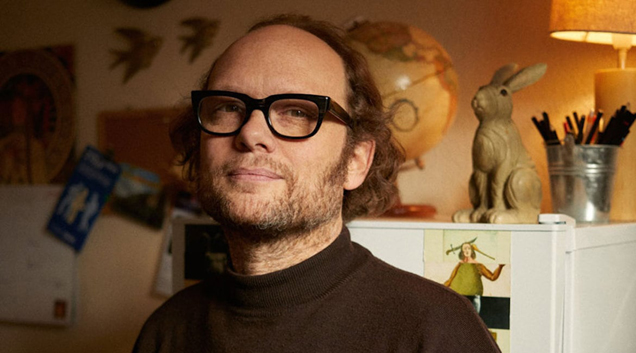
It’s a human touch that comes over strongly in the warm verisimilitude of the music. The Gilroy Mere methodology is not a remote, academic exercise. Ollie gets his fingers dirty. As a matter of principle, he diligently visited the location of all twelve abandoned stations featured on Adlestrop. Tramping through summery meadows and grotty edgelands alike, scrabbling around in the long grass, making field recordings of languid breezes and lugubrious birdsong. He took the same approach, inevitably, to Gilden Gate. And the sounds of these places play a crucial part in the compositional process.
“I listen to the field recordings as I improvise,” he explains. “They make you hear things you wouldn’t otherwise hear.
“I used to teach music. And I’d take the class down to the beach, make them lie there and close their eyes. If nothing else, it shut them up for a while! But then I’d get them to tell me what they could hear. And they’d realise it was an awful lot. The sounds of tea and coffee in the cafe behind them. People cycling past – I’d ask then which direction they were coming from. They could break the sound of the sea down into four or five constituent parts, too.
“Then I’d ask them that old question: if a tree falls in the forest and there’s nobody there to hear it, does it make a sound? Getting them to realise that sounds don’t really exist until they’re inside the heads of human beings. Until that happens, they’re just moving air! I can remember seeing one kid lying on the beach, and his knuckles went white at that revelation. He was really shaken…”
Where does all this come from? Let’s rummage further around Oliver Cherer’s own family history, the abandoned villages of a very personal and private landscape. Sorry, that’s incredibly pretentious. I annoy myself sometimes.
“Born in Clapham, brought up in Croydon,” he smiles. “I remember reading an interview with David Bowie where he used the word ‘Croydon’ as an adjective! That’s not good. But then, in 1977, we moved to the Forest of Dean. Which is fantastic for your actual hauntology. Everything is an abandoned lime kiln or an old iron working. All covered in the greenest moss you’ve ever seen.
“We moved there because, in 1976, my mum died. My dad went to run an insurance office in Gloucester. I had some piano lessons, then went on a school exchange to Germany and I stayed in the guy’s sister’s bedroom. There was a guitar under the bed, and I thought ‘I could play this’. This was in 1980.”
The inevitable roster of teenage bands swiftly followed. In 1981, it was 3 Imaginary Boys (“There were three of us, and yes – we liked The Cure”) and, shortly afterwards, the mechanical grooves of The Funktown Three. By 1985, his doomy goth band, Kiss The Blade, were recording Radio 1 sessions for the Janice Long Show. But, through it all, an enduring fascinating with field recordings and sound manipulation was burbling away in the background.
“I was always interested in experimenting,” he insists. “I had a mate at school who was really into synths, and we spent a weekend trying to make tape loops from his dad’s LPs of steam trains. I don’t know what we were trying to achieve, but we somehow knew that looping those recordings would be quite interesting.
“I had one of those really cheap Casio sampling keyboards too, and I recorded the sound of a tap pouring into the sink, and tried to play it back at different speeds so it sounded like a stream. I was always mucking about with this stuff. It’s always been there.”
I’m going to attempt some appalling amateur psychology, I warn him. Children who have been bereaved can often withdraw into their own worlds of quiet obsession. Poring over these early experiments, trying to capture the essence of things that would otherwise vanish forever… was this possibly the result of losing his mum at such a formative age?
“Well, my cassette recorder was given to me by my mum, and it would have been one of the last presents she gave to me,” he recalls. “And I always had a fascination with recording things – even if it was just the theme from The Rockford Files on TV.
“But dealing with my mum’s death… no, I actually became more outgoing than withdrawn. Years later, it all came tumbling down and I did have to deal with it. I remember, at one point, a doctor friend describing me as ‘pathologically happy’. Which was ridiculous, because I wasn’t, really – it had just been my way of coping.
“God, I’m doing the amateur psychology now…”
He seems genuinely happy now, I’m pleased to report. He laughs with raucous abandon, a man gleefully enjoying the amiable bumble of life around the music industry. The day job? Running a record shop in Bexhill-on-Sea. And I’ve given up counting the albums he’s produced under a welter of different pseudonyms. Gilroy Mere, he reveals, was a nom-de-plume concocted in cahoots with Clay Pipe’s Frances Castle (“We wanted something very English-sounding”), but he’s also been Dollboy, The Assistant, The Wrestler, even the perplexing Australian Testing Labs. It’s a delicious meander that owes a small debt to the Forest of Dean’s most celebrated 1990s chart superstars.
“My mate James Atkin was the singer in EMF,” explains Ollie. “Who got to No 1 in the States with their first single! Nice, eh? I used to see him throughout that period, and he asked me to help out with a remix for Adamski. Which I did, and Adamski rejected it. So we took his bits off and made our own record.
“We were called Cooler, and we signed to Polydor. They’d missed out on The Chemical Brothers, and wanted electronic Big Beat things. We did that for three or four years, then I started making records without beats. I discovered Music For Airports around the end of the 1990s and thought ‘Hang on a minute…’”
And the latest offshoot? Aircooled, a komische-inspired collaboration with one-time Elastica drummer, Justin Welch.
“I started recording during lockdown, and Justin was just up the road in his studio,” recalls Ollie. “I sent him these really long tracks – 22, 23 minutes each – thinking he’d maybe record a couple of drum loops for me to use. But he took it as a challenge to record full takes. Twenty-three minutes of motorik drumming! I really liked the results, and it completely changed the nature of the record.”
In early 2023, Aircooled toured with Suede. At the same time, Ollie was forging a further musical partnership with Lush’s Miki Berenyi (“Shoegaze with electronics… it feels new”) and – inevitably – the pull of his beloved Lost Places also continues to infuse a welter of additional projects.
“I’ve been working with a local writer, Alex Woodcock,” he reveals. “He’s become obsessed with a surrealist artist who seems a bit forgotten. Now… it’s either Stella or Edith Rimmington. Which one of those was head of MI5?”
Stella.
“It’s Edith, then. Alex is a poet who wrote a really great memoir about his time as a stonemason. He worked on Exeter cathedral. And he’s now written a piece about Bexhill, and a place called Veness Gap… which, inevitably, no longer exists. And he’s woven Edith Rimmington into the story. It’s all a long way off yet, but we’ve probably got half a record.”
It feels like a suitably poetic place to finish, particularly for a man whose releases often come accompanied by affecting verse. Adlestrop acts as homage to the poem of the same title, itself a touching 1914 tribute to the bucolic stillness of this abandoned Gloucestershire railway station. Author Edward Thomas – with tragic inevitability – was killed during the latter stages of World War I. Gilden Gate, meanwhile, concludes with a reading that perfectly encapsulates the Gilroy Mere ethos. That, by celebrating these lost places and people in literature, art and music, we help to preserve their immortality:
“Beneath these moss-grown stones, the waste of years / Lies many a heart now mouldered into dust / Whose kindred spirits grace the angelic spheres / Completely blest, and perfect with the just”.
“I found that poem in the Dunwich museum,” says Ollie. “And I can’t track down who wrote it. So I’ve got my fingers crossed I won’t get a tap on the shoulder from someone claiming copyright…”
At which point, the lusty crowd in the bar of the Salty Seadog raise their collective tankards and burst into raucous laughter. Sound the muffled bells beneath the waves, we’re all going over the clifftop together.
Gilden Gate is available here:
https://claypipemusic.bandcamp.com/album/gilden-gate
Electronic Sound – “the house magazine for plugged in people everywhere” – is published monthly, and available here:
https://electronicsound.co.uk/
Support the Haunted Generation website with a Ko-fi donation… thanks!
https://ko-fi.com/hauntedgen
 The Haunted Generation