(First published in Issue 122 of Electronic Sound magazine, February 2025)
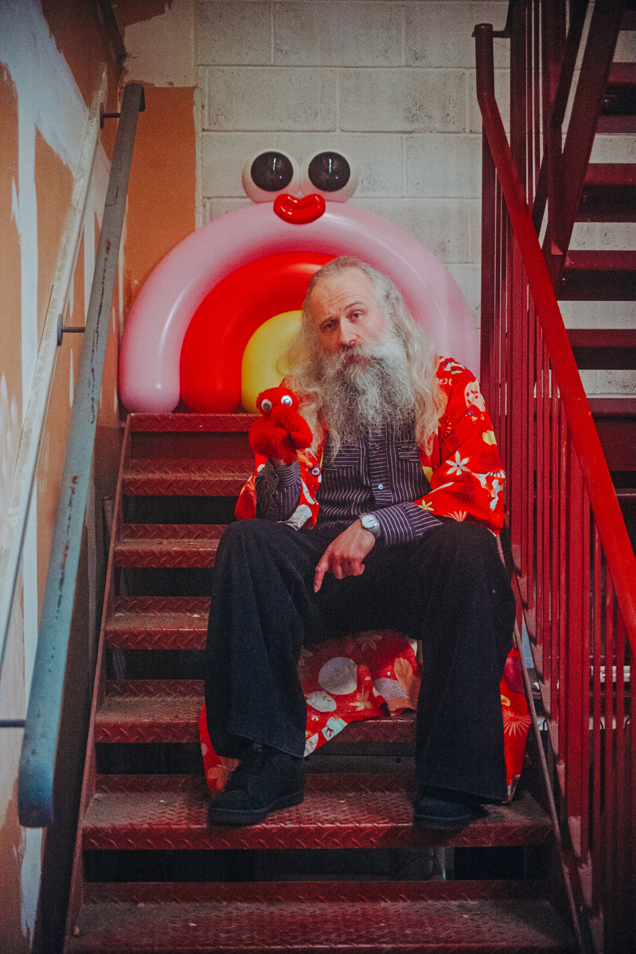
A KIND OF MAGIC
For two decades, Ian Hodgson has been the shadowy magician operating the levers of the mysterious Moon Wiring Club. Finally, he’s ready to pull back the curtain
Words: Bob Fischer
Pictures: Emily Smith
“You know when you see TV programmes on extreme hoarders?” muses Ian Hodgson. “That’s not too far from what my house is like. When people say ‘I wish I hadn’t thrown away my Top Trumps Horror Cards’, I just think ‘Yeah, why did you?’. I have a huge array of absolute garbage.
“But what I have found is that since I started making my own music, my need to collect old stuff has gone away. If I wasn’t doing that, I’d be saying ‘Give me all your old Tudor Crisps packets…’”
For almost two decades, Ian has been creating his own world. And it’s a world similarly stuffed with flotsam and jetsam from the farthest shores of popular culture. In his guise as Moon Wiring Club, he has crafted over 20 albums of electronic oddness, mixing hip-hop beats with samples from long-forgotten BBC dramas, marrying art deco imagery to beautiful Northern grimness.
It is a world populated by bizarre fictional characters: by visionary painter Algernon Aldridge, by glamorous actress Pomona Fripps, by experimental Edwardian musician Dr Lettow-Vorbeck. But in the midst of all this divine strangeness, one question remains tantalisingly unanswered. Who is Ian Hodgson himself? He is an elusive figure, lurking behind verbose press releases that seem almost wilfully evasive.
Ian, tell us everything. The full life story.
“I had a totally normal childhood,” he shrugs. “I grew up in Stockport, but we’d visit my gran who lived in a farmhouse on the North York Moors and my grandpa who lived in Gateshead. He was an amateur magician and a member of the Newcastle magic circle. My parents both worked in education, but they weren’t from well-off backgrounds, so we’d go to the library and tape the records. Then we’d drive over the Pennines, looking through the car window at the pylons and listening to Clannad’s Legend and an album called Telly Hits that had the music from Dallas and The Tripods.
“I’d also record the chart countdown, but I’d cut off all the DJ-speak at the end. So you’d have David Essex singing ‘Nightclubbing’ then the DJ would say ‘This week’s highest climber, in –’ before he was cut off. And if you listen to what I do now, there’s still an element of that.”
He is, unlikely as it seems, a regular-sounding guy with a soft Lancashire accent. He’s charming and funny, and – when he’s in danger of sounding self-absorbed – he switches voices to distance himself from such frippery. He’s already done the wanky music critic and the cheesy poptastic DJ.
“I was a head-in-the-clouds child,” he recalls. “Introverted and bookish. And my elder brother was a goth so when I was ten years old I was listening to bands like Fields Of The Nephilim. They would reference people like Aleister Crowley, and I’d think ‘I don’t know what this is, but it’s really interesting’.”
Was he a computer gamer as well? The pixellated ghosts of 8-bit favourites occasionally seem to drift across the Moon Wiring Club aesthetic. Did he spend huge tracts of his childhood lashed to a ZX Spectrum, lost in the surreal fantasy worlds of Jet Set Willy and Atic Atac?
“I didn’t have a Spectrum,” he says. “But my friend did and I would go round to his house and play on that. The big game for us was Everyone’s A Wally.”
What??! Flat-capped Wally Week wandering around the streets of a boring Northern town doing odd jobs?
“Yep. You had to collect the family’s giro. There was a punk, a grandad and a baby, and you had to go through the petrol station to get to the post office, which was closed. And I just remember exploring this weird town that was a bit like where I lived… but the sky was always black. That still sticks with me now.”
Want to know where the striking artwork of Moon Wiring Club comes from? The piercing female gazes that grace the sleeves of virtually every album? Try the 1990s art foundation course that the teenage Ian Hodgson took at Stockport College. Oh, and a Fine Art degree from Leeds Metropolitan University.
“I was interested in using stills from certain films, and at college I’d photocopy them to be really large,” he recalls. “Do you know the film Carnival Of Souls, from 1962? It’s about a church organist in a car crash – but did she actually survive or not? The director Herk Harvey filmed it in an abandoned pavilion arcade in Salt Lake City, and it’s got a really ghostly carnival atmosphere. The actress is called Candace Hilligoss, but I’d replace her with pictures of people I knew, like they were in a different reality.
“What I was trying to figure out was – if you’re a man, what are your motivations for using female imagery? In horror films there are inevitably a lot of women being chased, but that wasn’t what I was interested in. The conclusion I came to was that if you’re involved in using the male gaze, and you have a female protagonist who stares straight back at you and returns that gaze, then that’s a genuinely valid way of using that imagery.
“Then at university, I did my dissertation on the history of electronic music in cinema. Which was good, because none of the tutors had a clue about it.”
The post-student drift, I always feel, is worth a dissertation in its own right. That mid 20-something torpor can be truly dispiriting. Ian spent three years working in the Leeds branch of HMV (“I could see the next 25 years ahead of me, staying in Leeds, doing the family thing,” he grimaces) before a move back to Stockport and a failed attempt to write a sci-fi graphic novel called Host. But it was the purchase of a quintessential Noughties games console that provided him with unexpected purpose.
“I bought a Playstation 2 and a thing called MTV Music Generator,” he recalls. “In all music software now, you have a bar that runs across the screens, but MTV Music Generator had everything top down, like Tetris. So you could build blocks of sound using pre-existing sample packs from artists like Bentley Rhythm Ace. And because it was a Playstation game, it didn’t feel like musical software.
“In the back of the booklet, there was an advert for a sampler. You plugged one end into the PS2 and the other into an audio source, and I sent off for it. The first thing I sampled was Vault of Horror, the 1973 Amicus film. There’s a section with Tom Baker as a voodoo artist: ‘Do I get a little doll to stick pins into?’ And Terence Alexander cheating on his wife: ‘Darling, we’re living in the 20th century!’.”
“So I made some little tunes and took them round to friends who said ‘Fucking hell mate, these are shit’. But they thought the more ambient sections were interesting. So that was the musical genesis.”
Drifting through retail jobs in his home town, he found his mind – and feet – beginning to wander in esoteric directions.
“After I’d given up on the graphic novel, I thought I’d write a children’s book,” continues Ian. “I went on long walks along the Peak Forest Canal. I’d see an odd house and think ‘I wonder what goes on there?’ Or, next to a muddy farm track, there’d be a boutique wedding shop. Who thinks ‘I must get my wedding dress from Pott Shrigley, from the shop next to the power cable with the dead buzzard hanging from it’?
“So I was feeling much more part of my environment than I had been in Leeds. It was like I’d done a painting, then was peeling away the layers to find something underneath it. I was completely lost in my own thoughts. ‘You can see behind the pages of reality, maaaan’.”
That’s the magic of walking, isn’t it? Your legs don’t need instructions, so your brain is free to drift in odd directions.
“Exactly!” he grins. “The children’s book idea was called Strange Reports From A Northern Town and was full of veiled instances of things I’d seen, but they were all accounts by somebody called Cosmo Strangewood. In New Mills, there’s the Swizzels sweet factory where they make Love Hearts, but Cosmo would claim it was run by a Victorian android. They were like fairy tales – but who they hell were they aimed at?
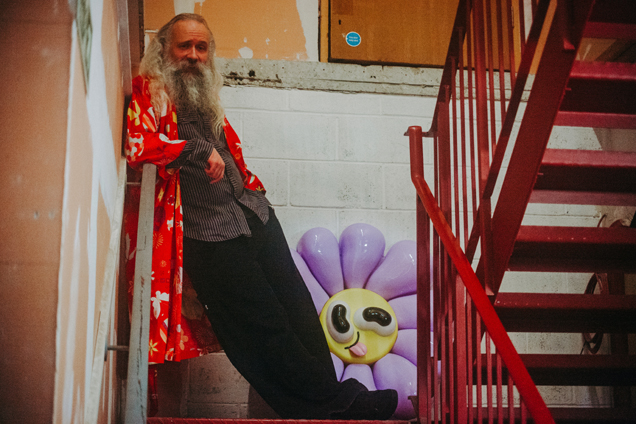
“But, at the same time, the music was getting better. And then, in 2005, I was working in the Stockport branch of Borders, and in my dinner hour I was looking through an art magazine with a feature on Ghost Box Records. ‘Oh, they’ve used the Penguin Books design, that’s a great idea’. And that suddenly focused everything for me. I sent off a cheque for their first two CDs and in the process of doing that I thought ‘What – if – I – combine – the – music – I – have – done – with – the – book – I – have – been – writing?’”
He finds a new character here: a Bernard Bresslaw-style dumbo, slapping his forehead at the trick he’d been missing for years. 2007 debut album An Audience Of Art Deco Eyes epitomised this joined-up approach, its clattering beats marrying library music woodwind to a cavalcade of plummy-voiced voiceover snippets, with the fluttering eyes of a 1920s flapper gazing winsomely from the sleeve artwork.
“It just never seemed obvious to me until then,” admits Ian. “I sent some artwork to Jim Jupp at Ghost Box, and he wrote back and said he liked it. And that affirmation from someone who wasn’t a friend or a family member was a big thing. I mean, I’d already sent him a cheque for £20, but he still didn’t have to say it”.
We talk for hours. We cover the name: a love of Raffles-style Edwardian clubs combined with a phrase he found in the 1930s Wonder Book of Electricity. “Wired to the moon,” he explains, is an old-fashioned term for insanity. He talks affectionately of his friendship with Ghost Box alumnus Cate ‘Advisory Circle’ Brooks and his self-consciousness at continuing to create his albums using the now antiquated MTV Music Generator.
Oh, and about cats. They’re all over his albums. Take 2010’s A Spare Tabby At The Cat’s Wedding. Or 2017’s Cateared Chocolatiers. Or the ‘Cat Location Trilogy’ of albums released between 2020 and 2023, comprising The Most Unusual Cat In The Village, The Only Cat Left In Town and Sepia Cat City. What gives on the feline front, Ian?
“In 2010, I was signing on and I felt like I needed to focus everything on my music,” he begins. “Now, are you familiar with the 1970s series of Worzel Gummidge?
Pretty familiar.
“In that case, you can tell me which episode the line ‘Spare Tabby At The Cat’s Wedding’ comes from?”
Maybe not that familiar.
“Ah, you’re a novice! It’s one of the best episodes, ‘Dolly Clothes-Peg’. When Worzel meets the shop window dummy Dolly Clothes-Peg, she says ‘There I was, like a spare tabby at the cat’s wedding’. So I had that phrase, and immediately I thought it sounded like a card game. As a child, did you have Racey Helps’ Happy Families?
No. I had a ZX Spectrum.
“Racey Helps made a series of playing cards,” he continues. “There was the bunny rabbit family – aw – the hedgehog family – aw – and the owl family who were slightly weird, and one of them was eating a mouse. And I thought there should be a card game called ‘Spare Tabby At The Cat’s Wedding’. So the whole cat thing came from an idea about an odd card game, but a lot of people hooked onto it. There was an 18-month period when people were really interested in what I was doing. ‘This is my moment, this is my perfect moment…’
“Everything since then has had a stronger narrative theme. I went from cats to gonks to birds to hats and then to a kind of folk myth about a hare, but a hare in a water-based theme park. And Cateared Chocolatiers came from a dream I had about mouldy carpet.”
I have to go, I tell him. I’d only set aside two hours for the interview (“That was optimistic” he shrugs) and I was meant to meet a friend an hour ago. With new album Horses In Our Blood the latest excellent addition to the oeuvre, let’s finish by creating a completely inadequate definition of the entire Moon Wiring Club ethos. Can we do it? Ian takes a deep breath.
“Someone once defined Moon Wiring Club as ‘a gang of lunatics in charge of a time machine’,” he ponders. “I thought ‘That’s not entirely right, but I’ll go along with it’. It’s that blend of things that I really like – you know, here’s someone in the Victorian era, but they’re wearing a digital watch.
“And my favourite song of all time is ‘Self Control’ by Laura Branigan. I had a tape of it that I recorded off the radio: ‘I live among the creatures of the night’? It gave me this weird image of a singer lost in a dream in the dark. So if you mix that with playing Everyone’s A Wally in a town where the sky is always black, I think that’s quite like what I’m doing.”
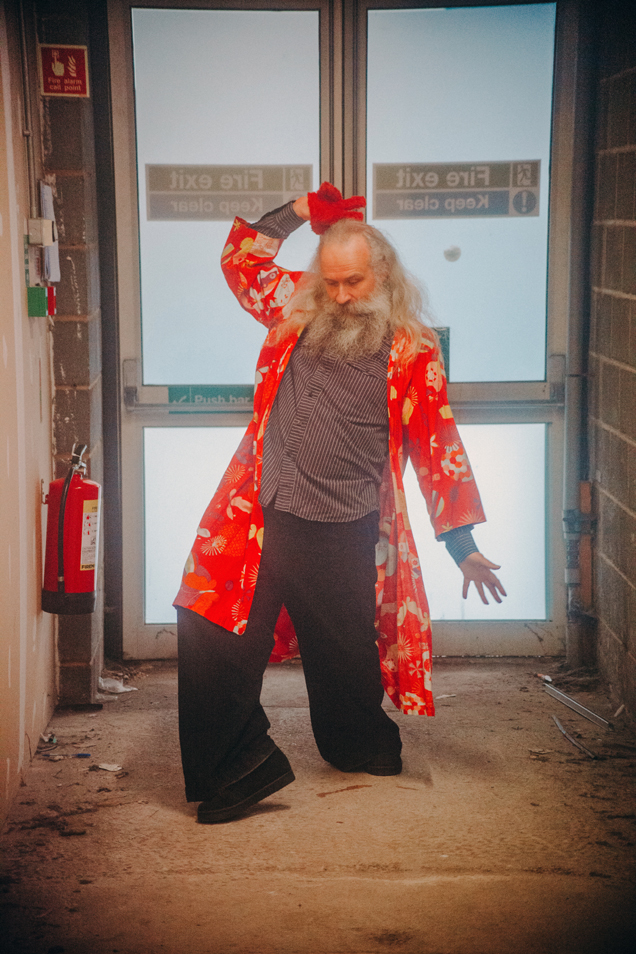
Further explorations of the world of Moon Wiring Club could begin here:
https://www.moonwiringclub.com/
Or here:
https://moonwiringclub.bandcamp.com/
Electronic Sound – “the house magazine for plugged in people everywhere” – is published monthly, and available here:
https://electronicsound.co.uk/
Support the Haunted Generation website with a Ko-fi donation… thanks!
https://ko-fi.com/hauntedgen

