(First published in Electronic Sound magazine #96, December 2022)
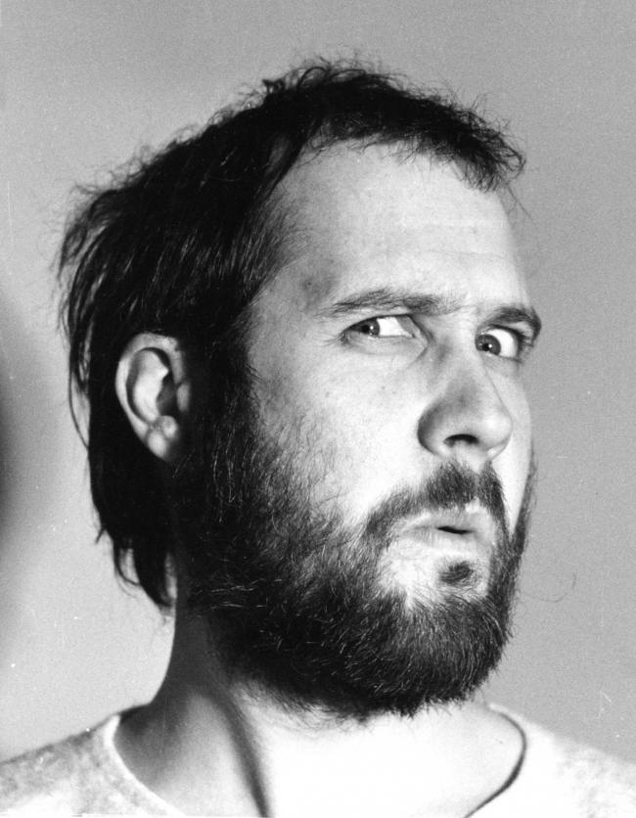
RONDO ALLEGRETTO
Brass knuckledusters, adjustable spanners, Pink Floyd collaborations and a surprising surplus of Bramley apples. In a secluded nook of East Sussex lies the unusual world of Ron Geesin
Words: Bob Fischer
“I was playing banjo with an amateur jazz band called Mahogany Wardrope’s Pinetop Stompers,” recalls a twinkly-eyed Ron Geesin, harking back to his teenage years in the late 1950s. “It was formed by a man called Paul Wardrope, as a play on his name. I was 16, it was the Teddy Boy era, and we were playing in a very low class area of Glasgow. I went to the toilet for a pee, and this proper Teddy Boy came in. Sideburns, shoes, jacket, the lot. I was brought up in a middle class village in Lanarkshire, and I couldn’t understand what he was saying. ‘Fuckthisandfuckthat’… as he was fitting a metal object onto his hand. I’d never heard of such a thing, but it was a brass knuckleduster.
“At that moment Mr Wardrope, who was better acquainted with the local colloquialisms, came in purely by chance and translated. This Teddy Boy thought I was a member of a rival gang, and was going to put me straight though the window. So it’s frightening to think that, if Paul hadn’t appeared at that moment, I might not be here today.”
Down a leafy lane in a quiet corner of East Sussex lives one of Britain’s most idiosyncratic composers. Ron Geesin and his wife Frankie – herself a respected textiles artist – have been married for 56 years, and have lived here for 51 of them, in a rambling smallholding festooned with overburdened fruit trees.
“Help yourself to apples,” says Frankie, as we potter around the kitchen. “We’re overrun with Bramleys this year.”
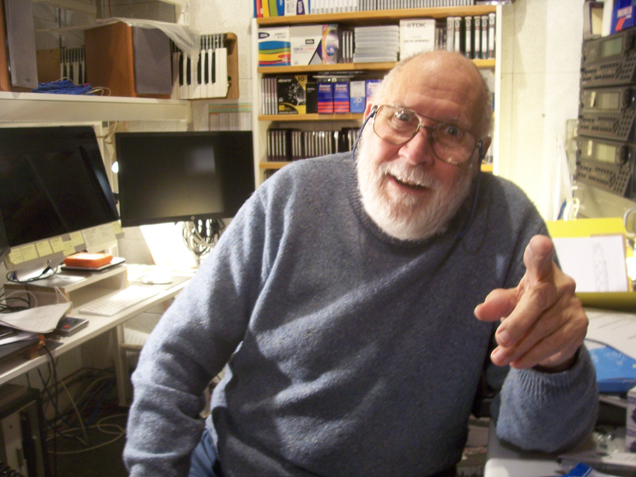
Ron and I decamp to his studio outbuilding, also overburdened: this time with the fruits of six decades’ worth of musical invention. There are racks of banjos, a Steinway grand piano and an original 1981 Fairlight synthesizer. His career has encompassed traditional jazz, tape manipulation, orchestral arrangement, electronic composition, film soundtracks, library music and an infamous collaboration with Pink Floyd. It’s difficult to know where to start, so we’ve plumped for the beginning. Undeterred by the threat of brass knuckledusters, Ron left his Scottish home at the age of 17 to play piano with a professional touring jazz band, The Original Downtown Syncopators. But his expanding musical interests were already leading to frustration.
“I was at a dead end and I couldn’t stand remaining with that band,” he recalls. “John RT Davies, my great guru and restorer of jazz ‘78s, had a sister with a vacant basement flat in Notting Hill, and Frankie and I moved in. And John was using tape all the time. That’s how he devised methods of de-clicking scratched ‘78s. So when I was visiting him in his studio in Buckinghamshire, I was watching him…
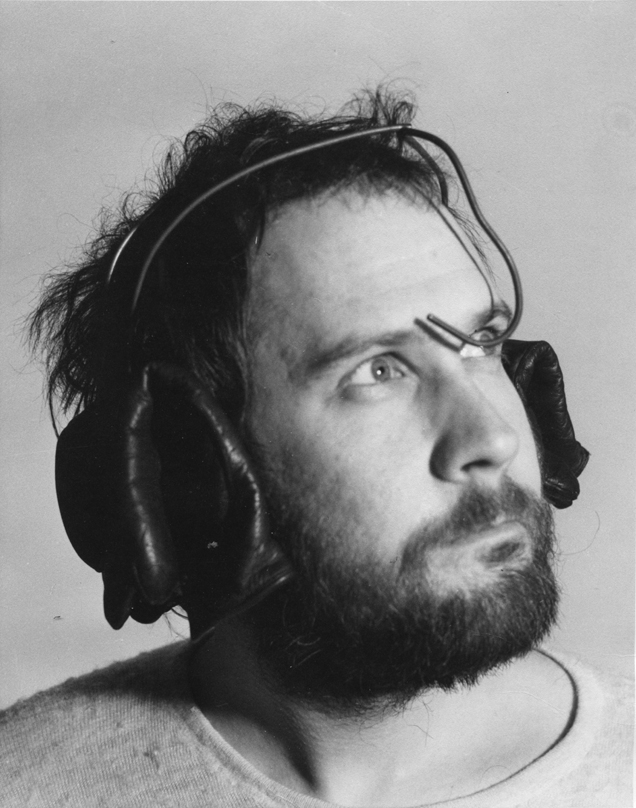
“I was also listening to the BBC’s Third Programme, and by 1965 they were playing a lot of electronic music. Somewhere, I’ve got 40 or 50 spools of tape that I recorded off air. So I was coming out of the jazz band and listening to Arnold Schoenberg and Anton Webern.”
In the interim, he briefly joined one of the most successful novelty bands of the post-war years, playing raucous, speeded-up versions of classical favourites. A venture that brought him into contact with another frustrated musical pioneer.
“I joined Dr Crock and his Crackpots in their revival years,” he chuckles. “They were shagged-out toothless wrecks, but they’d been quite famous in the 1940s. And that’s how I met Gavin Bryars. He was playing bass in a northern working men’s club, accompanying the likes of Shirley Bassey and Max Bygraves. I was doing solo piano pieces with the Crackpots, and he said ‘That’s interesting… where did you get those from?’ And when he came down to London, he stayed in our flat. Sleeping on the floor at 34 Elgin Crescent.
“He was a cunning bastard. He always managed to get out of doing the washing up…”
Debut album A Raise Of Eyebrows, released in 1967, remains a fascinating summation of Ron’s influences to that point. Opening with an alarming collage of sinister chuckles, smashing glass and rugby commentary, it delves down a Lewis Carroll rabbit-hole of wheezing harmoniums, thunderously rhythmic piano workouts and laconic monologues (“Humans pulsate!” “Where?” “Somewhere else…”). These glorious early explorations drew Ron to the attention of the BBC Radiophonic Workshop. Was he, as rumour has it, headhunted?
“Yes, if you want to put it so dramatically!” he laughs. “Desmond Briscoe did ask if I wanted to join. I went on a guided tour, but I thought – no. I wanted to keep my independence. Not realising, of course, that lots of the best work went to people within the Radiophonic Workshop. Film and TV jobs that you’d never get outside.”
Emerging psychedelic trailblazers were also paying attention. Ron befriended Pink Floyd’s Roger Waters, and the duo composed the soundtrack for Roy Battersby’s scientific documentary film, The Body. Sounding like lost episodes of Ron’s beloved Goon Show, track titles include ‘More Than Seven Dwarfs in Penis-Land’ and ‘Mrs Throat Goes Walking’.
Then, with Pink Floyd struggling to complete their 1970 album Atom Heart Mother before an impending US tour, Ron was asked to perform a salvage operation. Presented with a raw backing track, he composed sections for cello, a 10-part brass ensemble and the 20-piece John Aldiss Choir to forge the album’s 23-minute opening suite. Is he tired of talking about it, I wonder? His 2013 book The Flaming Cow, recently reissued in paperback with an added chapter, feels like it may have been intended as the final word.
“No,” he insists. “I wrote the book because, in some big Pink Floyd documentary, David Gilmour said ‘Oh, we got Ron in to do some arranging’. And I thought ‘You bastard!’ That’s what encouraged me to put down how it really was.
“They went away to America and left me to get on with it. And the reason it works is the difference between Pink Floyd’s vision and mine. To make it interesting for me, I had to weave around their backing track. Sometimes I’m going against it, coming in at right angles from where you think it’s going. Then I join it, then I split off again and go somewhere else. And I conjured melodies that Pink Floyd couldn’t have thought of if they’d tried.
“It’s the friction between those elements that make it work. They were only thinking about them, as Pink Floyd. So later, you had Roger Waters saying ‘If you gave me a million pounds I wouldn’t play that rubbish’. And Nick Mason, with his Saucerful of Secrets band, is now playing a version of it – but it misrepresents the whole idea of that friction.” He smiles, mischievously. “They trot out the lighter bits.”
Even Ron Geesin’s frustrations are laced with good-natured humour. And the differences don’t seem terminal: Mason contributes a gentlemanly preface to The Flaming Cow. Have either Waters or Gilmour commented much on the book?
“I visited Dave and took him a copy,” he smiles. “And he said ‘I think this might make me slightly annoyed…’”
So why are we here? Well, as Spike Milligan once pithily put it, “Everybody has to be somewhere”. But ostensibly we’re discussing Trunk Records’ release of a selection of Ron’s early film and TV soundtracks. Sunday Bloody Sunday was director John Schlesinger’s 1971 return to homespun British film-making after a Hollywood excursion for Midnight Cowboy. Its sensitive, semi-acoustic score is the perfect accompaniment to the tangled love life of Murray Head’s bisexual sculptor. Also included is the darker, more electronic soundtrack to a 1970 BBC documentary.
“Shapes In A Wilderness was about art therapy in mental hospitals,” explains Ron. “Bringing out whatever subconscious notions the patients had. One man was painting away furiously with his tongue sticking out, and there was a window behind him. He stopped suddenly, turned to the camera and said ‘They’re all mad out there, you know’. Fantastic! In true Lewis Carroll tradition, everything should be looked at upside down. Or back to front.
“John Schlesinger saw Shapes In A Wilderness and said ‘I must have that composer for my next film’. So the big men in black coats paid a visit to me. ‘Sunday Bloody Sunday’ had an Italian producer, Joseph Janni, and it was like the bloody Mafia coming round.
“I thought ‘Christ, I can’t handle this’. And I asked Steve O’Rourke, Pink Floyd’s manager, to do the deal. We met the producers around a table… not quite as long as Vladimir Putin’s table, but a big table in a big office in central London. We were on one side, they were on the other, and they opened their briefcases really slowly. Steve said ‘Alright boys – what have you got?’ They mentioned a figure, and he stood up and walked very deliberately to the door. But just before he got there, they said ‘Hold on a minute…’ and the fee was suddenly doubled. And that gave us the deposit for the place you’re sitting in now. 1971 was when we built this padded cell of a studio.”
It was a rare old time. The Body, Atom Heart Mother, Shapes In A Wilderness and Sunday Bloody Sunday were all completed within the space of a year. Ron also lent luscious production to Songs For The Gentle Man, the 1971 sophomore album of folk singer Bridget St John. He was in demand, darting between the biggest studios in London with the cream of the capital’s classical players at his behest. He could easily have become the wild card producer of the 1970s rock world’s leading lights. Why did he retreat to the solitude of East Sussex?
“We had two small kids, and life was becoming intolerable,” he sighs. “I was scared and I needed to get out. I was doing so much work that I was cracking up. That can happen.
“Moving down here, I tended to withdraw from working with other musicians. I developed my multi-tracking capabilities instead, and that dictated the kind of stuff I was doing…”
That “kind of stuff” included library music. In 1972 and 1975 respectively, Ron recorded two Electrosound albums for the KPM label. They comprise deliriously evocative synth instrumentals, liable to flood anyone raised in the era of BBC Schools Programmes on “the big telly” with overwhelming nostalgia for spam fritters and chickenpox.
“The first Electrosound album came about because I’d done The Body,” he recalls. “The boss of KPM thought ‘There are some interesting noises here’ and asked if I’d like to make an album of library music. Which at that point I knew nothing about, so I just went away and played. On an EMS VCS3, sir! It’s down there somewhere, in its suitcase…”
Both Electrosound albums, I jabber, are beautifully redolent of a period when pre-school infants were routinely presented with swathes of electronic music from the fringes of the avant garde. From the corner of the studio, Ron is staring at me with genial disapproval. He wags a finger.
“You’ve used two terrible words there. ‘Avant’ and ‘Garde’.”
Sorry. How about “experimental”?
“No! That’s another word I never use!”
“Outré”? “Esoteric”?
“Passionate!” he laughs. “I’ve always said that the easiest place to hide is in the avant-garde. I cite Edgard Varèse, that great and totally original composer. One of the last pieces he did was Poème Électronique, written for the World’s Fair in Brussels in 1958. For me, that piece has never been bettered. And he said, paraphrasing, ‘Nothing I’ve ever done is experimental. Everything has been completely considered.’
“That’s an important point. To me, ‘avant garde’ and ‘experimental’ are terms that have been devised to explain the unexplainable. And to sidestep embracing the fun of it all. If someone doesn’t understand something, they just want it pigeonholed.”
Can we do ‘eccentric’, though? Because there’s an air of delicious eccentricity hanging over the Geesin household like an autumnal mist. In an adjacent outbuilding, Ron talks me through his comprehensive collection of adjustable spanners. Literally thousands of them, mounted on whitewashed boards and divided into countries of origin. He’s written two books about their history.
“An escape,” he smiles. From what? “Composing fucking music.”

So is there a Geesin philosophy of life? We’d been talking for over two hours now. It’s been a delight, but I feel like we need a conclusion. We hark back to the late 1950s, and the brass knuckledusters of Glasgow’s most jazz-averse Teddy Boy.
“I realised, after surviving the Great Toilet Incident as a teenager, that humour was essential to human existence,” he explains. “From that moment on, I used it to draw the sting out of potentially dangerous situations. That fed into my live performances, and it runs all the way through to my work today. One of the ways I’ve got through life more or less successfully is by seeing the fun in everything I do.
“And I only ever believe what’s in front of me. What’s actually going on. I’ve got to play a note on the piano to believe I can actually play a note on the piano.”
There’s something of Taoism about that, I suggest.
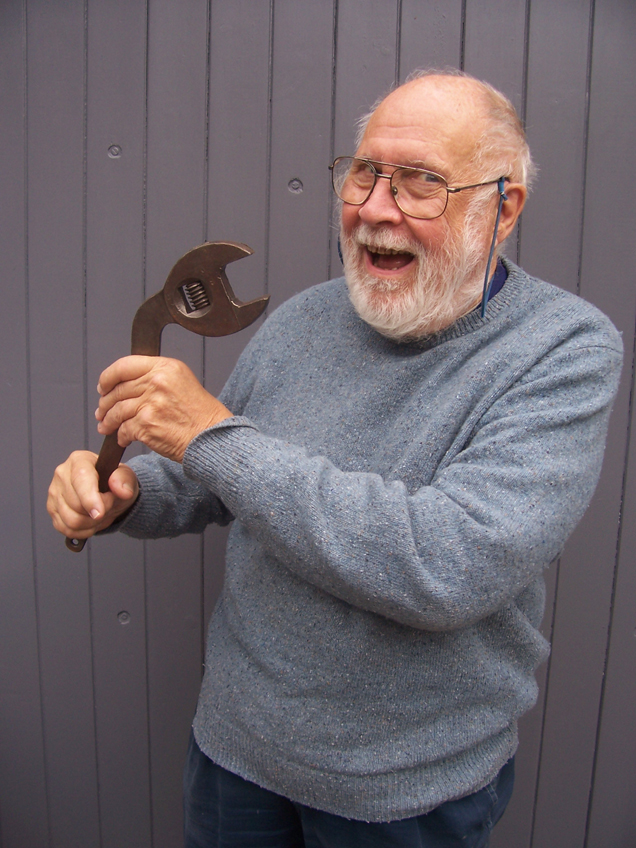
“Yes!” he exclaims. “The nearest thing I’ve got to a bible is The Importance Of Living by Lin Yutang. It was pretty famous when he wrote it in the 1930s, and it’s so down to earth and simple. There’s a chapter on the importance of staring. And just being…
“But he also mentions Taoism, and that led me to the Yin and Yang and the balance of all things. Just like Atom Heart Mother, in fact. The balance of opposites.”
So are you the Yin or the Yang?
“Both,” he smiles. “Because I can see…”
At which point, Frankie reappears with a bulging Sainsbury’s bag, overflowing with Bramley apples. There are further delights to come: in 2023, Trunk are releasing Ron’s soundtrack to Stephen Weeks’ unconventional 1974 horror film, Ghost Story. And the man himself continues to work on fresh material. The Geesins wave as I clamber into the car, and I thank them both profusely… with a passing thought to the vital contribution of Paul Wardrope, who may have never known the enduring effect of his timely intervention in a criminally uncelebrated Glaswegian lavatory.
Sunday Bloody Sunday is available here:
https://trunkrecords.greedbag.com/buy/sunday-bloody-sunday-11/
Ron’s official website is here:
https://www.rongeesin.com/
And Frankie’s is here:
http://www.francesgeesin.com
1970s photographs on this feature by Frankie Geesin, (c) Ron Geesin.
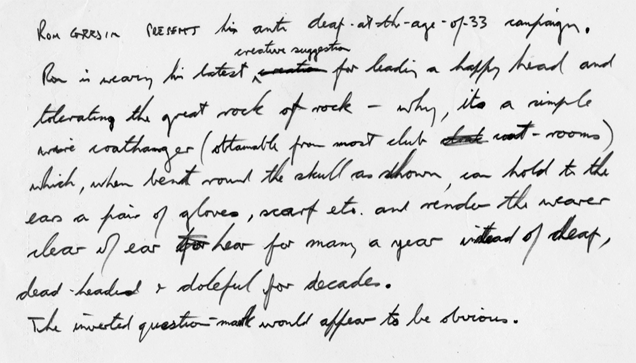
POSTSCRIPT: Just as Issue 96 of Electronic Sound was going to press, Ron contacted me with an e-mail entitled “Historical Revelation!”. In the process of organising decades’ worth of music manuscripts, Ron had unearthed his handwritten 1977 text for “that photo with the ear-muffs” – as replicated at the top of this feature.
It reads: “RON GEESIN PRESENTS his anti-deaf-at-the-age-of-33 campaign. Ron is wearing his latest creative suggestion for leading a happy head and tolerating the great rock of rock – why it’s a simple wire coathanger (obtainable from most club rest-rooms) which, when bent around the skull as shown, can hold to the ears a pair of gloves, scarf etc and render the wearer clear of ear hear for many a year instead of deaf, dead-headed and doleful for decades. The inverted question mark would appear to be obvious.”
Electronic Sound – “the house magazine for plugged in people everywhere” – is published monthly, and available here:
https://electronicsound.co.uk/
Support the Haunted Generation website with a Ko-fi donation… thanks!
https://ko-fi.com/hauntedgen
 The Haunted Generation
Thank you Bob, for curating these sonic excursions, and providing my workday vibe. 😉
LikeLike