(First published in Issue 98 of Electronic Sound magazine, February 2023)
THE DREAM TEAM
Stephen James Buckley and Mark Burford are, respectively, Polypores and Field Lines Cartographer. And holed up together in a remote Lancashire church, their minds frequently wander to cosmic vibrations, pixellated dreamstates and chain-smoking ghosts
“As I’m falling asleep, these weird phrases drift into my head. And sometimes I say them out loud. I’ve recorded them, with my phone at the side of the bed… ”
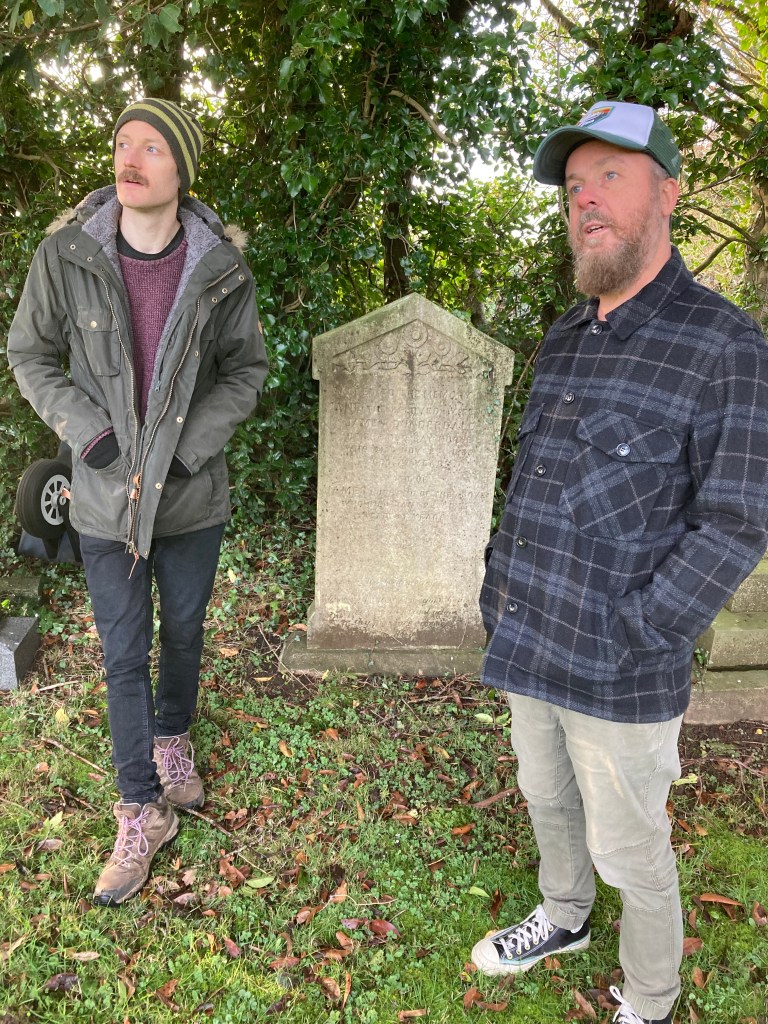
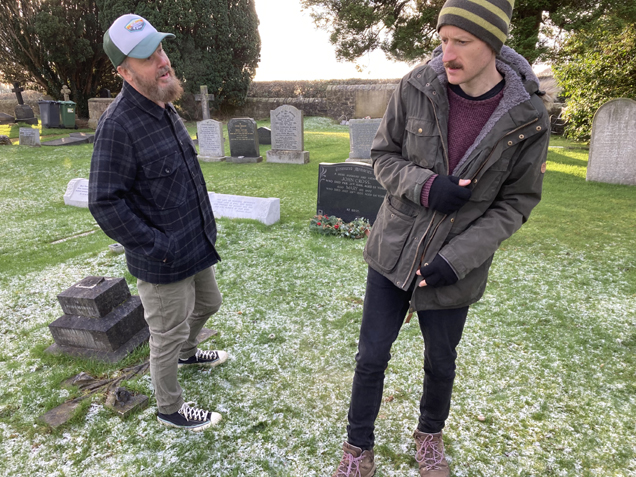
Two figures are striding purposefully through the mists of a frost-coated Lancashire churchyard. Their breaths hang in the air, and there is snow on the distant Pennines. Stephen James Buckley is tall and lugubrious with the drooping moustache of an Edwardian police sergeant. Mark Burford is impish and sparkly-eyed with a bushy, chestnut beard. In another era, they would be an hilarious Music Hall double act: Buckley and Burford and their Amazing Dancing Pianos. Instead, as Polypores and Field Lines Cartographer respectively, they make floating modular synth soundtracks to decidedly unusual frames of mind.
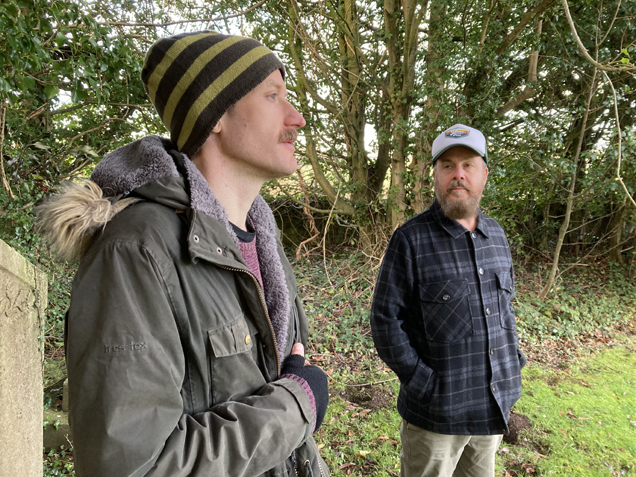
“So the new album was inspired by that hypnagogic state,” continues Stephen, his boots gently detonating brown puffball mushrooms amid the lengthening shadows of 19th century gravestones. “The state between wakefulness and sleeping where you start to experience all sorts of strange things. Would you like to hear one of the recordings?”
He pulls his phone from his parka pocket and slides a frozen finger across the screen. A recorded voice, a loose-lipped, half-asleep version of Stephen James Buckley, mumbles softly from the tinny speaker into the pale afternoon air: “These things take place in a little process called ‘Guinness’. The fingerprints of pop culture… Margoid Huntington”.
What the hell does that mean?
“Who knows?” he shrugs. “But I felt the ideas I was exploring musically lent themselves to that drifting feeling. The album is quite fragile-sounding and crystalline, and the first track – ‘Frost And Moss’ – was actually recorded on Christmas Day 2020. I went for a walk, and the frost on the moss was beautiful. Inspiring. So it’s a very pretty, twinkly album. A lot of what I do, I can’t really explain, but I know intuitively that this album feels like the weird space between sleeping and wakefulness. While also being quite frosty and bright and magical.”
The album is called Praedormitium and it’s his fourth for the Castles In Space label. Curiously, the 2022 Field Lines Cartographer album Dreamtides also used immersive modular textures to explore the nocturnal wanderings of the unconscious mind. Particularly, the lingering aftershock of a dream that left Mark Burford stranded on an imaginary pixellated shoreline, watching geometric shapes drift past on the “triangular tides” of some fantastical sea. Make no mistake, these are two men who fully appreciate the creative potential of a bloody good kip.
“Dreams are fascinating,” nods Mark. “And Dreamtides was one specific dream that I tried to articulate in music. It left such a weird impression on me that I couldn’t sleep again for days. All the colours were wrong, everything looked hyper-vivid. It still freaks me out when I think about it.”
“That sounds more like a near-death experience,” frowns Stephen.
We decide to leave the graveyard.
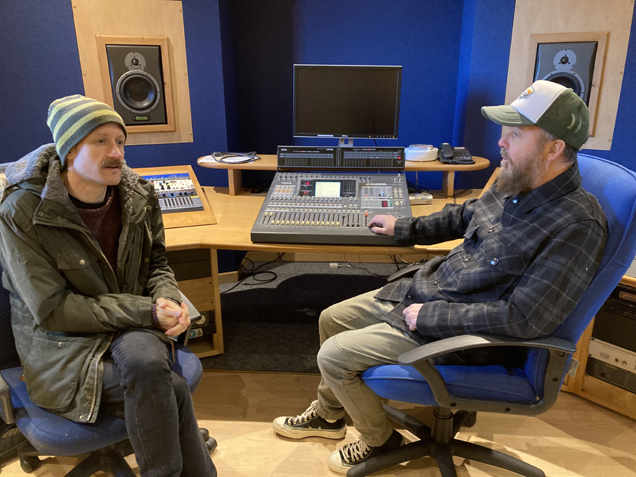
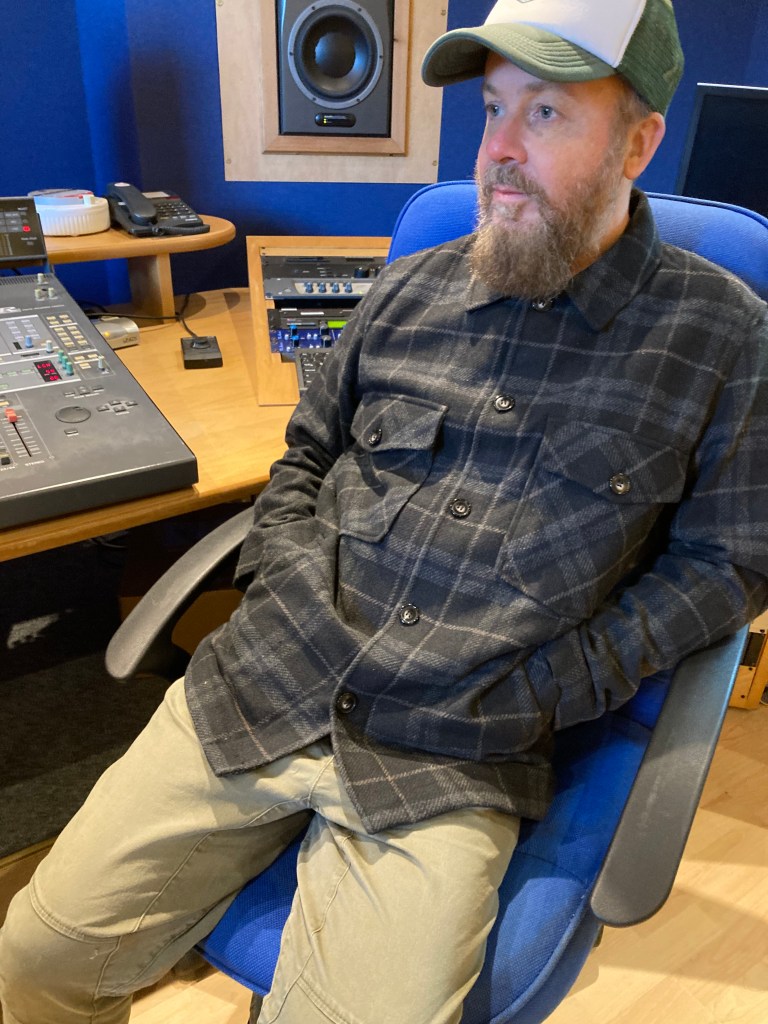
An ancient wooden door creaks, and we’re inside the vestry. Shireshead Old Church was built in 1757 to serve the doughty parishoners of this tiny Lancashire hamlet. But by the turn of the 21st century it had fallen into crumbling disrepair, until Lancaster musician Mark Burford – and a cosy consortium of friends – came along to respectfully convert those deconsecrated transepts into a state-of-the-art recording studio. Entering the control room is like passing through a portal: a magical transportation from windswept Pennine penury to plush, centrally-heated modernity. There are keyboards and mic stands everywhere. Strong tea is brewed. Fingers unthaw, and we slip into comfy chairs. The new Field Lines Cartographer album, Mark explains, is called This Vibrating Earth.
“It just dawned on me that everything in the universe essentially consists of stuff vibrating at different frequencies,” he says. “And that’s exactly what music is too, so I had an image of the universe singing to itself. I thought that was a beautiful notion, and I also realised the death of the universe occurs when everything stops vibrating. So I wanted this album to be quite grounded. I was thinking about the basic ‘hum’ of nature, of plants and animals, so musically it’s probably the most simple album I’ve done. It’s my pop album, really.”
“Simple lines intertwining… ” smiles Stephen, wryly.
“Sorry,” says Mark. “We can’t have a conversation without quoting This Is Spinal Tap.”
They met 15 years ago, when a youthful Steven approached Shireshead Studio seeking an honest living. Despite their close friendship, the duo ostensibly remain employer and employee. The genial Lancashire mill-owner with his humble foreman on the factory floor.
“He turned up at the door with a little knapsack,” chuckles Mark.
“I heard the streets of Shireshead were paved with gold,” deadpans Stephen. “At the time, I was working in Starbucks at Deepdale Retail Park in Preston. I’d graduated from university with a degree in multi-media and sonic arts, but I wasn’t doing anything with it. Then, through a friend, I discovered they needed someone at the studio.”
And first impressions?
“I remember thinking Mark was very quiet, and we’d have nothing in common. But we bonded over films, and when I started making electronic music, we became a lot closer. He lent me albums by Boards of Canada and Legowelt, and they were a huge influence on me. Before that I’d been making rock music, which Mark wasn’t really into.”
And Mark? Your earliest opinion of the youthful Stephen James Buckley?
“Quite intense, and very cool. He could be quiet and somehow not quiet, all at the same time. And he used to glam up when he was playing with rock bands… he was very handsome, and he’d wear eye make-up. Whereas I’m more comfortable hiding behind machines and keyboards. If we’re still talking Spinal Tap, I’m Viv Savage. But I like to proselytize about electronic music, so when I saw a weakness in Stephen, I pounced… ”
Since his teenage years, Mark had been “playing around with keyboards”. Arriving in Lancaster as a student, he formed techno duo Dfuse, supporting the likes of A Guy Called Gerald at 1990s end-of-term “extravs”. The debut 2016 Field Lines Cartographer album, Magnetic Anomalies, was the culmination of 25 years’ worth of electronic dabblings. Stephen, meanwhile, is bashful about his “messing about with mates” exploits in youthful Lancaster rock bands. I wonder if Mark’s influence was influential in him making the musical leap from battered Telecasters to synth patches and modular cables.
“I don’t think he inspired my decision to do it,” insists Stephen. “But once I’d started, I thought ‘Hang on… I’m working with a guy every day who can answer any question I have about electronic music’. It was like having a cool older brother with a great record collection.”
“I can’t take any credit for what Stephen has done,” says Mark, generously. “In eight years, he’s already eclipsed what had taken me two decades. And the contrasts are interesting: you could give us the same synths and the same patches, and we’d produce something completely different. Sometimes I do a tiny thing that makes me think ‘Oh, that’s a bit Polypores… ’
“And I sometimes think ‘This is quite Field Lines Cartographer’!” admits Stephen.
”But it’s only ever a hint,” insists Mark. “We come from the same place, but we see the world through different lenses.”
Both men cite the standard weirdness of the late 20th childhood as inspirations. For Stephen, it’s Labyrinth and the Usborne Book of Ghosts. For Mark, it’s JRR Tolkien and Fighting Fantasy gamebooks. But is there something deeper going on here? For both Buckley and Burford, the weirdness seems to have profoundly impinged upon their everyday experiences. The ghouls and goblins lurking in the murkiest corners of their favourite stories clearly spilled over into the rustling woodland of Lancashire and Warwickshire respectively.
“I grew up halfway between Coventry and Rugby,” nods Mark. “And there are various stories – from actual archaeologists – pointing to a place called Napton-on-the-Hill as being the last resting place of stone fragments from the Ark of the Covenant. Probably brought there by knights returning from the Crusades. And I love things like that… I don’t care whether they’re true or not. Britain is such an ancient country that stories like that exist everywhere. And the world is much richer for them.”

Even as adults, transplanting weirdness – mythological, fictional or even Biblical – into the mundanity of the everyday is the only thing that gets some of us through the cold, winter nights.
“Absolutely,” nods Stephen. “I’ve always superimposed fantasy onto reality. I make up daft mythologies about real-life people. There was a lab assistant at my school, and we once thought we heard a teacher refer to him as ‘Erk’. So we made up an elaborate backstory where our pottery teacher, Mr Barrett, had made him from clay. Like a Golem. One day, Erk seemed to disappear, so we decided he’d become self-aware and blossomed. But, a few years later, we saw a photograph from the Girl’s Grammar School, across town. And guess who was on it? Erk. So we concluded there must have been multiple Erks, all created by Mr Barrett. A lot of my friendships have been based on that ability to construct a fantasy world. Something that’s based on reality, but it becomes untethered.”
The breakthrough Field Lines Cartographer album, 2020’s The Spectral Isle, was inspired by salty medieval tales of Hy-Brasil, a mythical, mist-coated island in the Atlantic Ocean, reputedly populated by giant black rabbits. Polypores albums have also explored similarly fantastical environments. 2019’s Flora was a dreamy exploration of imaginary, oversized forests on alien planets, and 2020’s Azure floated dreamily through the tropical waters of a mythical underwater kingdom. Can they, I wonder, recommend mental techniques to ease that transition from everyday tedium to extraordinary flights of fancy? I need help, I tell them. I’ve got tax returns to sort out, and I’m losing the will to live.
“Salvador Dali used to sit with a metal plate on the floor, holding a coin above it,” suggests Stephen. “Then, when he began to drift off to sleep, he’d drop the coin and – very slightly – wake himself up. That allowed him to access his own hypnagogic state. I’ve tried to do this, but I’m a terrible sleeper and I don’t like doing anything that messes too much with me falling asleep.”
“My meditative state is actually when I’m making the music,” adds Mark. “The house could fall down around me and I wouldn’t notice. And I love that. I’m just doing what I’m doing, and it uses up my entire brain. My wife will say ‘You’ve not been to the toilet for over six hours now’.”
“Being in that state is my favourite thing,” agrees Stephen. “It goes back to me playing with Lego as a kid. My parents would say ‘Stephen, you’ve got to go out and play with your friends now… ’”
They’re wonderful company, and their partnership extends beyond music. And, indeed, the confines of this earthly realm. On the drive over, on the bleak and fog-bound A66, I’d listened to an episode of a new podcast, Vayse. Launched in September, it’s an engaging vehicle for Stephen and his childhood friend Peter C Hine to explore “mysticism, magic, high strangeness and the occult”.
“Peter and I met when we were about 10, and we’d go out hunting ghosts,” recalls Stephen. “And the podcast is essentially us being keen learners about the esoteric. We don’t claim to be authorities, we just want to know more. It’s us exploring all this nerdy stuff – ghosts and UFOs – without caring what people think.”
On the episode I listened to, the pair invited a guest contributor to recount the presence of an unearthly presence in his Lancashire home. Stand up, Mr Mark Burford. So does Field Lines Cartographer, to paraphrase the mighty R Dean Taylor, have a ghost in his house?
“Well I did… ” smiles Mark. “Our house is about 170 years old, a classic Lancaster terrace, and I was doing some work on it. My wife Nicola and I would sit on the sofa, and we both found ourselves saying ‘Did you see that?’ A shape at the top of the stairs in our peripheral vision. But as soon as we looked properly, it vanished. Other people saw it too, though. Friends would visit and say ‘What the hell’s at the top of your stairs?’
“Then we noticed the smell of cigarette smoke, appearing at the same time. So, for want of a better word, it was a ghost. And Nicola decided to be nice to it… she said ‘We’re not going to hurt you, and we hope you don’t mind what we’re doing to the house’. And that’s pretty much been the end of it. The cats still see it sometimes, but they’re cleverer than us.”
On that note, we glance nervously around the shadows in the farthest corners of the studio and decide to cut our losses. It’s barely 4pm, but – on this bleakest of winter’s afternoons – the sun has already set. Our mugs are cold and empty, and we leave them on a tea-tray in the vestry as a cold blast of Pennine air whistles in from the crepuscular churchyard. Still, it’s not a bad place to work, is it?
“In the summer, it’s idyllic up here,” nods Mark.
“But when the weather’s bad, it’s a fucking nightmare,” grimaces Stephen. “Especially when you don’t drive and you’ve got to walk to the bus stop.”
It doesn’t stop him refusing a lift and pulling up his parka hood to tramp down the hill, as Mark busies himself turning out the studio lights. Buckley and Burford – and their Amazing Dancing Pianos – are lost in their own worlds once again, happily marooned in a strange corner of Lancashire that feels forever trapped in its own blissful dreamstate.
Praedormitium is available here:
https://polypores-cis.bandcamp.com/album/praedormitium
This Vibrating Earth is available here:
https://fieldlinescartographer-cis.bandcamp.com/album/this-vibrating-earth
Electronic Sound – “the house magazine for plugged in people everywhere” – is published monthly, and available here:
https://electronicsound.co.uk/
Support the Haunted Generation website with a Ko-fi donation… thanks!
https://ko-fi.com/hauntedgen
 The Haunted Generation