The hissing of summer tapes…
There’s something curiously affecting about the gentle hissing of analogue tape. Once considered the sworn enemy of committed audiophiles, and almost hunted to extinction during the great Dolby Noise Reduction wars of the 1980s, the whispered fizz of a vintage cassette now gives me a delightful frisson of nostalgia.
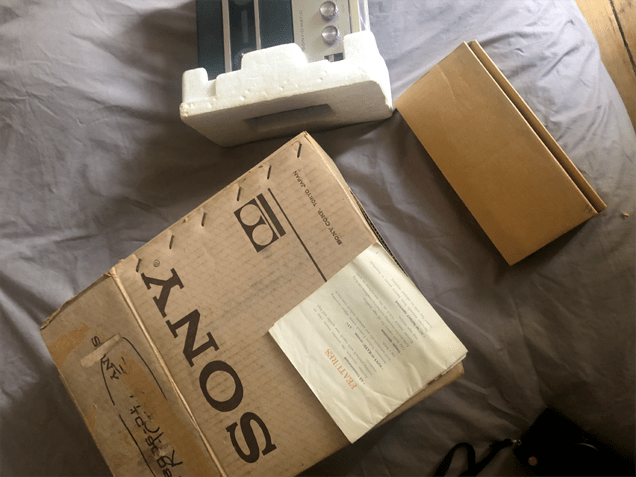
It’s a feeling also clearly not lost on Cate Brooks, whose new album Tapeworks was inspired by (and recorded on) the 1960s Sony -O-Matic tape recorder she acquired in 1998. Its miniature reels have since been pressed into service on many of her acclaimed albums, including her solo work for Clay Pipe Music and her own label, Cafe Kaput – as well as her Ghost Box recordings as The Advisory Circle. But this new collection, an immersive selection of ambient synth canticles, is intended as a full-scale homage to the machine that has been her faithful studio companion for the last 25 years.

I was delighted when Cate agreed to discuss the album’s genesis and recording, exclusively for the Haunted Generation website. Here’s how the conversation went…
Bob: So the tape recorder itself dates from the mid-1960s, but you seem to have acquired it in 1998. Where did you find it?
Cate: Basically, it was in a junkshop. I was living on the east coast at the time. In Lowestoft, the most easterly point in the UK! And my partner – who I’m still with – came over to visit. We went for a walk one morning, along a row of junk shops in the old part of town. And, in the window of one of them, we saw a 1960s Sony tape recorder in its original box. It looked pretty amazing, but there was no price on it, and I’m too shy for haggling – I just don’t do that kind of thing. But my partner said she’d go inside and see how much they wanted. It turned out they wanted £30, but she managed to haggle them down to £20. Which was amazing – I still remember her coming out of the shop, carrying the box. I was waiting outside, and she just presented it to me. “There you go!”
It was raining and it was really cold. A wet and miserable day in early February, but it was a day I’ve always remembered. I have a photographic memory for moments like that… as you know! And that tape recorder has been a constant part of my music-making ever since. This was my first phase of making music, I was doing a bit of teaching while I was at college…
I didn’t know that!
Yeah, I was studying for an HND in Music Production, and helping out with the A-Level college at the same time. So the recorder has been with me ever since that time, and I’ve used it quite a lot. In fact, the first thing I ever released on the Cafe Kaput label was an album I recorded as D.D. Denham, called Electronic Music in the Classroom. It was meant to sound like a very early 1970s experimental record, and one track is just called ‘1 2 3 4’. That was from the tape that came with the recorder – it’s literally someone speaking into the microphone, saying “1 2 3 4” to test it. I just created the sample from that.

Could that have been a recording of the original 1960s owner, then?
It might even have been the person who sold it to them. The background ambience sounds like it might be a showroom. And I actually know the shop it came from – a place called Hughes on Lowestoft High Street, their sticker was on the box. I used to go there years later to buy hi-fi stuff. I don’t know if it’s still there, but at the time it was the shop you went to for all your TVs and stereos – it was quite a big place. So maybe the voice was the original salesman, demonstrating it to the customer?
And, on the other side, someone had recorded Ready Steady Go or some other music TV music programme from the 1960s. Billy Fury was on it! You could also hear a budgie tweeting away in the background. Whatever happened to that budgie?
It is no more. It has ceased to be. It is an ex-budgie…
Yes! But it’s been immortalised on that tape, and it’s still there.
I love how old recordings can capture a single, fleeting fragment of time like that. A completely ordinary and mundane moment in someone’s life, and yet it’s been preserved on tape for almost sixty years. If those people are still out there somewhere, they’ll be completely unaware that these recordings of their younger days still exist.
Yeah, there’s a magic in that. We don’t know anything about these people’s lives, or even who they were. It was somebody literally holding the microphone up to the speaker on the telly… and when you do that kind of thing you also capture the movement of the air. So that creates a magic, too. It’s a whole different level of history, and I’ve always been amazed by stuff like that.
I thought I could hear cutlery rattling in the background, as well – so maybe they were cooking dinner, or washing up? It all just adds to the mystery.
I don’t think the machine had been used very much, though. It didn’t come with any tapes apart from that one, and all the documentation was intact. Even the head cleaner had never been used. It’s a just a little cloth in a plastic bag, but it’s never been opened – even I haven’t opened it. It had all just been put back into its box and left, and it’s now had this whole different life.

I’m a complete technical ignoramus – can you talk us through the recorder itself, please? What it looks like, and how it works?
It’s a Sony, and it’s portable. So it’s got very small, three-inch reels rather than the seven-inch or the ten-and-a-half inch reels you’d get with something like a Revox. I suppose it’s the forerunner of the cassette recorder. It had a microphone supplied with it, and it ran at two speeds… but to get the half-speed you had to remove a spindle from the mechanism itself. So it’s all very basic and low tech, and it has a built-in speaker. But it has a beautiful sound. It’s very hissy, even for the time it was made – not exactly hi-fi quality! It think it was mainly intended for people to record letters to their friends and family. Like on the title track of the Advisory Circle album, From Out Here… that was based on a tape I found at a car boot sale somewhere.
The press release for Tapeworks suggests you were keen to make the most of your tape recorder while it was still fully functional. Does that imply its days are, sadly, numbered?
No, it’s still in good condition. But it’s a bit like spending time with older family members while they’re still around – you have to make the most of them! It’s such a beautiful thing, and I thought “Why haven’t I done this sort of thing before?” I was really curious to see how it would sound. The moment you start to record onto it, you get different layers of hiss and noise, and I just wondered how they would stack up in a textural context. And it turned out they made for a really beautiful sound. Incredibly fragile, and very of its time. Mainly because of the circuitry – they just don’t make component circuits like that any more. So it’s a sound you just wouldn’t get with a piece of modern equipment – much as I love modern gear. And whatever modern instruments I used on it, they came out sounding really dirty. Which I loved. I wanted a whole album of that.
I also wondered what would happen if my friend Hazel recorded vocals onto it, and she was really interested in trying that out…

This is Hazel Mills? Her vocals on the album are lovely. She’s worked with Goldfrapp, hasn’t she?
Yes, and Florence and the Machine. We’re really close friends and we were chatting one day about the album. I said “Why don’t you record some vocals, I’ll put them onto the tape machine, and we’ll loop them around?” She was intrigued, and she recorded a few vocal textures without any clear idea of what I would do with them. I just curated a few bits that I thought would fit together. It’s a similar process to that used by the minimalist composers in the 1960s, and then by Brian Eno on albums like Discreet Music and Music For Airports. You have loops of different lengths all playing at the same time so they cluster together. But because they’re different lengths, you never hear the same thing twice in the same song. And the beauty and the elegance all depend upon what you feed into it – there has to be plenty of space. So Hazel would give me 20 very sparse lines, and I’d maybe chop out one of the loops then add another of a different length… there was an awful lot of playing around.
Again, be patient with my lack of technical knowledge, but what did the actual physical process of recording involve? Did you record different voice and synth parts onto your vintage tape recorder, then play them back one-by-one into modern editing software so you could experiment with them? Sorry, I might have confused myself here…
No, that’s essentially what happened. There were two approaches, really. Firstly, I could record sounds onto the Sony, and then play them back through the built-in speaker with a microphone held up to it. Or I could get the sounds off it directly – which took forever, and a lot of fiddling around, but I got there. And I think it was worth all the hours I put into it.

You have a long and proud history with tape hiss, often using it almost as an instrument in its own right. I’m thinking of albums like Shapwick – not only does that record have an awful lot of hiss, it also seems to have been recorded on very old and faded tape stock, so I think I can sometimes hear elements of previous recordings bleeding through into your music – possibly from the other side of the tape?
Yes, that’s definitely what you’re hearing. That album was recorded onto four-track cassettes, so – again – it was really lo-fi. I think there’s been an element of hiss on every record I’ve ever made… there’s kind of a hiss scale! Shapwick is drenched in it, and even though the newer Advisory Circle stuff is more hi-fi and polished, there’s still a bit of hiss. It just makes things sound more natural, I think. The world isn’t an anechoic chamber. So there’s always a bit of background noise in there, just to avoid things sounding too claustrophobic. Whether it comes from using old equipment, or – on the newer stuff – just cranking up the gain, it’s something I’m always interested in doing.
We’ve talked before about your lifelong synaesthesia – is it triggered by tape hiss?
It is, I get different colours from different types of hiss. I’ve studied an awful lot of hiss in the past! Even with synthesizers, they all have a white noise generator, and they all sound totally different to me. I’m fascinated by these background sounds, sounds that most people don’t really notice. It’s something I really love.
It’s curious – I’ve been working on an audio drama recently, and we needed the white noise of an untuned 1970s TV set. We experimented using different pre-recorded slices of white noise from Youtube and all kinds of sound FX websites, but they just didn’t have the right quality of white noise. It wasn’t 1970s white noise! In the end, the only thing that worked was actually plugging in a 1972 Philips TV, detuning it and shoving a microphone up against the speaker. Nothing else sounded right.
That’s the only thing that sounds authentic. You have to take into consideration the method of delivery of that sound – it’s coming through a small speaker made in 1972. The only thing you can’t replicate, and I’d really like to do some more research on this, is the room it was originally heard in. You can’t really have a room that sounds exactly like 1972, because every sound – including our voices – will have been reflected by the objects in that room.
I guess you’d have to reconstruct a room using authentic 1972 material and surfaces? And you’d need to cover the walls in blown vinyl wallpaper…
You would – you’d have to think about Draylon and Terylene fabrics! They’re all part of the sonic signature. I remember having a conversation with you about people’s voices in the 1960s and 70s, and you were saying how they were affected by the unfiltered cigarettes everyone was smoking back then. We don’t take these things into consideration, but if we want correct period sounds, then we should.
When we discussed Tapeworks over e-mail, you said something really interesting – that it’s an album “inextricably linked with my feelings about life over the last twenty odd years”. I hope you don’t mind me asking, but could you expand on that a little?
I’ve made a lot of music since I got that recorder, and when I took it down from the shelf again my mind wandered back to the day I first saw it. And all the times I’d used it since – for D.D. Denham, for The Advisory Circle and all the rest of it. And I was thinking… my life in many ways is a lot better now, because I’m so much happier. But things are never quite as simple as that. There were good times back then. I had a great time at college when I was starting to really learn about music technology, and I was going into studios for the first time. I remember sitting there, thinking “This is what I want to be doing for the rest of my life…” and thankfully it’s what I have done.
It was also the beginning of the longest relationship I’ve ever had with anyone, and thankfully that’s still going strong and it’s now better than ever. All of this came back to me, and I wanted Tapeworks to make me think about those times, about how I felt back then – and how I feel about those times now. So the music had to sound a particular way. I had to be really considered about the timbre of those compositions. I thought if I could convey those feelings to myself, then maybe they would come through in a different way to anyone listening. Because what I really like is making a connection – it’s everything to me. People finding a connection to a record, even if they don’t know exactly why. When people say they’ve got that connection from listening to my stuff… I want that.

So what’s the next project? Something for Ghost Box, or something for Clay Pipe?
Clay Pipe is next. It’s basically an album of experiments I did back in 2015. I got a particular instrument called a Buchla Music Easel, and it’s a whole different world. It’s an electronic instrument, but you can’t really call it a synth. These tracks were the first recordings I made, within the the first month of getting it. I put them away and forgot about them – but then I thought “You know what…?” There were 25 tracks, and some of them were complete rubbish. But this crop I thought were really listenable and just needed mixing.
2015 was also the year my cat, Brillo, died. He was my studio cat from the beginning, he was there when I recorded these tracks, and they’re my connection to him. He was amazing, and this album is my little tribute.
Brillo? As in the pads?
Yes! Originally, he was a little charcoal cat, but he gradually morphed into a very sleek animal. He looked like Bryan Ferry – he had the smartness and the cheekbones! We’re talking Bryan Ferry at the height of Roxy Music here… very early 1970s Bryan Ferry. Brillo was great, and he seemed really drawn to the Easel. I recorded a lot of these tracks sitting on the floor, and he was always there.
Please tell me you’ve named the album after him?
I haven’t – it’s called Easel Studies. But there is a track called ‘Con Brillo’. So he’s on there…

Tapeworks is available here:
https://cafekaput.bandcamp.com/album/tapeworks
Support the Haunted Generation website with a Ko-fi donation… thanks!
https://ko-fi.com/hauntedgen
 The Haunted Generation