(First published in Electronic Sound magazine #77, May 2021)
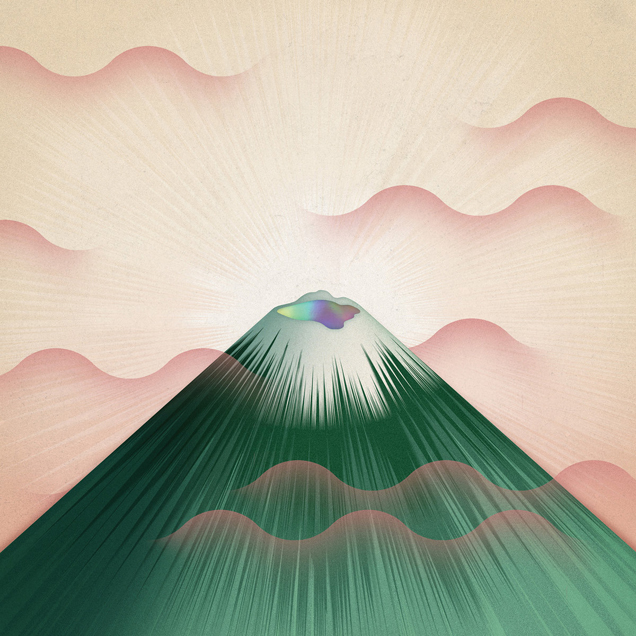
THE HILLS ARE ALIVE
Is the new Gruff Rhys record a concept album about a sacred mountain on the North Korean border? Not really, but it’s a complicated story. And it encompasses the 13th century Prince Dafydd, a pilgrimage to meet Linda Ronstadt, the world’s biggest slate quarry and a pervading obsession with the work of Klaus Dinger…
Words: Bob Fischer
“It’s a very important mountain, especially for the Korean people”, says Gruff Rhys, thoughtfully. Although, to be honest, everything he says is pretty damn thoughtful. “Their whole origins are related to that mountain, and culturally, they’re very tied to it, so I’m overstating as much as I can that the album is about an imaginary Mount Paektu of the mind. It’s pretty abstract.”
Notebooks out, class: Paektu is an active volcano on the border between China and North Korea. It’s a mountain sacred to the North Koreans in particular, seen as the birthplace of Dangun, the semi-mythical founder of the first Korean kingdom. It also provided the initial spark of inspiration for the new Gruff Rhys album, Seeking New Gods. He’s never been there, but was intrigued by the name in a book. This is complex stuff to be discussing at 10am on a Tuesday morning with this most softly-spoken of Welsh polymaths, but he’s characteristically patient and polite.
“I didn’t want to make an offensive Orientalist record,” he explains. “But the mountain is what inspired me. I then just applied it to people. Imagining people as mountains, I suppose. And it became a more personal record.
“I wrote some songs with Mount Paektu in them, and they just sounded awful. Dropping in references to historical characters and dates… they were a bit ill-fitting. So once I realised that, I relaxed and stopped feeling any pressure to have a narrative.
“I don’t want anyone to notice that there’s a theme to the record, really. The songs can exist without the concept.”
We’re on the phone. He’d sounded surprised and a little cautious when he answered, but had reassured me he was expecting the call (“I always sound like this”) before embarking on a genial conversational meander that gently reflects the time of day. It’s a unhurried breakfast of an interview, courteous and contemplative, and he does seem endearingly concerned that the album will be misinterpreted as an act of cultural appropriation.
“I didn’t want to make a quasi-mystical record,” he insists. “I grew up in a mountainous area, and they’re very real for me”.
His love of the distinctly windswept is perhaps unusual amid the giddy urban circus of the music world. We’ve spoken before, I tell him. In February 2020, as part of a tour of intimate rural venues, he played the Parochial Hall in Great Ayton, a picturesque North Yorkshire village. The day before the gig, I’d interviewed him for the local radio station, and he’d expressed an interest in scaling Roseberry Topping, the mini-Matterhorn of the North York Moors. The morning after the show, he actually did it. This wasn’t just idle radio banter, he genuinely spent his day off on a pretty strenuous climb of this notorious local landmark. Alongside support act Elaine Palmer, her husband Jake, and Robert Nichols, lead singer of Teesside post-punk legends Shrug. Robert later told me they’d spent much of the assault discussing Great Ayton’s most famous one-time resident, Captain Cook.
“Say a big hello back,” chuckles Gruff. “If I’m on tour, I just want to see everything. You meet local people and get exposed to things you wouldn’t normally see. Local TV or radio shows… and record shops, especially! Number one would be a good local record shop. Number two would be a mountain…”
He laughs and tells me about the piles of 7” singles he accumulates on tour (“I always look out for Mediterranean disco or Malaysian pop”) but the mountains draw us back. A love of high places, it seems, is a family trait. His late father, Ioan Bowen Rees, was an enthusiastic climber whose profound connection to the local Welsh peaks seeped into his work as a poet, and – indeed – the 1987 compendium he compiled: The Mountains Of Wales: An Anthology In Verse and Prose.
“Yeah, he was obsessed by it,” says Gruff. His mother, Margaret Wynn Meredith, was also an accomplished poet. It’s a touching connection… did the family spend a lot of time walking in the hills together?
“Every weekend, more or less. And I’d mess around on the mountains with my friends, or in the old quarries in the foothills.
“I’m from Bethesda, and the mountain range is the Carneddau. In the 13th century, it was the equivalent of the Tora Bora in Afghanistan. After the Norman invasion, that’s where the Welsh princes were hiding. Prince Dafydd was found there – a bit like Saddam in Iraq, he was hiding in a little cave. Just above Bethesda.
“There’s industrial history as well. They were mined for slate… the biggest slate quarry in the world is in Bethesda. So it’s not overly idyllic, either. It was a well-balanced place to grow up.”
And is Prince Dafydd’s cave still there?
“Yeah,” he laughs. “But it’s behind a farmhouse, so it’s not on public land. There should be a massive Brutalist sculpture or something there. Fifty foot, and made of concrete…”
The bulk of Seeking New Gods was recorded in the Mojave desert (“It’s like The Flintstones,” he grins) at the climax of a 2019 American tour that seemingly became a profound bonding experience for Gruff and his band. Although tellingly, he kept the mountainous origins of the album a secret from his fellow musicians.
“I didn’t want to over-romanticise it for them,” he admits. “We’d been touring for a few weeks, listening to mad long jams on the stereo. A lot of mid-1970s Miles Davis. We were doing 12-hour drives between gigs, so you can listen to 15-minute songs and they’re over in a flash… your sense of time changes.
“So we’d been listening to the same music as each other for weeks, and we’d rehearsed the new songs in soundchecks. We were primed! And the new songs became more ‘jammy’. When they finished, we’d just carry on playing. So I didn’t want to overcomplicate a good thing. We were in a spiritual enough place without messing it up with mysticism and romanticism.
“And I hadn’t booked a studio, but then a place called Rancho De La Luna in Joshua Tree came up. We did a gig in Los Angeles, then drove out there.”
I’m imagining a Fear And Loathing-style road trip into the desert.
“It was intense,” he concedes. “Osian our piano player was in trouble, he should have been in hospital. He was seriously ill, but nobody realised…”
“And Kliph the drummer is a lifelong Linda Rondstadt fan. And he noticed she was giving a talk in Reno, Nevada on the day we were travelling to the studio. So he took the van, with all the gear, to Reno to see Linda Ronstadt’s spoken word show! And got to meet her. It turned out that was her last-ever public appearance.
“So we were in the studio, and the gear was somewhere in Nevada. And, on the first day, the studio didn’t work – nobody could understand what was wrong with the desk. And it sounds daft, but there’s a lot of bleed on the record. The drum sound comes through the piano mic, stuff like that. That makes it feel a bit ‘live’. But there’s no humidity out there, so it’s not a damp-sounding record. The sound travels faster to the mics!
“But we overdubbed it all in Bristol, so that reintroduced some dampness…”
If the interview is a breakfast, it’s like we’ve finished the toast and had a bucket of black coffee each: the conversation is suddenly supercharged. Particularly when discussing the vintage synth that provides the album with a unifying background drone. It doesn’t sound damp, it sounds great.
“The Solina!” he exclaims. “It’s a 1970s synth and I put it through a big old phaser. I suppose I’m into that whole era of mid-1970s experimentation. I love Harmonia, and anything Michael Rother or Klaus Dinger were involved with after NEU!.
“I read a book called Electri_City [by Rudi Esch, published in 2016], about the electronic music of Düsseldorf. It’s all anecdotes from the people who were there, and it’s just hilarious. When that came out, I was obsessed with that era: mid-1970s ambient music. Brian Eno, Haruomi Hosono and Laurie Spiegel… that really evocative sound, but still played by actual people.”
Despite this talk of Düsseldorf experimentalism, Seeking New Gods remains – at heart – a breezy, West Coast-influenced pop album. Lead single ‘Loan Your Loneliness’ even concludes with a two-minute guitar solo worthy of Steely Dan. This effortless combination of disparate influences has come to define his solo oeuvre, just as it forged the career of the band that made his name.
“The Super Furry records…” he ponders. “We were always experimenting with electronics. Largely through [main keyboard player] Cian Ciaran. He would have a second studio room set up with samplers, so we could take things from a live setting for him to deconstruct in the electronic room. He did amazing stuff. It was a really interesting mix of production styles.”
He’s keen to stress his respect for his fellow Super Furries, but has now been a solo recording artist for longer than he was with the band. To those of us whose adult music tastes were forged in the maelstrom of the 1990s, that feels slightly mind-boggling. When I bring this up, he pauses for a long time.
“I suppose what was amazing about the Super Furry records was the intensity,” he muses. “We released nine albums in 13 years. It was an insane rollercoaster ride, totally non-stop, with nothing else in our lives. A really different way of working… and harder to keep up.”
Does he sometimes miss that intensity, though?
“It’s just a different part of my life,” he explains. “I’ve got kids now. When you spend six months in a studio, non-stop…”
I guess you’ve got to sacrifice a lot.
“Well, it wasn’t a sacrifice at the time, by any means. It was amazing. But it would be harder to do now, I think. For me.”

Nevertheless, he’s still clearly compelled to explore, both geographically and artistically. Seeking New Gods is his third album in as many years, and 2020 saw the publication of a “selective memoir”, Resist Phony Encores!. As one Beatles obsessive speaking to another, I can’t help but ask about an onstage encounter detailed in the book: a 2012 Africa Express showcase in London, where Gruff joined organiser Damon Albarn to provide backing vocals for surprise guest Paul McCartney. As they did so, they held up the whimsical placards that have become a staple of Gruff’s live shows. “APPLAUSE”, “LOUDER” and “APESHIT” elicited the intended responses, but the accidentally-displayed “TAX THE RICH” prompted a bemused glance from McCartney, immortalised on camera. Gruff still seems embarrassed by it all.
“I’ll have to send him the book,” he says. “I feel a bit bad. I sort of positioned myself as a McCartney troll in the book, but I’m more respectful of him”.
“The Super Furries met him at an awards ceremony in 1999, and we were hammered. And Cian started hustling him: ‘I want to remix your stuff! Send me some tapes!’ We were really on him, but he reacted well to it, and within a week he’d sent Beatles master tapes to be remixed… with a heavy reminder not to bootleg them! It was completely insane.”
“So you know, I’d come across him before and he seemed pretty grounded.”
The conversation drifts, from on-record interview to off-record appreciation for McCartney’s musical genius and good-humoured largesse. This is the Beatle, remember, who recorded himself chomping carrots for the 2001 Super Furries album Rings Around The World. We swap podcast recommendations (Adam Buxton versus Andrew Loog Oldham) and Gruff reassures me that Osian the keyboard player is now fully recovered from his illness. “Fit as a fiddle…” he insists.
So what’s next? He’s predictably coy and modest.
“I’ve got things on the go, but I’m not sure what I’ll finish first,” he admits, before pausing mischievously. “And sometimes things just don’t get finished…”
But, after an hour, our metaphorical breakfast has drawn to a conclusion, and the softly-spoken polymath seems distinctly fired up to return to his ever-expanding ‘To Do’ list. Simply – to paraphrase generations of intrepid mountaineers – because it’s there.
Seeking New Gods is out now on Rough Trade.

