For decades, Britain had its own secret and largely undocumented publishing industry… the humble school magazine. Scrawled and typed during languid “free periods” and crudely photocopied by hangdog English teachers desperate for a Silk Cut and a black coffee, these gloriously ramshackle publications were filled with the preoccupations of the Great British Teenager: pop reviews, fashion advice and genial wisecracks about the leather elbows and corduroy flares of Mr Watkins in the geography department.
In 1983, however, one ambitious 16-year-old had more than just the Thompson Twins and the new Top Man summer collection on his mind. Ken Davidson was preoccupied by the prospect of impending nuclear armageddon, and – with the Cold War heating rapidly and US Cruise missiles arriving at RAF Greenham Common – he became determined to alert his classmates to the prospect of a seemingly imminent nuclear apocalypse.

Over to you, Ken…
“Imagine my joy at being asked to contribute a comic strip to a school magazine! Since 2000AD burst onto the scene in 1977, I’d gone beyond having comics bought for me by my Mum (Vulcan, Countdown, TV21 etc) to actively seeking out purchases myself. By 1983, at the age of 16, I’d amassed enough to warrant bagging and boxing them.
It’s a little hard to imagine now, but collecting comics was not a hobby known to the general public, and it was usual to attract sniffy comments from peers about them being ‘kids stuff’. Being given space in the school mag was my opportunity to show another aspect, and what teenager can resist taking things a bit too seriously?

Glenrothes High School is a state secondary modern located in Fife, Scotland. My recollections of the place grow warmer as I get older, but I have to remind myself that I hated most of my time there. During the 1980s, senior staff still sported black capes, with mortar boards on display, though never donned. In the Scottish system, punishment for repeated infractions was provided by the leather belt. Though strict discipline was very much the norm, I applaud the school’s progressive curriculum. Of note was the approach to sex education – biology lessons were delivered at the same time as ‘social’ lessons regarding responsibility, protection and respect. Additionally, there was mandatory education of cooking, metalwork, sewing and woodwork for both boys and girls from the age of 12. Given this was the 1980s, I do wonder why some schools still demonstrate poor policies in these areas.
When a certain Mike Soutar*, a pupil in the year above me, instigated a one-off school magazine project, word got to him that I had a talent for scribbling. I was asked to draw up a few pages, and I could choose any topic.
Born in 1967, and having seen the optimism of the moon landings, Skylab and Apollo-Soyuz giving way to the Cold War crescendo of the 1980s, it’s no surprise that I decided to make a comic about nuclear holocaust. I’d had quite enough of waking with a jackhammering heart upon hearing air raid siren tests at night, waiting for my bedroom curtains to light up with an atomic flash. The local newspapers seemed to regularly feature articles on how much of Fife would vanish in nuclear fire, as the county housed radio relay stations, an RAF base, a power station and other prime targets. Time to purge some quiet British despair?
1983’s TV one-off The Day After had just aired in the UK. It was a drama about the lead-up and immediate consequences of a nuclear attack on the USA. It predated the BBC’s notoriously dark Threads by some months, and seared itself into my mind for two reasons. Firstly, it was set in the US mid-west, and the juxtaposition of the optimism of wide horizons, blue skies, and rolling fields with the horror of those same horizons being filled with rapidly expanding mushroom clouds, all on a sunny day, was desperately memorable. Secondly, whoever did the sound design for the atomic attacks created a special place in aural hell – the noise being a blend of a TNT explosion, metallic shriek and a tenpin skittle strike. Thinking of it still makes me wince.

I had collected Jim Starlin’s Dreadstar comic, and one issue featured the deployment of an atomic weapon and its grisly aftermath. I was particularly moved by Jim’s rendering of a melted human corpse. It was suitably grim, and I ripped it off.
Meanwhile, 2000AD ran a Judge Dredd story by artist Ron Smith. The style of his illustration of a dark, broiling, convoluted mushroom cloud was pinched to make a splash page.
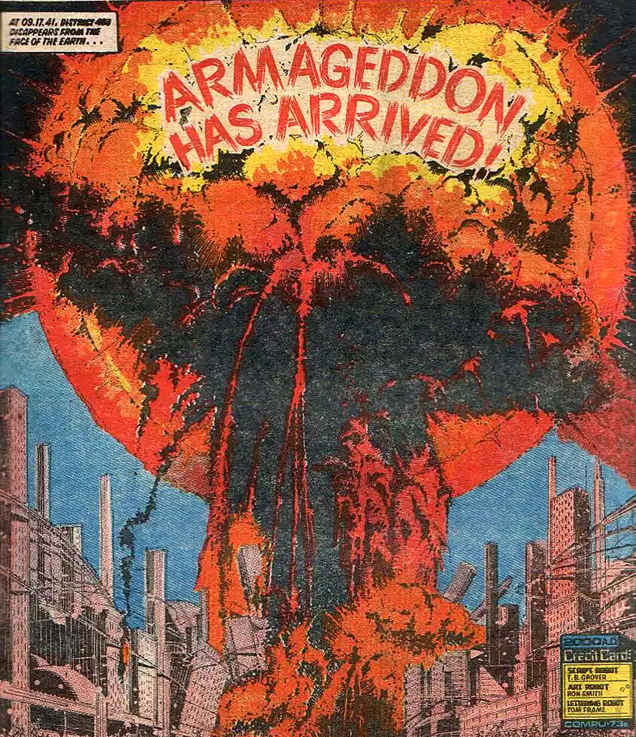
I’d heard somewhere that comic artists typically drew their pages ‘twice up’ in size, thereby tightening up their lines when they were reduced for reproduction. Mr Phillips, art teacher at the school, berated me one day for giving him a headache. He’d been tasked with printing the school mag, and the school’s photocopier didn’t do reductions, meaning he had to trundle off the the local library and use theirs to make page masters. He must have shifted one page accidently during this process, making my figures strangely shortened on one page. I was aghast, thinking that folk would assume I’d bungled the anatomy. What was I saying about taking things too seriously?
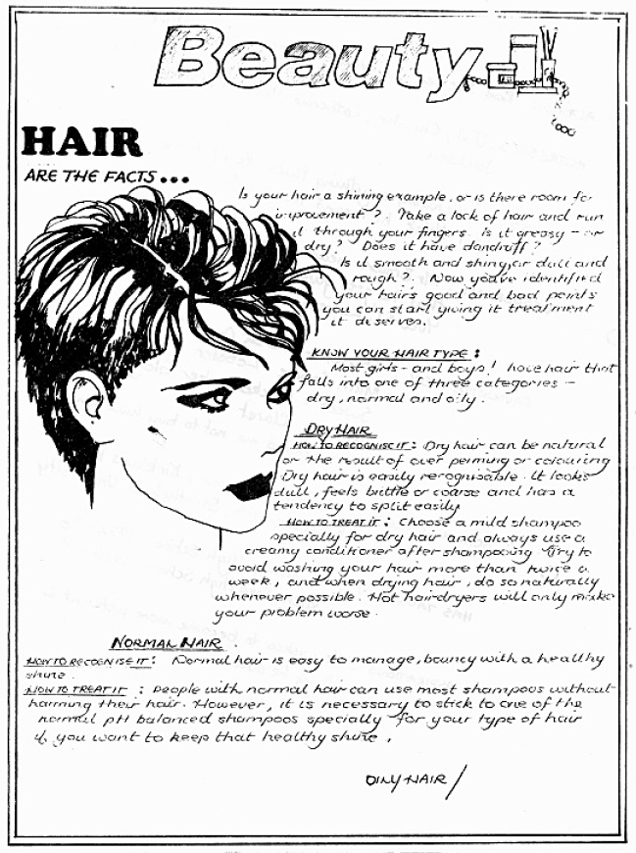
When the magazine appeared, I didn’t know what to make of the contrast between my po-faced comic strip and the rest of the content: faux horoscopes, fashion tips and school news. It’s clear that Mike tried to accommodate these unlikely bedfellows by following my comic strip with articles on Ronald Reagan and cruise missiles. Very topical.
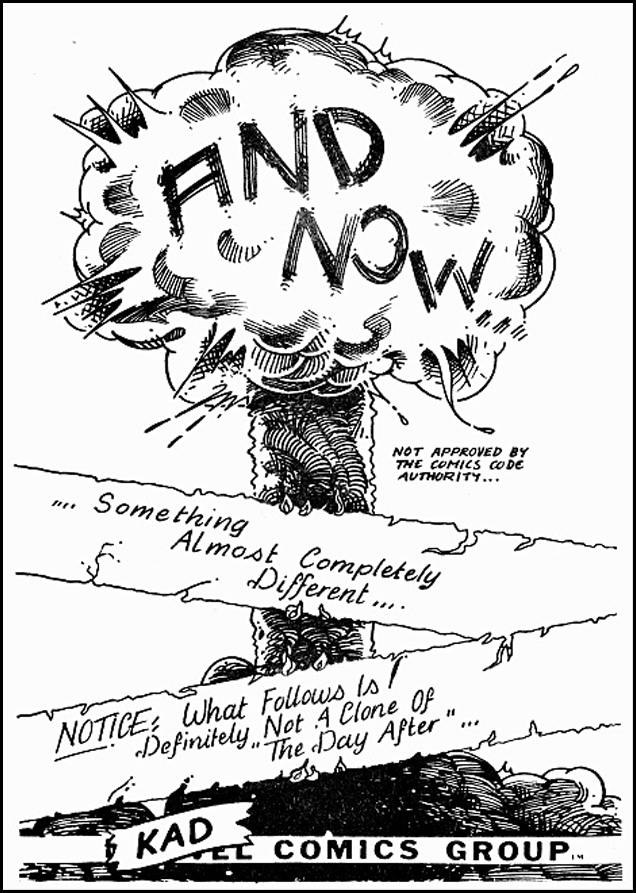


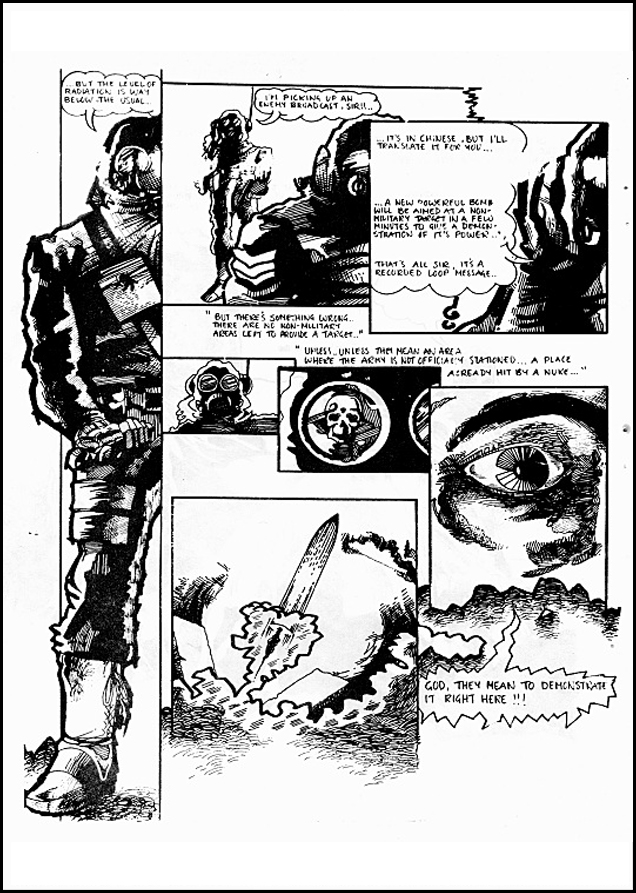

*At 17 years old, Mike Soutar scored a role at Dundee’s DC Thomson as a sub-editor. While there, he tried to get me a gig illustrating the covers for Starblazer comic. I was very grateful but I didn’t quite have the chops for it. At the age of 23, he became editor of Smash Hits, and his ‘magazine supremo’ moniker was secured. A publishing and business professional, you may have seen him on a little telly programme called The Apprentice…”
Ken is now a professional graphic designer, and you can find him here:
davidson-igd.co.uk
Felt Trips is a collaborative effort. If anyone wants to contribute their own childhood drawings from the era, I would be utterly delighted – please drop me a line using the “Contact” link at the top of the page. A good quality scan would be perfect, but – if not – then a clear photo of your artwork, lying flat, is fine. And maybe a few words of explanation, too: when the drawings were done, how old you were, what inspired you to tackle those particular subjects? Thanks so much.
Support the Haunted Generation website with a Ko-fi donation… thanks!
https://ko-fi.com/hauntedgen
 The Haunted Generation