(First published in Electronic Sound magazine #113, May 2024)
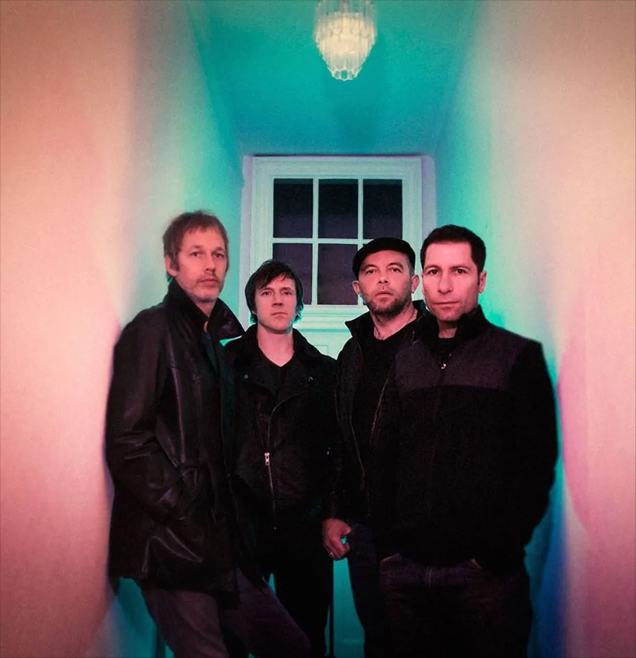
RIDE ON TIME
Together for eight years, apart for nineteen, than back together for another ten. Life in Ride has been a rollercoaster, but new album Interplay is a synth-heavy triumph
Words: Bob Fischer
“I love the word ‘widescreen’,” exclaims Mark Gardener. “Ennio Morricone is a god to me. And John Barry. And Antônio Pinto and Hans Zimmer. All the soundtrack boys!”
All four members of Ride are in a smiley, chipper mood. And “widescreen”? Possibly the perfect epithet for their new album, Interplay. It’s 36 years since they formed as students at the Oxfordshire School Of Art And Design, and 28 years since a mid-Britpop split that veered dangerously close to the messy. But in the thrilling decade since their 2014 reformation, they have sounded utterly rejuvenated. Interplay is their third album since the reunion, and – while they’ve never been averse to a spot of electronic dabbling – its lavish use of vintage synth sounds has lent the band an impressively cinematic quality.
“We gave ourselves the challenge of going into this album with no content whatsoever,” says drummer Loz Colbert. “We deliberately tried to start by jamming in the studio. And we took it as far as we could, but it started to go almost go the wrong way. So just as things were starting to turn a bit sour, we opened it up for everyone to bring in demos. And that’s when we got tracks like ‘I Came To See The Wreck’ and ‘Sunrise Chaser’. And one of the tracks I brought in was ‘Last Night I Went Somewhere To Dream’.
This song, the album’s press release boldly proclaims, was the catalyst for a change of mood. A track whose beautiful 1980s touches – woozy Depeche Mode synths and stadium-filling guitars – seem to have spread rather delightfully around the rest of the album, too. Was ‘Last Night I Went Somewhere To Dream’ really the nudge they needed to connect with their inner U2?
“I think it was the shuffly beat!” smiles Andy Bell. “But I wouldn’t say it was that overt. We started talking about those kind of tunes, but without saying ‘This could be the direction for the album’. It was more ‘Do you remember how we used to fucking love The Unforgettable Fire?’ We put it on one day, in the studio. The strings, and that lovely Brian Eno production… we applied some of that stuff to ‘Sunrise Chaser’. So little bits crept in, but at that stage it wasn’t ‘Let’s have an 80s pop concept, guys!’”
The jamming sessions and the bulk of recording took place at Mark Gardener’s own OX4 studio, but Mark himself chuckles at the idea of Bono-based bonding sessions.
“Maybe the guys were doing all that while I was mic-ing stuff up or hoovering,” he laughs. “I love The Unforgettable Fire and The Joshua Tree too. But I was engineering, as well as being the guy in the band. So while the others were sitting around getting inspired, I was probably on the phone to management saying ‘It’s time for an engineer to come and help, because I’ve had enough!’”
The album was completed at Vada Studios, a residential complex near Stratford-upon-Avon.
“John Lydon had been there the week before,” notes deadpan bassist Steve Queralt. “So I slept in his bed.”
And had the erstwhile Rotten left anything lying around? Earplugs? A half-empty tub of hair gel in the bedside cabinet?
“No,” says Steve. “But I didn’t do the Four In A Bed thing where they go round looking for pubic hairs.”
There are blank stares all from all quarters.
“Have you never seen that programme?” he asks. “It’s on Channel 4. People who own guest houses stay in each other’s hotels. It’s a really bitchy show, and the first thing they do is put on white gloves and go around looking for dirt. ‘This is disgusting! There’s a pubic hair in the toilet!’”
“That,” says Andy Bell, “is the most Channel 4 programme ever”.
Five interminable, rotten years have passed since their 2019 album This Is Not A Safe Place. The world, as Cate Blanchett points out in the first Lord Of The Rings film, has changed. I feel it in the water. I smell it in the air. Has Interplay been a tricky album to make in such tumultuous times?
“It has,” says Steve. “We went into Mark’s studio at the back end of the pandemic, whenever the government would allow us. Three lots of one-week sessions. Hanging over us at the time was a huge legal affair that had been brewing for a couple of years – that was coming to a head. And because it was the pandemic, the money was running out. The band couldn’t actually do anything, so we were relying on other jobs or savings. It wasn’t the perfect environment to work.”
“Some of the lyrics allude slightly to some of those things,” says Andy. “It’s quite an introspective-sounding record. With This Is Not A Safe Place, I’d been to an exhibition about Jean Michel Basquiat, and that was a big inspiration for the songwriting. But this time, everyone was looking inwards.”
Some of the songwriting, I suggest, goes a little beyond the benignly introspective. Take ‘Monaco’: “Broken by this country / We get smashed into pieces / Better take these pills cause everything’s for sale.” Is this also an album coming from a rather pissed-off place?
“Yes!” replies Mark Gardener. “I’m in a band, which pays OK but not that well any more, and like a lot of people I’m also a small business owner. And it’s just so hard to keep it all alive. Through the pandemic, then into the energy crisis, it’s been madness. I’m in my early fifties now, and I’m having to work so many long hours.”
Melancholy and righteous indignation? It’s a potent combination, and the release of a third belting Ride album in a row makes that 19-year gap all the more frustrating. Is there a part of them that hankers for a parallel universe version of Ride? An alternate reality where they stayed together between 1996 and 2014 and Interplay is their 17th studio album?
“The gap is the secret of our success,” smiles Andy Bell. “For any bands out there who are struggling, I’d say take 19 years out. It definitely helps the chemistry.”
Andy, of course, spent a huge chunk of the interim years as a member of Oasis. Mark and Loz, meanwhile, formed late 1990s psych band The Animalhouse, but the experience was short-lived.
“I moved to rural France in about 2000,” says Mark. “Totally dejected. Not with music itself, but with the way the whole industry had changed. So I worked in a walnut orchard. Listening over and over to Hans Zimmer’s soundtrack to The Thin Red Line – that was the best therapy! I recommend anyone who’s been in a band to have that experience. Work in a walnut orchard for a few months while listening to Hans Zimmer.”
Meanwhile, Steve Queralt recounts a particularly telling moment from the late 1990s. Making ends meet by working in the Oxford branch of Habitat, his blood ran cold when Radiohead frontman Thom Yorke walked into the store, keen to purchase a new sofa.
“That was a really awkward moment,” grimaces Steve. “There was me, a year out of Ride, and I had to get a job because the money had run out. And then Thom Yorke walked in. My career was over, and his was just blooming. We clocked each other, had the briefest of conversations about what he wanted to buy, then he left.”
“‘The most expensive sofa in the shop, please!’” laughs Andy.
“He didn’t buy it!” exclaims Steve. “That was actually my second awkward conversation with Thom Yorke. The first was on the way to a festival in Sweden. The bus picked both bands up from the airport, then stopped at a service station. And I tried to talk to him about crisps, but he just wasn’t interested. I mean, who doesn’t want to talk about crisps?”
“So,” begins Loz. “If Radiohead were a packet of crisps, what flavour would they be?”
“Worcester Sauce,” says Mark. “I really like them, but they’re not mainstream.”
“Kettle Chips, lightly salted,” says Steve. “One of my favourite crisps for one of my favourite bands.”
We’re doing this, are we? Really? Go on then, what about Ride?
“Cheesy Wotsits,” says Steve.
“No, they’re way too mainstream,” protests Andy. “We’re more of a connoisseur’s choice. I’d say something that you can’t readily get. Like Nik Naks.”
“Does anyone remember baked bean-flavoured crisps?” asks Steve. “My dad used to buy them for me when I was about five.”
Andy Bell is frowning.
“I won’t have those anywhere near Ride’s legacy,” he grumbles.
It’s a typical Ride conversation. For all the grandiose sonic cathedrals of sound they have created over the decades, they are endearingly funny and down-to-earth. So when they meet now as relaxed fiftysomethings, can they still recapture the delights of being four daft teenagers at art college in 1980s Oxford?
“Yeah, those are the great moments,” says Loz. “When it just gets back to the four of us having a laugh together.”
“We’re just slightly more haggard teenagers now!” grins Mark. “But there is an element of that, for sure. There’s a weird chemistry that happens with us. It’s good, and I think we keep each other on our game quite well.”
They begin reminiscing delightfully. About the emergency food parcels that Mark’s mum once delivered to their shared student house (“What is a rissole?” asks a baffled Steve), and about Big Spiderback, the reggae covers band that Steve and Andy formed between college deadlines. Their speciality? A UB40-style cover of Barbra Streisand’s ‘Woman In Love’. They’re clearly now at ease with each other’s company, but how do they view their own back catalogue? Can they ever light a pipe and slip on a bit of vintage Ride for pleasure?
“Once I’ve recorded an album, I can’t really listen to it,” says Loz. “That definitely happened with [1990 debut] Nowhere. I didn’t touch it for years. But then you come back later and think ‘Oh, this is quite good, really’. You’ve removed yourself from the process and can just listen to it as music. If I stick to doing that, and don’t overdo things too soon, I can be quite proud of the albums.”
“My go-to would be Nowhere or [1992 album] Going Blank Again,” says Andy. “Nowhere is a bit more difficult when my vocals go out of tune, but I can get into the general sound and the cool early songs.”
In the run-up to our conversation, I reveal, I’ve listened to all of Ride’s seven studio albums in order, one after the other. An approach the band themselves seem to view as an unnecessary feat of human endurance. And the album that really surprised me? The one they’ve come close to disowning in the past. In 1994, with relationships frazzling, they produced Carnival Of Light, a genuinely lovely collection of psychedelic pop gems.
“End of call!” says Loz, shaking his head. “It’s been nice chatting to you, Bob…”
Really? I know it a was a traumatic time for Ride, but honestly – the songs are great.
“It just didn’t feel as focused as some of the other albums,” he continues. “I’m not going to completely trash it, I think it has some great stuff and there were some good moments for us. But it just felt like we weren’t really pushing ourselves. We were all a bit comfortable, and possibly not saying ‘Is this actually any good?’ It’s a bit loose, whereas some of the others are a lot more focused.”
“We didn’t stay in our lane,” adds Steve. “We thought we could do something that clearly we couldn’t.”
Isn’t it nice though, as a band, to branch out and try different things?
“Yeah, but within a certain realm,” he says. “We can’t stray too far.”
“We’ve now kind of set ourselves up in a lane that’s broad enough to experiment,” adds Andy. “But still be good!”
We discuss their favourite electronic influences. Andy cites Harald Grosskopf’s 1980 album Synthesist, and Mark waxes lyrical about Boards Of Canada’s ‘Dayvan Cowboy’. Steve plumps for Vangelis’ 1973 soundtrack to L’Apocalypse Des Animaux, while Loz nominates Autechre’s intense 1993 debut Incunabula – and he also credits Martin Hannett’s work with Joy Division as a major influence on Ride’s latest sonic palette.
“There are a lot of electronic elements to this album,” he says. “The heart of it is definitely four people in a room playing live, but it’s also been developed, and there’s an interplay with all the electronic parts. That’s the bit that’s going to be a challenge when we play live. Do we take somebody with us that plays keyboards?”
“We should all come onstage with four keyboards,” says Andy. “That would be amazing.”
“As long as they’re all keytars,” says Steve.
Mark Gardener, meanwhile, is still pondering his favourite Ride album – and comes to a heartwarming conclusion.
“It’s Interplay,” he says. “I think we’ve hit heights that I always thought we were capable of. Things on the early albums have always niggled me, but this one doesn’t. It’s like a fresh, sonic blood transfusion, and it feels really good to play these songs.”
Interplay is out now from Wichita Recordings.
Electronic Sound – “the house magazine for plugged in people everywhere” – is published monthly, and available here:
https://electronicsound.co.uk/
Support the Haunted Generation website with a Ko-fi donation… thanks!
https://ko-fi.com/hauntedgen
 The Haunted Generation