(First published in Issue 119 of Electronic Sound magazine, November 2024)
LANDMARKS
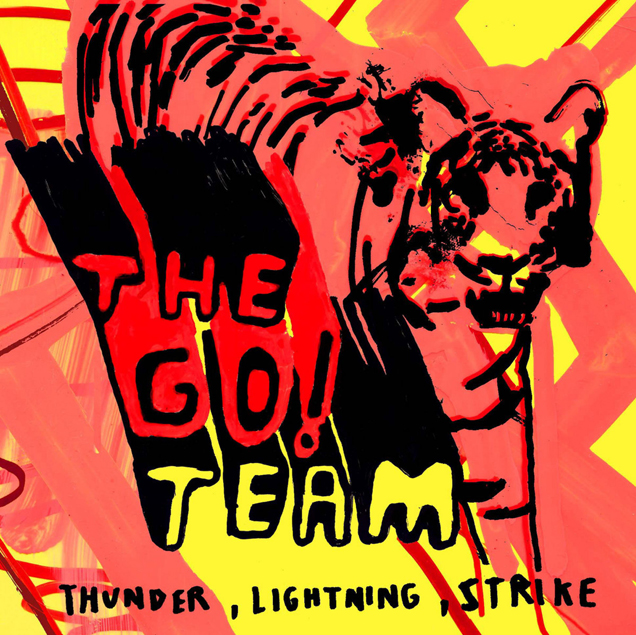
It’s twenty years since The Go! Team’s debut album Thunder, Lightning, Strike found the giddy middle ground between Sonic Youth and Sesame Street. With a deluxe reissue now on the shelves, Main main Ian Parton looks back on his complex relationship with breakthrough single ‘Ladyflash’
Interview: Bob Fischer
“I was living in Brighton and working as a TV researcher in 2004, generally on documentaries about skeletons and bog bodies. I think I had two weeks off, and I literally loaded the car up with gear and recorded the album at my parents’ house in Wales. They were on holiday – probably in Minorca, they always went to Minorca. I set the drums up in their kitchen, which it transpired had quite a kick-ass sound. I like spaces that aren’t actually studios, there’s something a bit clattery about them, and that became the hallmark of The Go! Team’s drum sound. And the computer with the record button was in the basement where my dad kept his car, so I was constantly running up and down the stairs.
“I don’t know if I had any grand plans, I was just pleasing myself. But I was certainly fucked off with that whole bullshit NME world, the ‘lads in the band’ tight jeans brigade. I wanted to redefine what being cool could be – something more technicolour and more feminine.
“I’d been slaving away at the songs on a four-track for years. In my student days, I’d get Tijuana Brass loops and put white noise over them, so I always had these ideas about worlds colliding. For me, it was New York that encapsulated the feel I was looking for: Sesame Street, Woody Allen, The Velvet Underground, Sonic Youth, Midnight Cowboy. I was seeing a Venn Diagram of all that stuff.
“And ‘Ladyflash’ would already have existed on multiple cassettes. The intro would have been on one tape, and the chorus on another: ‘We came here to rock the microphone’. I’ve always thought sampling was potentially a bit shit if it was just one cool idea looped, with a beat over the top. So I wanted to get as far away from that as possible by having eight ideas on one song – which I think ‘Ladyflash’ does.
“Then it’s me playing bass, drums and guitar – there’s all sorts of shit going on. The noise mindset was still very important to me, too. My brother Gareth is a sound engineer, and he was my partner in distortion! We put it all through a thing called the Culture Vulture, a valve disruption unit where you can dial in a bit of filth. It was an aesthetic choice to put a wall around everything in that way.
“Clearing the samples never crossed my mind. It was only when major labels got involved that things started getting hairy. The aesthetic of the album comes from these dusty, crackly old records. I want you to think of all this old shit, all these different decades butting up against each other. It’s that crossing of time that’s really interesting – from 1960s girl groups to people like Roxanne Shanté in the 1980s. That’s where the title came from. I’ve always kept notebooks full of phrases that I’ve heard, and when it comes to naming songs I just raid them. And ‘Ladyflash’ seemed to suit, because I wanted all the best things about female music shoved into one song.
“But the major labels are tightwads, they just miss the point of it all. I remember some bloke from Sony [the album was reissued by Columbia in 2005] sidling up to me at the Mercury Music Awards and saying ‘Can you clean it up?’. For the majors, it’s a legal black and white – their world is so litigious. So we were given these bullshit session player recreations that were just laughable, and me and my brother were pissing ourselves. We just said no.
“It was painful, but I think we got away with it. If you imagine every person sampled on ‘Ladyflash’ wants 10%, and there are fifteen people on there, then that’s more than the actual song is worth. But I was willing to give away whatever it took to keep the song as it should be.
“We were proper hip for about a minute – comically so! It was quite funny, but there was also a lot of pressure. Finding a band to play live, going from Australia from Japan to America, not going home for two months. And then giving up the day job. I went from SXSW, where we had queues around the block, back to documentary making. My boss kind of sacked me, but it was the right thing to do. He could see my heart wasn’t in it any more. You only get one chance at this.
“We did ‘Ladyflash’ on one of the very last episodes of Top of the Pops, and it was quite bleak. It was recorded at ten o’clock on a Monday morning and there were about 20 people in the audience, just being shoved around. Some of our band members were in Australia because we were playing the Big Day Out festival, so we had to use stand-ins wearing crash helmets. Still, it’s a good one to have under your belt.
“But ‘Ladyflash’ became a bit of a curse. We didn’t play it live for maybe five years, in the same way that Beck wouldn’t play ‘Loser’. It can be a bit dangerous when you’re dining out on one track. But we’re playing it again now, and it’s really satisfying. Life’s about those moments, isn’t it? When the crowd is together as one. You can’t really turn that down.
“And I don’t think it sounds particularly dated. We were unique then and we’re still unique now! I still have the same mission statement: ‘Can something be classic songwriting but still fuck with people, be experimental, take left turns – and be groovy as well?’ There’s a hierarchy of importance in my head, but melody is always at number one. So hopefully you could play a song like ‘Ladyflash’ on a guitar and it would still work.
“What has changed in the last twenty years is that music is less tribal now. In the 2000s, you picked your side – you were an indie kid or a dance kid. But ask anyone what they’re into now, and they’ll say ‘Oh, I like a bit of everything’. So I guess in a way The Go! Team might have predicted that whole ‘anything goes’ mindset.”
‘Thunder, Lightning Strike’ (20th Anniversay Edition) is out now on Memphis Industries.
Electronic Sound – “the house magazine for plugged in people everywhere” – is published monthly, and available here:
https://electronicsound.co.uk/
Support the Haunted Generation website with a Ko-fi donation… thanks!
https://ko-fi.com/hauntedgen
 The Haunted Generation