(First published in Issue 105 of Electronic Sound magazine, September 2023)
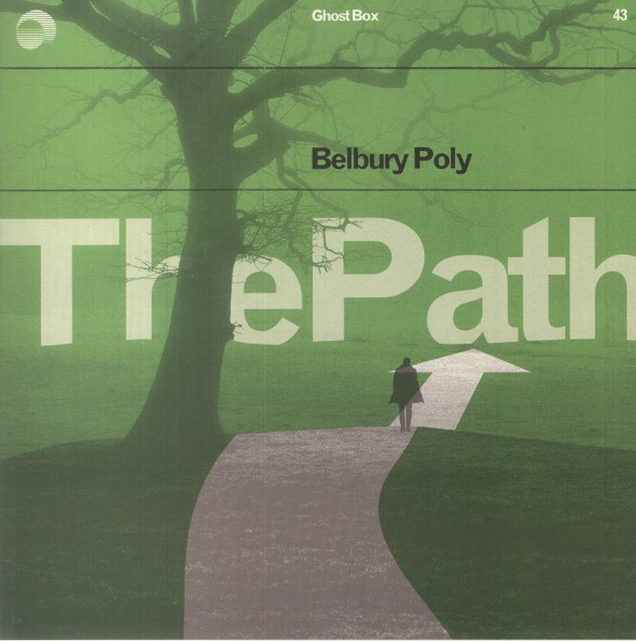
THE FAIRY HIKERS
For his latest album as Belbury Poly, Jim Jupp has assembled a Ghost Box supergroup with a Transatlantic feel. Gathered together for the first time, they discuss The Twilight Zone, flat-roofed pubs, and the fairy folklore that inspired the new record
Words: Bob Fischer
Photos: Andi Sapey
“The first track on this album picks up from the final track on the previous Belbury Poly album,” explains Jim Jupp. “They both use a field recording from a wood near my house, by a main road. To me, it’s a very familiar sound – birdsong with early morning traffic. So we’re continuing the fairy folklore themes of that last album, of people being pixie-led and going missing in nature. But this time, in a more contemporary, modern setting.”
It’s a baking hot Sunday lunchtime, and the whole Belbury Poly gang is here – the first time they’ve all met in person. And what a curious assortment of people they are: two eccentric Brits enjoying an afternoon of entente cordiale with two equally offbeat Americans. Jim is, of course, co-founder of Ghost Box Records, the politely genial rector of a distinctly unusual parish. He’s accompanied by relaxed bassist Chris Budd, a gin-sipping London lounge lizard in neckerchief and vintage shades.
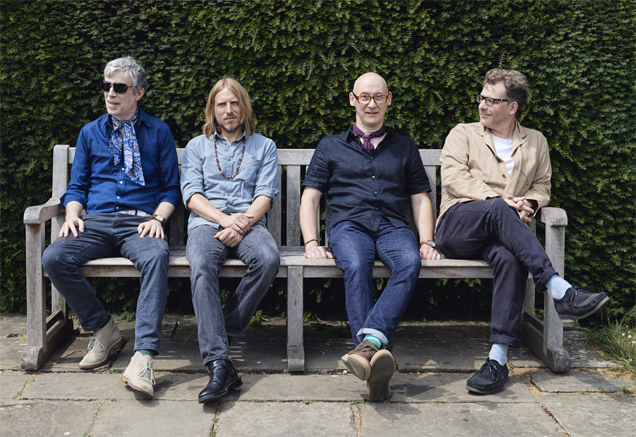
Also here are fast-talking US beat poet Justin Hopper – resplendent in pork pie hat, tipped at a jaunty angle – and an actual rock star in Texas-based flautist Jesse Chandler, immaculately frazzled on the final weekend of a month-long European tour with Midlake. Assembled around a pub table in West London, they look like the house band from some strange, long-forgotten Hanna-Barbera cartoon.
And the new record? It’s called The Path. As Jim says, it’s a sequel to his 2020 Belbury Poly opus, The Gone Away. Both albums are about fairies… more specifically, the long-standing fairy predilection for luring unsuspecting travellers off the beaten track to their doom. Even in contemporary cityscapes.
“It reminds me of a conversation I had with my mum about my grandad,” says Chris Budd. “He was once pixie-led in the middle of Hammersmith. You think of it happening in a field, but he was coming out of a cinema in West London, where he grew up. And suddenly, immediately, he just didn’t know where he was. He found his way home eventually, but when Jim started talking about people being pixie-led, that story made sense. I don’t think I’ve ever been pixie-led myself, but maybe it’ll happen today, on my way home.”
The group approach is important here. The Gone Away was an album of Jim’s solo electronica, recorded as a deliberate throwback to Ghost Box’s DIY origins. The Path is an expansive musical ensemble piece, a funk and jazz-fuelled odyssey with a Transatlantic feel reinforced by Justin’s mellifluous narration. Is this “pixie-led” school of oddness something that resonates equally with Belbury Poly’s new Stateside recruits? Jesse Chandler grew up in upstate New York, at the foot of the Catskill Mountains.
“There’s definitely a spookiness about the Catskills,” he says. “It’s a very old mountain range, with a lot of lore and ghost stories. My friend and I, growing up in Woodstock in the 1980s, used to go exploring. There was a loop of three or four miles with houses all along it, including ours, but within that loop was a giant forest. So we’d run into hobos, and we once found a pile of heavy metal magazines in there, left in a backpack. Our challenge was to get lost on purpose then somehow find our way home…”
So in the context of The Path, I wonder, is being “pixie-led” a metaphor for the giddying pace of change to our modern towns and cities? After all, we don’t need the malevolent influence of fairy beings to make us lose our bearings in familiar surroundings. I keep getting lost on the sprawling new housing estate five minutes’ walk from my front door.
Jim nods.
“It happens in London all the time,” he says. “The rate of change is incredible. I lived here for ten years, and when I come back now – even to the centre – it looks completely different. The roads go in different directions.”
“That’s why we tied together those folkloric elements with that claustrophobic Soho jazz vibe,” adds Justin.
“And it wasn’t intentional,” says Jim. “But it made perfect sense for this to be, broadly, an Anglo-American project. It took the music in a direction I wouldn’t otherwise have taken. These two cultures that know each other intimately, but even today we often don’t know what the hell each other is talking about.”
“It’s a special relationship…” smiles Justin.
Let’s dig further into that relationship. The complicated cross-pollination of – as George Bernard Shaw once put it – “two countries separated by a common language”. The genesis of The Path arose from long walks across the Sussex Downs, with Jim and the now Essex-based Justin exploring a plethora of narrative ideas. Including, at one stage, a struggling US writer (“Sound familiar?” quips Justin) being driven to mental breakdown by the sheer strangeness of the British landscape.
“One of the very first things Jim and I discussed was the idea of the circular walk,” says Justin. “Always starting and ending in a pub! That’s such a British thing. It made me wonder what would happen if someone like Jack Kerouac was doing ‘On The Road’ – but on a circular walk? That whole sense of freedom and beatnik jazz, forever going forward, forward, forward… it would just turn into this kind of degenerative destructiveness.”
“Our other idea,” adds Jim, “Was what I think Justin called a ‘taxonomy’ of weird landscape features. Things that, to British people, seem quite normal. Flat-roofed pubs. Footpaths that just stop. Roundabouts. Motorway signs to ‘The North’! We take all these things for granted, but they’re actually really odd. So we imagined this American guy wandering around the British landscape, thinking ‘What the hell is all this?’”
The music of The Path reflects these dichotomies. It’s American jazz and funk, but filtered through the prism of vintage British film soundtracks and library recordings. The title track in particular feels like a thrilling, distant cousin of Roy Budd’s score to Get Carter. Jim also cites the influence of eminent British jazzer Michael Garrick, in particular his long-buried 1968 recording, Prelude To Heart Is A Lotus. Jesse, listening intently, admits he’s been fascinated by the contrasts between the two schools.
“I grew up listening to and emulating American jazz,” he says. “But in the last decade or so I’ve heard some of the more obscure British artists. There’s a sense of freedom amongst the Americans, an effortlessness in how they play. Here it’s maybe a little more constructed, more thought-out. It’s no less musical, but it’s coming from a different angle.”
That’s probably, I suggest, because all British people are deeply repressed.
“Should we perhaps say ‘mannered’?” protests Chris. “But yes, the music is often very spare. It’s jazz at its fighting weight. That cinematic element is important, too – this was functional music, doing a job. And I really responded to that.”
It’s weird though, isn’t it? In the US, jazz is seen as the ultimate in musical expression. In Britain, we grew up hearing it as the background music for the Test Card on BBC2. I remind Jim that, the last time we spoke, he cited the jaunty theme from One Man And His Dog as an important formative influence on the early sound of Belbury Poly.
“TV themes are never far away from any Ghost Box album,” admits Jim. “I know we talk about this all the time, but there’s something really evocative about them.”
“Well, they’re repetitive, aren’t they?” ponders Chris. “You might hear a film score once or twice, but how many episodes of Man About The House were there? TV themes lodge in your head through familiarity.”
“I think it might be necessary,” interjects Justin, “for someone to explain to Jesse what One Man And His Dog is…”
“OK…” says Jim, taking a deep intake of breath. “In this country, farmers train border collies to herd sheep. Using all kinds of whistles and hand signals. And it’s done at the level of a competitive sport, so every week – on primetime TV, on one of our three channels – we watched organised sheep-herding. ‘Come by’! At the end of the show, the sheep ended up in a little square pen, and you’d hear a ripple of applause from across the fields. But it also had this laid-back, jazzy synth music as its theme.”
“Did this compete on television with snooker?” asks an incredulous Jesse.
It competed on television with everything. It ran for nearly forty years.
“Netflix have got it now,” deadpans Chris.
We’re being pixie-led off the conversational trail here. There’s a danger of being sidetracked by Jesse’s new-found love of mushy peas (“I’m a fan of peas in general, but those… wow”) and Chris’ appreciation of vintage Sesame Street animations.
Instead, let’s talk about Justin’s honey-voiced narration of The Path. Ultimately only loosely tethered to that initial narrative of a landscape-inspired breakdown, it nevertheless follows a grand tradition of American beat poetry edging curiously close to themainstream. Alongside solemn warnings about straying into fairy realms (“One step into the stray sod and you’re committed to the cause”) there are soliloquies about the lingering potency of childhood flying dreams and the mystical properties of moths.
“It’s entirely serious,” says Justin. “Except that it’s also a tiny bit tongue-in-cheek. Does that make sense? It’s dramatic and beatnik-y and everything, and that’s sort of funny. But it’s also 100% for real.”
He stresses the influence of Ken Nordine, the great mid-20th century voiceover man whose surreal 1967 spoken word album Colors had its origins in a series of jazz-influenced paint commercials.
“Because of my background,” explains Justin, “I have a real love for what I think of as middle class, middle-20th century, Middle America. My grandparents were from the Mid-West, basically dirt farmers who became middle class, and for them everything was middle of the road. But Ken Nordine made a really psychedelic version of that. A version that’s fucked up.”
“There’s something of Rod Serling’s introductions to The Twilight Zone about your narration as well,” adds Jim.
“Rod Serling was my single biggest influence on this album,” nods Justin. “I went to the same High School as him. The Twilight Zone has lots of stories about very ordinary people descending into madness, having bizarre things happen to them. Things they can’t explain to anyone else. And, knowingly and unknowingly, a lot of what happens on this album was about capturing that kind of feeling.”
Musically, the album has clearly been a hugely collaborative exercise.
“I made some fairly simplistic demos,” explains Jim. “I knew at least half the tracks would have a backbone of drums and bass guitar. I actually based a couple of demos on the kind of breakbeat samples that DJs were using in the 1990s, then passed them around for everyone to lay down their own arrangements.”
“Should we talk about the spreadsheet?” asks Jesse. “There was a colour-coded spreadsheet. This is the most efficiently-recorded album I’ve ever been part of…”
“That’s because I’m so uptight!” laughs Jim. “It was just a list of tracks. With the sessions that needed doing, and who was going to do them.”
He’s keen to praise the contribution of session drummer Max Saidi, perhaps the only Ghost Box recruit to have previously worked with both Peter Andre and Will Young. He came on the recommendation of Chris Budd, and the longstanding relationship between Jim and Chris seems pivotal to the album’s cohesive feel.
“Jim and I have been friends for decades,” says Chris. “Our wives went to university together, and now we’re a gang. I’m always keen to get involved with Ghost Box, even though Jim’s actually quite a good bass player, and he doesn’t really need me. I remember turning up at his studio one day, and he said ‘Look, I’ve bought a bass!’ And I thought ‘Oh, fuck…’
For Justin too, the album’s collaborative nature was clearly a rewarding experience.
“The tracks with my words were composed in tandem, back and forth and back and forth, in a way that was really special,” he says. “It was much more of a collaborative project than most things of this ilk. If you listen to older poetry records, it’s just someone playing music and someone else reading poetry… but that’s very much not what happened here.”
Even as we speak, creativity is fizzing around the table. Jesse reveals his next Ghost Box album, recorded under his regular nom-de-plume Pneumatic Tubes, will be based around the pseudo-spiritual aspects of the 1980s jogging craze. At the same time, he divulges, he’s collaborating with Justin on a theatrical performance inspired by the legacy of actual pneumatic tubes, the hydraulic mailing system pioneered in the late 19th century. Jim is clearly proud of the gloriously offbeat projects being moulded together by his label’s disparate alumni.
“Since this thing started coming together,” he says, “It’s been nice to think about Ghost Box having a ‘stable’. There’s something really cool about that. Like the Wrecking Crew…”
“Yeah,” agrees Justin. “But it’s the Wrecking Crew if everyone in the Wrecking Crew lived in the middle of nowhere and shunned the outside world.”
And with that, the company breaks and we begin to forge our own separate paths into the twisting alleyways of West London. Jesse, on his last afternoon in the UK, is soundchecking for a solo show in a nearby basement venue. Justin and Jim go in search of the latter’s mysteriously elusive Premier Inn. And Chris? Who knows. Perhaps he finally fulfils that longstanding ambition to be pixie-led around the streets of Hammersmith. If he has vanished for good, let this be his epitaph… extensive research reveals there were actually 39 episodes of Man About The House.
The Path is available here…
https://ghostbox.greedbag.com/buy/the-path-47/
Electronic Sound – “the house magazine for plugged in people everywhere” – is published monthly, and available here:
https://electronicsound.co.uk/
Support the Haunted Generation website with a Ko-fi donation… thanks!
https://ko-fi.com/hauntedgen
 The Haunted Generation