(First published in Issue 110 of Electronic Sound magazine, February 2024)
FUNNY BUSINESS
After two decades as an acclaimed folk musician, Trevor Deeble has undergone a startling reinvention. Spoofing the more sinister side of motivational corporate culture, he has become the intense synthpop guru behind the Office For Personal Development
Words: Bob Fischer
“I’ve managed to reach 38 years old without ever actually having worked in an office,” says Trevor Deeble. “But I think it’s probably a case of the grass always being greener. Everyone working in an office wishes they were musicians, and every musician just wishes they had a regular pay cheque.”
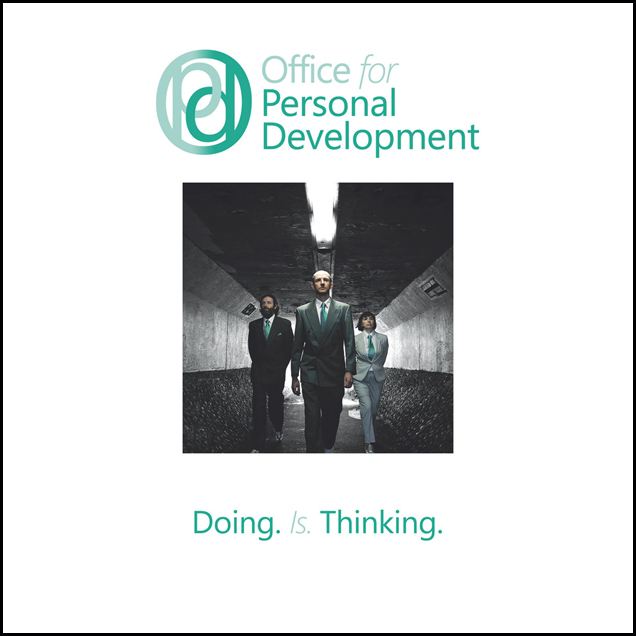
With a merciless satirical eye, Trevor is now happily combining these disparate callings. He has become the driving force behind Office For Personal Development, a brilliant, razor-sharp synthpop spoof of testosterone-driven corporate culture. The debut album, Doing. Is. Thinking, comprises 11 shimmering anthems to shiny-toothed capitalism, with Trevor cast as a cufflink-fiddling motivational guru.
As we speak over Zoom on a wintry morning, he is already in character. Suited and booted, he sports immaculate lapels and an unpleasantly fluorescent tie. Behind him is what appears to be a bustling open plan office, festooned with the pastel-green logos of this thrusting new enterprise. Impressive? Of course. But as Trevor sings in a robotic monotone amid the relentless bleeps of the album’s title track, “Thinking is the path that leads to not doing…”
Nevertheless, there are questions that need answering. This is all, I ponder, a crunching gear change from his previous musical career as an accomplished folkie. In the 2000s, Trevor and his now-wife Hannah were part of bluegrass outfit Indigo Moss, before finding further acclaim as acoustic duo Trevor Moss and Hannah-Lou. Success was not entirely elusive – they played the Royal Albert Hall and toured with Beth Orton and Tori Amos. But it was Trevor’s disillusionment with the commercialisation of folk music, he explains, that provided the spark of inspiration for Office For Personal Development.
“Everything became very corporate and slick,” he says. “We’d play a folk festival, and – without any irony – artists would turn up wearing the sponsor’s t-shirts and carrying roll-up banners. I just found it bizarre. But as a musician, you do have to lead a strange double life. You just want to be an artist, but the marketing aspect has become so prevalent. It takes up so much of your time. So the OPD felt like a natural vehicle to make a comment about that process.”
And the conversion from one-take, harmonised folk music to pounding, electronic anthems? Where did that come from?
“Me and Hannah couldn’t really tour any more because of the kids, and I’d just finished a solo record,” he recalls. “It was done, mixed and mastered and I listened to it back… and I was just completely bored. So I shelved it. I started experimenting with electronic music instead, and went completely down the wormhole. It was a totally fresh start. I’d never used a MIDI keyboard, never touched a drum machine, and I didn’t know how anything worked at all.
“Then two things converged. Me and Hannah were coming back from a festival, and throwing ideas around for what I could do with my new electronic thing. And an advert came on the radio for one of those wellbeing and mindfulness courses. It was made to sound so corporate and shiny, and I just thought ‘That’s it! That’s what I want to do’.”
And so Trevor Moss, folk musician, became Trevor Deeble, director of the OPD and wannabe motivational guru. Those weird, sinister organisations that offer self-improvement programmes and worryingly intense mentorship in return for unwavering cult-like devotion and a modest five-figure sum? The OPD mercilessly spoofs them all, not least with their relentlessly inventive live shows. Together, Trevor and bandmates Del Querns (Head of IT) and Jenna Love (Goals Liaison Officer) have created an immersive and theatrical experience.
“I enter through the audience shaking hands with everybody on the way,” says Trevor. “People have no idea what’s going on, and their first encounter is often me right in front of them, giving them a lanyard! And there are team-building and trust exercises throughout the show. You know at metal gigs, when they separate the audience into two halves? We do that, and when the song starts you have to rush across the room, shake hands with someone and tell them what your goals are for the next quarter.”
It sounds great fun. But it’s hard to believe, I suggest, that Trevor has genuine affection for this uber-corporate world. Is there a lot of anger in there as well?
“There is,” he concedes. “But I think a lot of those corporate motivational speakers are like that, too. I’ve often thought they come from a position of bitterness. They’re quite damaged people who maybe didn’t succeed as much as they wanted to – had they actually become millionaires, they wouldn’t be running these schemes, would they? And that element of tragic failure comes out in the show. My character has a breakdown and ends up half-naked, standing on his head…”
Reaction from his folk contemporaries, he admits, has been one of bemusement. But at least one synthpop legend has given the OPD his seal of approval. The whole project, I suggest, feels like the spiritual heir of Penthouse And Pavement, Heaven 17’s monolithic 1981 album of joyous yuppie-baiting. Trevor nods and reveals that high-level talks with Martyn Ware have already taken place.
“We had a really good conversation about the creative potential of pop,” he reveals. “Martyn said a similar thing to me – that he was disappointed pop music seems to have lost its creative soul. Pop is where the avant garde should reside, and traditionally it always has. It’s where boundaries should be pushed.”
And has that 1980s aesthetic also pushed its way into the OPD philosophy? This is, lest we forget, a band clad in shiny suits from Burtons Menswear. The title track from the album was even released as a limited edition single on 3½” floppy disk.
“I think all that happened quite naturally,” says Trevor. “Nostalgia is good fun, isn’t it? But I think the OPD will quickly develop. For the next album, the suits might go. Artistically, it’s a bit too straightforward if you’re doing synthpop and dressing like it’s the 1980s.
“So the second album will probably be about hoodies and webcams. And people working from home.”
Doing. Is. Thinking is available here:
https://theopd.bandcamp.com/album/doing-is-thinking
Electronic Sound – “the house magazine for plugged in people everywhere” – is published monthly, and available here:
https://electronicsound.co.uk/
Support the Haunted Generation website with a Ko-fi donation… thanks!
https://ko-fi.com/hauntedgen
 The Haunted Generation