(First published in Issue 119 of Electronic Sound magazine, November 2024)

CAFE SOCIETY
The ninth Field Music album, Limits Of Language, finds brothers Peter and David Brewis in a nostalgic mood. Overdosing on Marmite in their favourite Wearside cafe, they look back on the vanished eateries and melancholy early Septembers of their youth
“If you want to understand Field Music,” says David Brewis, “You have to be presented with me and Peter disagreeing with each other. Because that’s what we’re like. We’re not deliberately contradictory, but we’re not a sealed unit who agree on everything.”
Is that true, Peter Brewis? Do you – ahem – agree with that? He’s been busy spreading industrial quantities of Marmite on a toasted brioche, and looks up with raised eyebrows.
“Sorry, I wasn’t listening,” he says, and smiles apologetically.
It’s the perfect introduction to the Brewis brothers. They’re not exactly chalk and cheese, more a tangy Stilton on the same platter as a soft, gooey Camembert. Peter is the older (“by two years and ten months,” they both specify in uncanny unison) and is amiably chatty. David is more softly-spoken, draped across a wooden chair and sporting impeccable rock star hair. We’re in Sonny’s, the busy Sunderland cafe attached to Pop Recs, the town’s beautifully bespoke small music venue. It’s doing brisk Tuesday morning trade, and everyone who enters hollers a warm greeting in the Brewis brothers’ direction. For two decades, the fascinating, funk-fuelled adventures of Field Music have been a cornerstone of the town’s musical community.
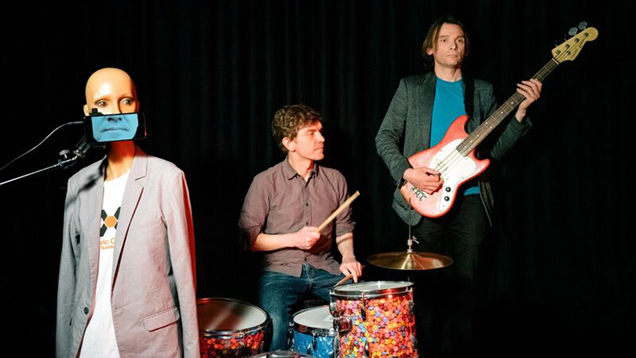
(Photo: Andy Martin)
New album Limits of Language is their first release since 2021, when the chiming guitars of Flat White Moon took the brothers’ sound perhaps closer than ever before to traditional indie-pop territory. The new album, it seems, is partly a reaction to that, a collection of thrillingly angular synth-funk soundscapes woven around plaintive lyrical concerns. It sounds like Thomas Dolby getting misty-eyed about the indoor roller coaster at Metroland. A comparison that seems to delight them both.
“The touring for Flat White Moon finished, and we had loads of musical ideas we wanted to play around with,” recalls David. “And, as we periodically are, we were a bit sick of the grind. You know: make a record, figure out which songs work live, add those songs to the greatest hits set”.
“Greatest hits?” splutters an incredulous Peter. “In the words of the Red Hot Chili Peppers, ‘What Hits?’ But yeah, it’s the problem we always face. We’d become Field Music, a ‘normal song’ indie rock band. And I detest that. I don’t want to be that. I don’t want to be in that section in the record shop.”
So is he saying Field Music could (and indeed should) have a bash at anything? Latino fusion? Death metal? Hour-long modular synth explorations with Polynesian nose flutes? Much to the despair of hard-headed music executives, mainstream bands used to do that kind of thing fairly regularly.
“Yeah,” nods Peter, defiantly. “As long as me and Dave have a co-operative vision, that’s Field Music. Simple as that. I’ve got into the Yellow Magic Orchestra recently – people kept saying they were the best band in the world, and I’d say ‘They can’t be’! But they’re actually pretty close. Almost a Beatles-esque bunch of people, with both serious ideas and fun ideas, all put together.
“And I love that playful, silly seriousness. Or serious sillyness. Or whatever…”
Sunderland feels unmistakeably autumnal, and a half-hearted breeze pushes vermillion leaves around the grey pavement outside. It’s a feeling encapsulated by the album’s opening track, ‘Six Weeks Nine Wells’. Infused with the listless torpor of September, it evokes perfectly that dreaded moment when the boundless glee of the summer holidays finally surrendered to uniforms and homework. “The six weeks’ days are long / But not enough to be continued / No sequel or a second part”.
It’s been 34 years, I tell them, since my last September school term. But that feeling still overwhelms me at this time every year.
“You still remember it, don’t you?” agrees David. “I think about that feeling even more now that I’ve got kids myself. I’ve been trying to figure out how much freedom I should give them. When I was eight or nine we had a lot of freedom – we’d just moved to Cleadon, a little village outside Sunderland. The ‘nine wells’ were the fields between the village and the train tracks. So it was ‘Bye, Mam and Dad’, then we’d wander to the end of the street, jump over a gate and run around. And try to snog some of the lasses we hung around with – although I wasn’t always very successful in that department.
“You felt safe enough to be wild, but you also felt a bit vulnerable. There was always the fear of bigger kids coming along and beating the crap out of us. It was both exciting and boring at the same time.”
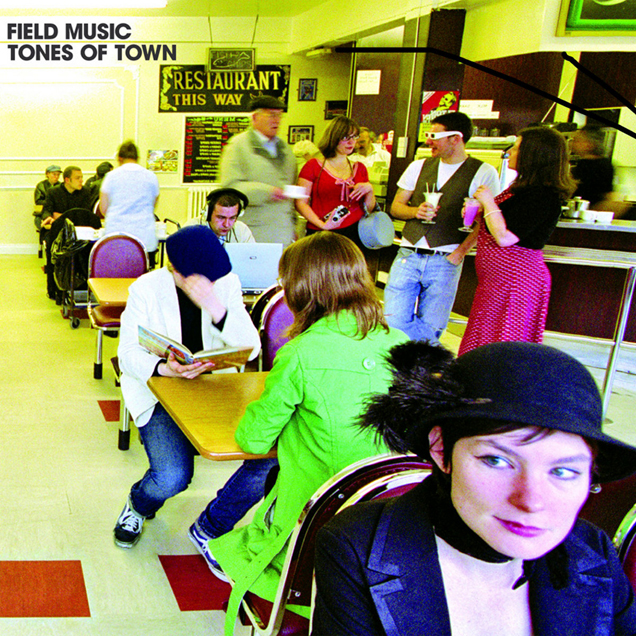
When it comes to much-missed childhood haunts, however, it’s a certain Wearside eatery that takes the proverbial biscuit. The Louis Cafe was a Sunderland fixture for the best part of a century, spending 43 of those years in a Brutalist shop unit on the town’s busy Park Lane before closing for good in 2018. There’s a picture of it on the cover of their 2007 album, Tones Of Town. And – they both point out – further references on almost every other Field Music release. Including the new album, where the brassy beats of ‘The Waitress Of St Louis’ explore their memories of the cafe with a sense of genuinely profound loss.
“It’s where we used to go as kids with our parents and our grandparents,” remembers David. “In the mid-1990s, when we were just starting to make music in Sunderland, we were both educators on a youth project. It’s where we first met Ian Black and the guys from The Futureheads. But after every single session, we’d meet our mam and dad in Louis. So it was a central point, and we got to know the family who ran it, the Maggiores.”
“The waitress was Maria Maggiore,” adds Peter. “She was there when we were kids, and she was just this incredible figure. I’ve got a big photo of the cafe in my flat, and it brings me a lot of comfort. The front of it had a Piet Mondrian quality – it was like a maths problem, and it looked like it would be there forever.”
Getting old is more emotionally complicated than you’d expect, isn’t it? Nobody tells you that you’ll experience grief for actual places. One of my favourite childhood copses is currently being bulldozed for a sprawling cluster of five-bedroomed executive homes, and I can’t drive past the site any more. Peter is nodding sympathetically.
“I find it very difficult to look at where Louis was,” he says. “It’s a bed shop now. Called ‘Slzzp @ Louis’. And I don’t know whether I want that. You centre yourself as a person using these geographical features, so when those features go away, it’s unsettling. And it makes you confront yourself – why the hell are those features so important to me?”
Go on then – why are they?
“Because we construct our sense of self from those places,” chips in David. “From our music tastes to how we deal with people, all these aspects of our personalities are made up of the experiences we’ve had in those places.”
“Sometimes it can feel like the opposite of having an adventure,” says Peter. “But I think you need those places to have adventures and flights of fancy from. I’ve seen Paddy McAloon say something like that. It doesn’t matter that he’s from County Durham and that he still lives in County Durham, it’s all up here [he taps his temple]. You can imagine anything.”
“Yeah,” agrees David. “My daughter was actually listening to Prefab Sprout the other day, and she asked me where Albuquerque was.”
There are many reasons to love Field Music. The music, naturally, is great. The Brewis brothers themselves are passionate, funny and self-effacing. But one particular thing, I tell them, has always really endeared them to me. Over a decade ago, they blew the lid on something that still remains a semi-taboo in what we’ll grudgingly call “the creative industries”: the frequently unspoken truth that there’s just no fucking money in this game any more. In 2012, in the wake of their fourth album Plumb being nominated for a Mercury Music Prize, Peter Brewis revealed in an interview with The Guardian that his own personal income rarely exceeded £5,000 a year.
Have things improved for them? They are both shaking their heads.
“It got easier for a bit, now it’s become much more difficult again,” says Peter.
“There’s a huge part of the music industry that says in order to be successful, you have to show yourself to be successful,” adds David. “And then people will take you seriously. And they’re probably right.”
“People say ‘What do you mean, you don’t want to play at the Stadium Of Light?’” continues Peter. “But although I love successful bands, it’s never driven me. I got a drumkit when I was 12, but I never had any ambition to be successful. I just wanted to survive. At school, careers advisors would say ‘What do you want to do?’ And I’d say ‘I just want to rock out’.”
As we chat, David shifts slightly in his seat and winces a little. For the first time since we sat down, it strikes me that – to use the vernacular of the football training ground – he’s perhaps struggling to reach full match fitness this season.
“That’s the other big influence on this record,” he nods. “I’ve done something to my knee. I had surgery in January and it hasn’t worked. I can play drums for a few minutes, long enough for one song, but even then it affects how I feel the next day.”
“It’s affected how we’ve approached everything, really,” says Peter. “If you don’t mind me saying so, I think you’ve been pretty down.”
“Yeah,” says David. “The combination of that and the financial woes of trying to hold everything together have been the primary influence on my contributions to this record. I’d say ‘It is what it is’, but I hate that phrase.”
“In Dave’s natural style, I think he’s played it down a bit,” says Peter. “Even when he’s hobbling around and clearly not feeling too good, he’s never going to say ‘Oh god, I’m so depressed’. That’s just not his vibe.”
“You see that in plenty of album promo campaigns,” says David. “‘I’ve written about my mental health struggles’”
“Can I write about your mental health struggles?’” deadpans Peter.
“So long as I can do yours”.
We all laugh. It’s a North-eastern thing. We just can’t talk about (yuk) actual emotions for a sustained period, can we? Love tends to come from doing rather than talking. Pop Recs was founded by local guitar heroes Frankie and the Heartstrings, and when their drummer Dave Harper died in 2021, Sonny’s was re-named in honour of his ten-year-old son. Directly opposite the cafe is a mural of 21-year-old singer-songwriter Faye Fantarrow, who died in 2023 after a year-long battle with cancer. Field Music joined Frankie and the Heartstrings to played live at a benefit gig to raise money for her treatment. Make no mistake, the North-east of England boasts a close-knit musical community.
But that love, and that unbridled passion for the music itself, is laced a self-deprecating sense of humour and a pragmatic stoicism that feels like an essential component of bands from Teesside, Tyneside and Wearside alike.
“I’m assuming most of us take the music quite seriously, but we don’t necessarily take ourselves too seriously,” nods Peter. “I think we all realise the absurdity of it all. It’s a silly thing to be doing, isn’t it? I feel very different about it now to how I did when I was 26 or 27, when we were putting out our first record. And I felt too old to be doing it even then.
“But I haven’t found the thing that I really want to do yet. The thing where we synthesize all our ideas and bring everything together. I just don’t know how to do it.”
Despite David’s opening salvo at the beginning of the interview, the Brewis brothers have seemed in pretty open agreement throughout. So can they now agree on this final point, too? The alluring notion that, despite all their achievements over the past two decades, the best is still to come? The younger Brewis sucks a thoughtful tooth.
“There are still things I want to try out,” he ponders. “But I don’t think there’ll ever be an end to that process. It’s just what we’re like.”
He pauses again.
“And if there was an end to it, we’d just have to focus on being a Doors tribute band instead”.
Peter? I’ll try one last time – do you disagree?
“No, I’m up for that,” he smiles, and the last of the brioche bites the dust.
Limits of Language is out now on Memphis Industries.
Electronic Sound – “the house magazine for plugged in people everywhere” – is published monthly, and available here:
https://electronicsound.co.uk/
Support the Haunted Generation website with a Ko-fi donation… thanks!
https://ko-fi.com/hauntedgen
 The Haunted Generation