(First published in Issue 111 of Electronic Sound magazine, March 2024)
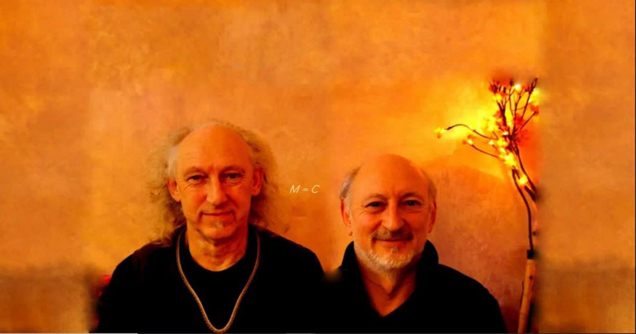
A ROOM WITH A WOO
Since the early 1970s, brothers Mark and Clive Ives have been recording as Woo – arguably the UK’s most prolific DIY band. Two newly-released albums, Robot X and Xylophonics, raid the 1980s and 90s wings of their extensive musical archives. As Clive Ives explains, it all began with Uncle Fred’s musical saw
Words: Bob Fischer
“Uncle Fred was great,” says Clive Ives. “He was an old RAF guy with a big moustache, such a sweet man. My brother and I would only see him very occasionally, but he was a great storyteller. He’d say ‘The next time you come, we’re going to make a film!’. So we’d turn up six months later still thinking about that, but of course by then he’d completely forgotten whatever he’d suggested.
“Then one day, he got out a saw and started playing it with a bow. It went ‘Wooooooo!’. And, as I remember, Mark said ‘Hey, that’s a great name for our band’.”
And so it proved. Since 1972, Mark and Clive Ives have been recording splendidly odd music under the collective name Woo, amassing an extraordinary archive of home recordings. The albums that have actually been released – over 30 of them – barely scratch the surface of a body of work that playfully embraces folk music, ambient soundscapes, dub, avant-garde jazz and a few experiments that even veer dangerously close to conventional pop music. Album titles include How To Make Your Home Look Like Space, Paradise In Pimlico and Dobbin’s Lost His Coconuts. It’s a wonderful world to explore, a giddy mish-mash of melodic mysticism and Pythonesque humour. Imagine Graham Chapman’s silly Colonel marching around the parade ground, bellowing at Kraftwerk to cover Bonzo Dog Doo-Dah Band songs. Or possibly the other way around. And this whole splendidly offbeat musical journey began in South London in the early 1960s.
“We started playing in our garage, when I was about seven and Mark was nine,” recalls Clive. “The kids in our street would pay a penny to come and watch us, but we must have been unbelievably bad. Mark couldn’t play anything, we had two other guys on guitars, and me on my grandad’s old drum kit – he played with the Royal Marines. We were being The Beatles! We grew up watching them get more and more famous, absolutely devouring everything they did.
“And The Beatles’ music was transforming at an incredible pace. They went from the very accessible ‘Please Please Me’ to the far-out, psychedelic ‘I Am The Walrus’ within four years! Each of their albums inspired and informed our musical education. Then, in 1967, there was ‘All You Need Is Love’ – an international message of love and optimism, and one that could be easily understood by people all over the world. It was a profoundly optimistic time for us.”
In an early example of their admirable eclecticism, however, the brothers were combining their explorations of the psychedelic realm with an interest in the more grounded world of traditional pub jazz.
“We had another uncle, Uncle Ivor, who was a great sax player,” recalls Clive. “We’d go to his Sunday lunchtime gigs, in rough old pubs where the guys were hammering out old jazz standards. And that opened the door for Mark to play his clarinet, because he’d sometimes join in.”
By 1972, following Mark’s own stint with the RAF band, the brothers were holed up in a terraced house in Wimbledon, creating home recordings with prolific abandon. And, by the mid-1970s, their musical ambitions had been transformed by Clive’s purchase of an early synthesiser.
“It was a little Roland that I bought for £300,” he remembers. “Until then, I’d been bashing saucepans and kitchen utensils while Mark was playing the guitar, but I saw this synth in a magazine and thought ‘That’s what I want!’ The whole idea of making home recordings with a synthesiser was such an exciting adventure. We’d say ‘What can we do tonight? Let’s make something that sounds like it comes from Russia, or a Parisian cafe, or like something you would hear on late night BBC Radio Three!
“But we weren’t really trying to get our music out there. It took another five years for Mike Alway from Cherry Red Records to come to our studio and say ‘Wow, this is great – I’ll help you release something’.”
The debut album, 1981’s Whichever Way You Are Going You Are Going Wrong, combines pastoral woodwind and folk-rock guitars with McCartney-esque basslines and swirling electronics. It was warmly reviewed, earning them comparisons to both Durutti Column and the Penguin Cafe Orchestra. In the US, Bruce Licher – founder of the Independent Projects Records label – found a copy stored in the warehouse of the San Francisco branch of Rough Trade Records, and was smitten. In 1988, the follow-up album, It’s Cosy Inside, finally gained a release on his label.
By this time, the brothers’ interest in Raja Yoga and Krishna Consciousness was lending their music a more contemplative feel.
“There’s a song on It’s Cosy Inside called ‘The Bird’,” says Clive. “It’s a really soft, mystical track… and we just said ‘Where on earth did that come from?’ My brother was a very mystical guy when he was younger, a real soul-seeker. So we were aspiring to make more mystical music, and that track – in its own strange way – really captured something.”
A profound interest in the spiritual, he explains, has been a long-standing passion for both Ives brothers.
“Mark travelled to India in his twenties and had a very powerful, life-changing spiritual experience,” says Clive. “Then, some years later, I had a good friend who was a Krishna devotee. He often talked to me about Krishna consciousness, and I spent many uplifting hours chanting with him and his friends. So all of these experiences have influenced both our music and our visual art.”
The duo continue to write and record together, with 2020’s dreamy, jazz-tinged Arcturian Corridor a recent highlight. But the mining of their extensive archives has also uncovered a rich seam of unreleased gems. Bruce Licher and Independent Projects Records have come onboard again to issue two new collections of vintage material. Robot X is a disquieting collection of 1980s synth instrumentals, Xylophonics a gentler 1990s showcase for the Ives brothers’ earliest digital recordings.
“About ten years ago,” recalls Clive, “Our friend and guitarist Larry Lloyd said ‘I can’t bear it, you’ve got all these DAT tapes and cassettes. I’m going to make it my mission to digitise everything for you’. Which he did, and there were something like 1,500 separate tracks. So when we look back at our archives, I sit there with Mark and say ‘When did we do that?’. And we listen out for whichever synthesiser or gizmo we were using at the time. Robot X loosely dates from the 1980s, but because we’ve got so many tracks, we don’t really know exactly when.
“But when Bruce asked us what inspired the Robot X album, the influence that really came back to me was Terry Gilliam’s 1985 masterpiece Brazil. That blend of sci-fi and dark comedy.”
It’s an influence that also seeps into Clive’s decidedly Gilliam-esque new video for one of the album’s pivotal tracks, ‘The One That Got Away’.
“It starts with a robot flying over some of the local houses, watching everything – it’s a comic way of looking at surveillance,” he explains. “Then it takes you into the mass-production of the robots. Outside the factory are huge piles of scrap, all the redundant spare parts. And this is reality! Every country in the world is about to start producing millions of these robots, and they’ll all eventually become scrap, because we’ll upgrade everything. So the finale has one little Robot X moving across this panorama of scrap. And then, in the final moment, you see him taking off into the sunset and escaping.
“And as I’m explaining it, I’m realising there are a few more things from Brazil in there!” he laughs. “That movie really got into my bloodstream”.
Xylophonics, meanwhile, is easier to date. Its production techniques narrow it down to the mid-1990s, when the brothers first began recording using computer technology.
“For years, a friend of mine had been saying ‘You’ve got to get a computer’.” explains Clive. “I’d been really resisting it, but when I finally got one, I changed my mind. In the past, I’d had to use a funny Synthi machine to link a step sequencer to a drum machine, but suddenly I had a computer and the whole idea of recording looped, minimalist compositions became much easier. So these are our earliest experiments in using that technology.”
Why the initial reluctance, then? He shrugs.
“Before computers came into everyday use, I was convinced that the technology would hinder my creativity,” he explains. “It took me a while to realise that this wasn’t true, and that computers can actually enhance artistic possibilities.”
So, as they enter their sixth decade of recording music together, what does the future hold for the Ives brothers? More original material, or more gems from those extensive archives?
“Both!” smiles Clive. “I’ve got new compositions that I’m working on, and I want Mark to work on them as well. So that’s my priority. But he’s still really happy to keep going through the archives.
“About four months ago, we said ‘Right – this is the final time we’re going through all this stuff’. We shortlisted all the things we hadn’t used, and we were amazed at how much of it we still really liked. There’s a really funny, quirky album in there somewhere. And a very gentle one. And some quite weird stuff, too.
“And Mark is very specific with his memories of it all. He’ll say ‘I remember this one! We had cherry pie and custard that night!’. We even found one recently where he’s doing a really awful impersonation of Barry White. But he’s very specific about his singing, and I’ve got a programme now where you can take the vocals off, so we did that… and now it’s an instrumental.”
The Woo back catalogue is available to download here:
https://woo-music.bandcamp.com/
Selected CDs and vinyl available here:
https://www.independentprojectrecords.com/woo
Electronic Sound – “the house magazine for plugged in people everywhere” – is published monthly, and available here:
https://electronicsound.co.uk/
Support the Haunted Generation website with a Ko-fi donation… thanks!
https://ko-fi.com/hauntedgen
 The Haunted Generation