(First published in Issue 118 of Electronic Sound magazine, October 2024)
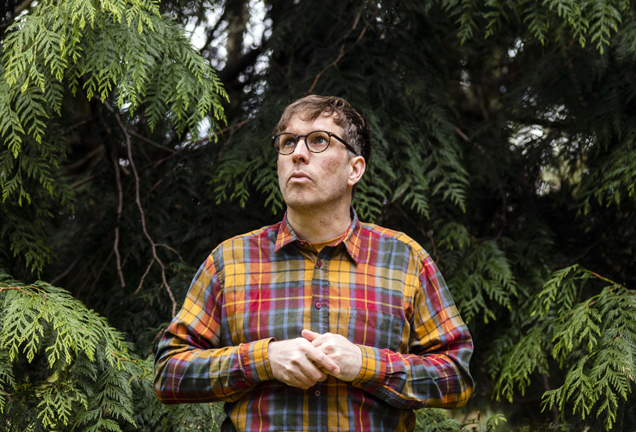
(Photo by Victoria Wai)
YOURS FAITHFULLY
Faithful Johannes? The Alan Bennett of hip-hop, John Betjemen with beats. And weighing on his mind at the moment are life-threatening lawns, river monsters called Tony and the “icky” thoughts that have inspired an album riddled with very English anxieties
Words: Bob Fischer
“The new album is called The House At Night, and I tried to capture that feeling when you’re on the landing because you need a wee, and you’re looking out of the window at the orange lights in the street,” explains Faithful Johannes. “And you feel a bit icky and eerie. A bit inbetween places.”
We’re enjoying afternoon tea in a tiny bookshop cafe in his adopted home town of Durham. He is, to put it bluntly and pragmatically, a slightly nervous fortysomething man sporting spectacles and a rather wayward baseball cap. For over a decade, he has been making hip-hop music of a curiously English stripe, weaving Alan Bennett-level observational humour and his own crippling social anxieties around incongruously contemporary beats.
The new album, a collaboration with Hartlepool producer Jonathon ‘Neocia’ Evans, is wonderful. To quote Johannes’ own press release, it’s “a record about childhood and parenting and television”. So a mish-mash, then, of his own fading childhood trauma and the 21st century imaginings of his two young children? He nods.
“My daughter will plan what she’s going to dream about in advance,” he says. “I don’t really believe her, but she’s really confident about it. So there’s a song called ‘Plan Your Dreams’, and that’s all about her.”
And what does she dream about?
“She’s into top hats at the moment. And she invented a river monster that drags you into the water by your feet. We were walking along the riverbank one day, and she suddenly said ‘He’s called Tony Rossinger’.”
Tony, heartwarmingly, has his own dedicated track on the album. But the record is also riddled with memories of Johannes’ own very real childhood anxieties. “That car is ticking,” he whispers on opening track ‘Autoreverse’. “Must have a bomb hidden / Patiently underneath”.
“I remember once hearing a car ticking because the engine was cooling down, but at the time I thought it was an IRA bomb,” he explains. “I thought ‘Shit, someone is bombing suburban Chester. I’d better go home and consult with my mother, she’ll know what to do’.
“So I guess it’s an album about that gap before you have a settled understanding of the world around you. A gap that leads your imagination to make these little funny jumps.”
It’s also a record, I suggest, that is almost painfully self-critical. “Why did I say that terrible joke to the postman?” he ponders, on pivotal mid-album track ‘Phobias’. “Why get fast passes for fly rollercoasters / When I’m too shy to skip queues and show them?”
“I do get really nervous about stuff,” he admits. “I’ve got a garden, and I have a constant feeling that it wouldn’t take much for the vegetation to become unmanageable. Dave over the road is furious, I’m sure. He’s lovely, but he hasn’t got a single weed in his paving. Whereas I once let the grass grow so long that I had to lift up the mower to go over the top of it, then I got my foot stuck underneath. I had to have plastic surgery.”
He is, you might surmise, an unlikely hip-hop fan. But as the bookshop closes and we retreat to an outdoor bench bathed in the gentle glow of late summer, he recalls a childhood soundtracked by some classic old school beats.
“The first rap music I remember liking was The Disposable Heroes of Hiphoprisy,” he says. “Remember them? ‘Television, The Drug Of the Nation’? That record was really big for me as a young teenager. I loved Asian Dub Foundation, too. And Public Enemy – I really listened to what Chuck D told me to do. I never played on Playstations because he told me they were the new plantations. I took it all very seriously.
“And I’ve been in bands since I was 11. The first one was called The Adventurous Hazlenut. Then it was Sprawl. Then Perry. Then Yoda.”
Leaving Chester as a teenager, he spent a decade in Sheffield (“I was the bassist in a trip-hop band” he shrugs, enigmatically) before moving to Durham in 2006 and teaming up with local sampler and clothes shop impressario Jonathan Swift to form a duo, Outside Your House. They frequently described their output, with typical self-effacement, as “barely rap”. Their live shows incorporated both an ironing board and a standard lamp.
“Jonny ran a vintage shop round the corner,” says Johannes. “We went for beers for a few months and he sent me some instrumentals. I started singing on them, but it felt better to talk instead. He was just the right person at the right time to give me that enthusiasm and support.”
It was an outfit that also gave him his current moniker – a name that aficionados of central European folklore will recognise instantly as the hero of a fable collected by the Brothers Grimm. His real name, I have been given special dispensation to disclose, is actually Tim.
“Faithful Johannes is my nom-de-rap,” he smiles. “I came up with the name because I always knew the band wouldn’t last. Jonny makes a great job of everything he does, but then he moves on. So the name was a bit of deliberate self-preservation.
“My very fortunate life partner Leslie-Ann gets read to every night. I’d read all of David Sedaris and Alan Bennett to her, with all the appropriate voices, and I’d moved onto Philip Pullman’s versions of Grimm’s fairy tales. Faithful Johannes is a servant who gets turned into stone, but there’s no thought-through life lesson there. If you like, I can try and work one out backwards and let you know?”
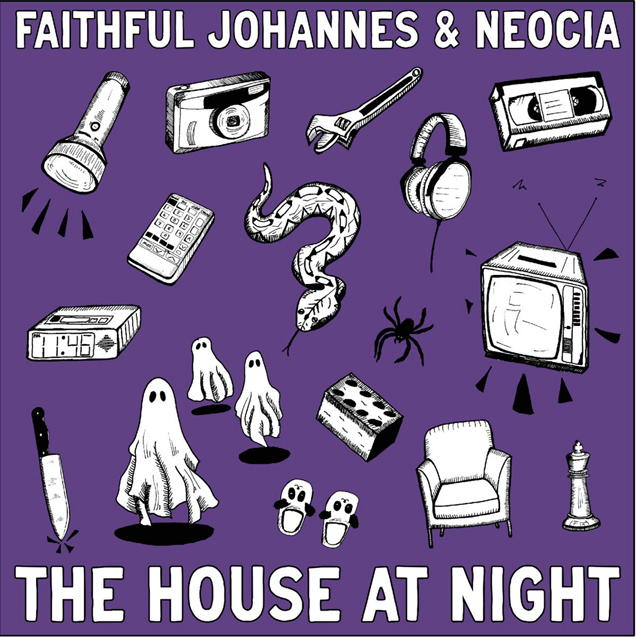
Alan Bennett, the Brothers Grimm and Public Enemy? These are, I suggest, mind-boggling combinations that he somehow seamlessly contrives into a perfect whole. He seems bemused by the suggestion that he’s doing anything particularly unusual, but is clearly proud of the record he and new partner Neocia have contrived. So is this it? After a lifetime of peripatetic drifting through both cultural influences and Northern cities, is he finally settled – both artistically and geographically? He looks unsure.
“It seems weird to say, but it still feels like I’m still figuring out what I’m trying to do,” he smiles. “And I kind of always want to be still figuring out what I’m trying to do.
“But I don’t want to move house again. I mean… I might move to Cullercoats when I retire, but I guess everyone has that dream. Don’t they?”
The House at Night is available here:
https://faithfuljohannes.bandcamp.com/album/the-house-at-night
Electronic Sound – “the house magazine for plugged in people everywhere” – is published monthly, and available here:
https://electronicsound.co.uk/
Support the Haunted Generation website with a Ko-fi donation… thanks!
https://ko-fi.com/hauntedgen
 The Haunted Generation