First published in Issue 91 of Electronic Sound magazine, July 2022:
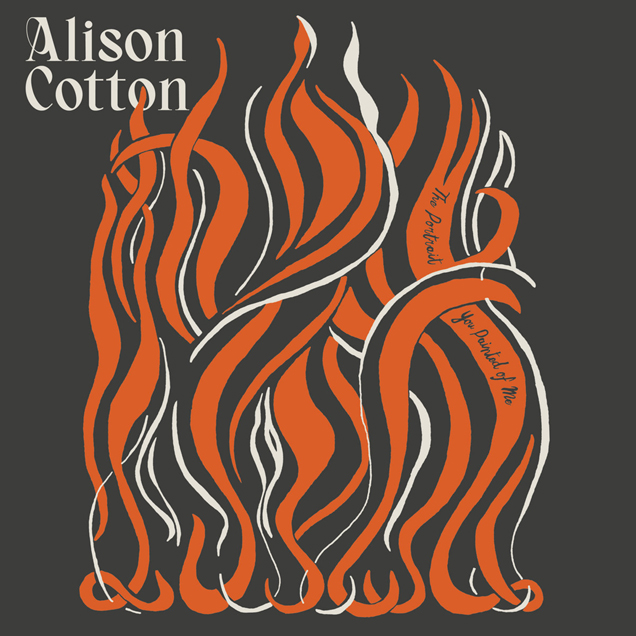
A NORTHERN SOUL
Alison Cotton has played synth-pop with Saloon and folk-rock with The Left Outsides. But her new solo album enters more experimental territory, evoking the beautifully bleak heritage of her native North-East
Words: Bob Fischer
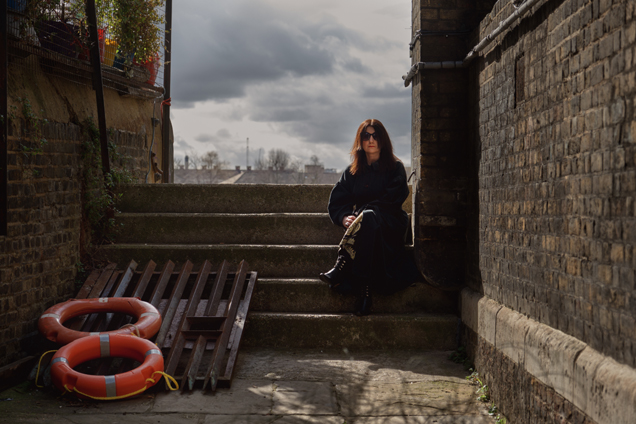
Pictures of Alison Cotton: Al Overdrive
“A distant relative of mine, Helen Hughes, was a world famous spiritualist,” says Alison Cotton. “She was from Seaham, and she helped with the abolition of the Witchcraft Act in the 1950s. Apparently, when she was a kid in bed, she’d be talking all the time to the ‘other people’ in the room…”
As a summation of an artist’s ethos and inspirations, its a story that’s difficult to beat. On an exposed stretch of County Durham shoreline, the doughty harbour town of Seaham stands resolute against the ferocious winds and waves of the North Sea. Once a bastion of two traditional North-Eastern industries – mining and fishing – its tragic history is woven into the haunting drones of Alison’s new album, The Portrait You Painted Of Me. And a sense of supernatural otherness has long since lingered over her musical explorations: both in the unearthly acid folk of The Left Outsides, a duo formed with husband Mark Nicholas, and in a series of increasingly experimental solo albums.
So is it a family trait? Can she see “beyond the veil” as well? She laughs.
“Well, a lot of people say I’m psychic. I’ll be thinking about someone, and then they’ll text me. It happens all the time…”
It’s over 25 years since she left her native North-East, but pandemic separation from the windswept landscapes of Wearside proved the starting point for a beautifully melancholic album of funereal viola, wordless harmonies and mournful experimentation.
“Almost every year of my life I’ve been back in Sunderland for Christmas,” she explains, that lilting accent still proudly prominent. “But in December 2020, lockdown was called at the last minute. So I suddenly had a lot of time on my hands, and I decided to spend it recording. And when I picked up the viola, I just immediately started thinking about the North-East. I was really homesick.
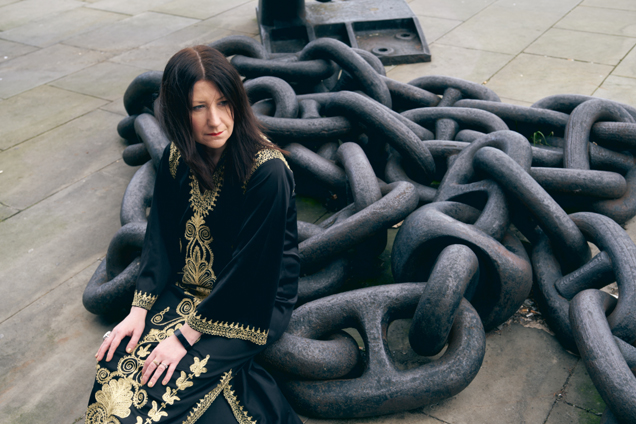
“I was thinking particularly about mining… I wanted to create a subterranean sound. To feel like I was going down that tunnel myself. And, as I was playing, I really felt as though as I was trapped. I had tears streaming down my face. On my mam’s side of the family, a lot of the men were miners. None of them are alive any more, but when I was growing up they told me stories. My uncle was from Seaham, and he died from emphysema as a result of working down the mines.”
‘That Tunnel Underground Seems Neverending’ captures perfectly the opaque oppression of the colliery pit. And, on the other side of the industrial divide, ‘17th November 1962’ is a date ingrained into the maritime folk memory of a generation of Wearsiders. At 4.10pm, the lifeboat George Elmy was launched into a howling gale to aid the crew of a stranded fishing vessel, the Economy. Five fishermen were rescued, but – faced with 12-foot waves at the entrance to Seaham harbour – the lifeboat capsized. Of the ten people on board, only 32-year-old mineworker Donald Burrell survived. Among the victims was his nine-year-old son, David.
“I always remember being in Seaham when I was a kid, and standing one afternoon looking out to sea with my mam,” says Alison. “And she told me that story. She’s a good storyteller, so descriptive. She was a teenager living in Seaham when it happened, and it affected the whole community.”
“The sea in the North-East is so different to the sea in any other part of the country. It’s so rough, so bleak. Very real.”
Like many North-Eastern families, the Cottons sought salvation in the spiritual. And the album has the spacey echo of church cloisters, too. On opening tack ‘Murmurations Over The Moor’, a multi-tracked Alison adopts distinctly choral qualities.
“I was brought up Church of England, but I went to a Catholic School: St Anthony’s in Sunderland,” she recalls. “I was taught by nuns, and they were really strict – one of them threw a dishcloth at me during a cookery lesson! I think I was just working too slowly.
“But I’ve always loved church music. I grew up listening to a lot of sacred music composers: Arvo Pärt, Monteverdi, Da Palestrina. My dad was brought up a strict Methodist, and my mam is still religious. She took me to St Nicholas’ church in Sunderland every week, and I’d wear a robe and serve bread and wine to the congregation. But it was time to stop once I started going out on a Saturday night. It didn’t feel right to do it hungover on a Sunday morning…”
It was an academic background, too. Her parents were both English teachers who met while students at Durham University. So was Alison’s childhood home a repository of classic literature? Were there musty Penguin Books on every wall?
“There still are!” she smiles. “I really liked the Brontës and Charles Dickens. Reading those books at the age of fourteen really influenced the things I see when I’m playing music now. You’re quite impressionable at that age, and full scenes have stayed in my head.”
Her music, I suggest, shares the doomed romantic yearning of 19th century literature. And ‘Violet May’, the only traditional lyric on the album, was inspired by a visit to Sissinghurst Castle, once the home of Vita Sackville-West.
“There was something about the tower where she wrote,” explains Alison. “I was really inspired by that. But the song isn’t based on her at all… Violet May is a character I created, a reclusive artist with all her work kept in that tower. It’s a fairy tale: her best friend is waiting outside, desperately wanting to see her again. She sends her letters, telling her how the garden has become completely overgrown…”
The viola, then? Not an obvious instrument for a kid growing up in 1980s Sunderland.
“I was seven, and I wanted to play the violin,” she recalls. “So we had to queue up outside the school instrument cupboard, and as usual I was very shy. Always at the back. And by the time I got to the front, there were only violas left. I didn’t even know what they were, but I took one – and I’m so pleased I did.
“I was in the school orchestra, then the local junior orchestra, then the youth orchestra. Sunderland Music Authority was brilliant – we toured France, playing in cathedrals and little town halls with champagne receptions! Although I was probably drinking orange juice at the time.”
And then back home to Sunderland Empire, for a collaboration that will leave a generation of middle-aged TV geeks consumed with jealousy.
“A performance with Tom Baker!” she laughs. “He was narrating The Snowman, and we were accompanying him. We had a day with him, and I remember – on a break – going down the street to the local chippy. I was eating my chips by the stage door when Tom came over and started chatting to me and my friend. Wearing his scarf, and nicking chips from our bags! He was lovely, and had so much time for everyone. This was probably about 1986. I’ve tried looking online, but I can’t find anything about it.”
Neither can I, and bloody hell – I know my way around a fair bit of Doctor Who minutiae. Can anyone help? Meanwhile, as those difficult teenage years progressed, Alison found her tastes taking a turn towards the distinctly alternative.
“I started going to see bands when I was about fifteen,” she recalls. “One of my first gigs was the Rollercoaster Tour at Whitley Bay Ice Rink – so I saw My Bloody Valentine and the Jesus And Mary Chain. That was a big part of growing up for me. I really looked up to bands, although I always thought I was too shy and lacking in confidence to ever do it myself.”
Nevertheless, in her first weeks at Reading University in 1995, she played a part in the foundation of one of the 21st century’s most durable indie outfits.
“I was playing in the university orchestra,” she recalls. “And I saw an advert on the notice board looking for people to help put a band together. I thought ‘I can’t be in the band, but I’d like to meet this person…’ Because music was the most important thing in my life, and I still didn’t know anyone who was into the same bands as me. It was Martin Noble, who lived in my halls, and I ended up going along to rehearsals with my viola.”
These were the earliest stirrings of British Sea Power.
“We were called British Air Powers at the time,” she explains. “It was really just playing for a laugh at first, then Neil and Woody joined and we entered the Battle of the Bands at the Student Union. It was really good fun. And we started playing in venues like The Alley Cat in Reading town centre. Then Adam and Mike from Saloon came to one of those gigs…”
I interviewed Adam Cresswell from Saloon a couple of months ago. He said he saw you in 1997 and basically headhunted you to join his new band.
“I was so naive, I didn’t realise you could be in more than one band at a time!” she sighs. “Obviously I don’t regret being in Saloon, it was great. But I could have just done both. Everything had to so be regimented with me…”
Seven years making quirky synth-pop is an unlikely adjunct to a musical career now infused with both austere folk traditions and sonic experimentation. In band publicity pictures, she looks characteristically bashful: a spectral presence at the back of gritty, monochrome shots. And the band themselves hovered perpetually on the brink of commercial success. 2002 single ‘Girls Are The New Boys’ topped John Peel’s annual Festive 50 countdown, albeit amid accusations of vote-rigging that Cresswell claims ultimately broke the band’s spirit.
“It wasn’t fun any more,” agrees Alison. “But I’ve heard more about it since it happened than I did at the time. I’m assuming it was all happening online, but I wasn’t on the internet back then. I didn’t even know how to use a computer.”
With Saloon in disarray, she retreated to home life with husband Mark, her partner since those first, faltering months at Reading University.
“He wasn’t a student, but he would hang out in the Student Union,” she laughs. “Everyone liked him. He looked like a student…
“After Saloon split up, we started writing songs together. But it was the same thing with confidence: I didn’t think I’d ever be able to sing them live. But then Mark joined a band called The Eighteenth Day Of May, and I went to their first gig at the Freemason’s Hall in London. And I was totally blown away. I thought ‘OK… maybe I could actually join, just not do much!’ I went straight into recording the album, then started playing live with them. We did so much in such a short space of time. We played SXSW, and we supported Robyn Hitchcock and Peter Buck.”
The band’s eponymous 2005 release, their only album, is a criminally-neglected folk-rock classic. Metaphorically speaking, The Eighteenth Day of May barely limped into June, although four members – including Alison, Mark and trad-folk obsessive Ben Phillipson – quickly formed The Trimdon Grange Explosion. So, Alison… another musical project inspired by a Country Durham industrial tragedy? In February 1882, 69 mineworkers lost their lives in a gas explosion at said colliery.
“I hadn’t even thought about that!” she exclaims. “We just wanted to carry on playing folk music together, and Ben owned an album called Along The Coaly Tyne, with a song called ‘The Trimdon Grange Explosion’. Written by Tommy Armstrong, who was known locally as The Pitman Poet. Ben loved that song, and asked me if I’d like to sing it live. Something that was still quite new to me…”
It seems those confidence issues are now firmly behind her. With The Trimdon Grange Explosion still a going concern and The Left Outsides preparing to record their seventh album, Alison has become a focal point for both bands. But it’s perhaps her solo work that most effectively embodies the dark otherness of the North-East. Those mournful, manipulated viola recitals reek of Wearside melancholy: the desolate streets of once-thriving pit villages now struggling to find purpose in a world without fossil fuels.
We’ve gone around the (red-bricked, terraced) houses this afternoon, and covered some decidedly dark material. Go on, I say – tell me something frothy to finish. Tell me the most un-Alison Cotton Alison Cotton fact imaginable. She smiles, mischievously.
“In 2006, I joined British Sea Power again for the John Betjeman Gala at the Prince of Wales Theatre,” she recalls. “An incredible, star-studded event. And I did my make-up with Joanna Lumley, who befriended me! It wasn’t even in the dressing room, we were just using the mirrors in the toilets. Then everyone had to go onstage at the end to sing together, in front of Charles and Camilla. There was Hugh Grant, Barry Humphries, Stephen Fry… it was amazing. Joanna was standing with Nick Cave, and I was lurking behind them, not knowing whether to join in. All I could see, all around me, were celebrities. Then Joanna and Nick turned around, and beckoned me over. Joanna said ‘Come and sing with us!’ So I was in the middle of them, sharing a songsheet…”
That’ll do. She may not be dabbling with the dark arts of her illustrious ancestor, but Alison Cotton creates her own distinct brand of strange magic.
The Portrait You Painted Of Me is available here:
https://alisoncotton-uk.bandcamp.com/album/the-portrait-you-painted-of-me
Electronic Sound – “the house magazine for plugged in people everywhere” – is published monthly, and available here:
https://electronicsound.co.uk/
Support the Haunted Generation website with a Ko-fi donation… thanks!
https://ko-fi.com/hauntedgen
 The Haunted Generation