(First published in Issue 108 of Electronic Sound magazine, December 2023)
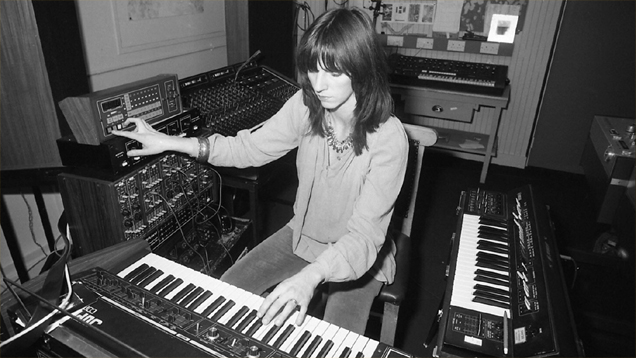
SINGING IN THE WIRES
Elizabeth Parker was a mainstay of the BBC Radiophonic Workshop and one of Britain’s most in-demand composers of TV and film soundtracks. But a new compilation, Future Perfect, gathers together previously-unheard pieces from her own private archive. Expect ghostly nuns and clunky scaffolding
Words: Bob Fischer
“I was thinking of nuns in a deserted abbey,” says Elizabeth Parker with a smile. “Maybe they’re ghostly nuns? They’re singing, but then some kind of great force comes along and destroys them all! Possibly a big storm? It was very definitely an image of a crumbling abbey, with the nuns in their ghostly white and black, and something awful about to happen.”
She pauses for a moment of self-reflection, then bursts out laughing.
“Believe it or not, I’m actually quite a happy person…”
She’s discussing the vivid mental imagery that inspired ‘Ghosts In The Abbey’, a haunting track on new compilation Future Perfect. With its ecclesiastical choir being slowly submerged by an atmosphere of ambient foreboding, this is – quite possibly – the darkest moment of an album already steeped in glorious disquiet. Elizabeth nods in agreement.
“If you think of the colours of this album, they’re mauves and purples with the occasional flicker of steely grey,” she ponders. “But not a lot of bright orange or pink.”
Nevertheless, it’s a fascinating and affecting collection, its 26 tracks taken from Elizabeth’s own vast, forty-year archive of private recordings. She enjoyed a hugely successful career as a prolific composer for TV and film, including a twenty-year stint with the BBC Radiophonic Workshop, but this collection – she reveals – comprises music recorded almost exclusively for her own pleasure.
“I’ve always been interested in sounds,” she explains. “I carried a Walkman around in my handbag for years, so if I heard an interesting sound anywhere I could record it. When we were in Cornwall, it was the boat wires twanging. When we moved house and had scaffolding up, it was the scaffold boards. Those clunks and clicks had wonderful sonorities, and I had to make something out of them.”
Cornish boat wire and clunky scaffolding alike are proudly included on the album. The former, recorded on a 1970s holiday, is incorporated into the nerve-jangling percussion of ‘The Killing Skies’. The latter is woven into the stark ambient textures of ‘Devil’s Lightning’ and ‘Post Apocalyptic Fog’. This desire to use sound to evoke specific feelings and atmospheres has, Elizabeth explains, been a lifelong passion.
“I was brought up very conventionally,” she recalls. “I did cello to Grade 7 and piano to Grade 8. But, when I was twelve or thirteen, I spent a lot of time improvising on the piano. And it drove my father mad… he and my mother were very classical and they found it really irritating. But, when I played for a ballet class, they wanted music for giants and fairies and butterflies. And they realised I could make up tunes, matching sounds to movement.
“By the time I was 18, I was going to the Queen Elizabeth Hall in London and listening to a lot of contemporary music. ‘Beep! Boop!’ People like Harrison Birtwistle. It was probably too far that way… but classical was too far the other way. And somehow I became interested in that merging of music and sound.”
A music degree at the University of East Anglia was followed by a Masters in Electronic Music. Along the way, she was mentored by the pioneering Tristram Cary.
“He completely despaired of me!” she laughs. “He had a studio in Norfolk, with a big Synthi 100. And his pieces were also ‘beep, bleep, bloop’! He explained how I could get that sound, but to me… well, my physics and maths are awful. I’m not like Delia Derbyshire. But he taught me the fundamentals of making sine waves and square waves by using the Synthi 100. One of the earliest pieces on the album – ‘Space Drift’ – was done with him. It was agony for me, and I wasn’t in my comfort zone, but it gave me a good start.”
She joined in the BBC in 1978 as a studio manager, but admits she always had an eye on the corporation’s quirkiest musical enclave.
“I’d heard about the Radiophonic Workshop at university and I thought I’d try to get there,” she says. “The easiest way was to join the BBC, do my training, then get an attachment. And when I told someone I was going to the Radiophonic Workshop, they said ‘Why on earth do you want to go there? They’re all mad!’”
In her first major job, she used the manipulated wails of her own ethereal vocals to create ‘Special Sound’ for ‘The Stones Of Blood’, a rare Doctor Who foray into the realms of Folk Horror. Dick Mills, the show’s regular producer of unearthly hums and alien soundscapes, was away on annual leave. But it was the permanent departure of another Radiophonic Workshop stalwart that led to Elizabeth’s association with the Doctor’s most fierce sci-fi rival.
“Richard Yeoman-Clarke left halfway through Blake’s 7,” she recalls. “So was I prepared to take it on? I said yes. Mad! What was the little square synth that Dick Mills used a lot? The VCS3. I made lots of door noises with that. And then, of course, I started to say ‘Do you think Servalan, when she’s in her bed chamber, should have some music?’ It was a baptism of fire, but another very good grounding.”
These earliest experiences at the Radiophonic Workshop were, she admits, somewhat daunting.
“I was quite young, really,” she sighs. “I was a bit nervous. It was fantastic later on in my mid-forties, when I was doing stuff I really loved, but the beginning was quite tough. The others seemed to have more of a feeling for the technology and the engineering side of things, but I’d come from the arts side. Everything that I did, I had to learn.”
She was, she confesses, never a science fiction fan. Nevertheless, she made further pivotal contributions to the genre. The appallingly sinister rattle of the psychotic plants in the BBC’s 1981 adaptation of Day Of The Triffids? Memories are vague, but she thinks it’s probably the manipulated clacking of her own tongue. She also remains proud of her single musical score for Doctor Who, a stark and strident synth soundtrack to the 1985 Colin Baker story, ‘Timelash’.
Meanwhile, the Workshop’s Maida Vale studios provided their own moments of gleeful surreality.
“The canteen was a riot of people!” she smiles. “All the orchestras and conductors, but you’d also have Pete Townsend and The Who. You never knew who you’d bump into. I remember Muhammed Ali being shown around my studio! I had his autograph pinned up on my peg board for years.”
And were they all, indeed, “mad” at the BBC Radiophonic Workshop? One-time Head of Department Brian Hodgson has gleefully recounted the story of how Elizabeth’s joyous, two-minute jingle for BBC Radio Blackburn almost resulted in the Maida Vale studios requiring full-scale disinfection. Her unsolicited reward, it seems, was a sizeable consignment of Lancashire black pudding. She laughs heartily at the memory.
“It was a very hot Friday afternoon and I’d gone home for the weekend,” she recalls. “Unbeknown to me, a package had arrived. Quite big, and wrapped in brown paper with string. Nobody knew what it was, and our secretary Val just put it in a metal filing cabinet. On Monday morning, she said ‘Oh Liz, there’s a package for you’. So I got it out, and… oh, my god.”
She holds her nose at the memory.
“It’s pig’s blood, isn’t it? In a very hot cupboard…”
Her work brought her to the attention of Delia Derbyshire. The sleeve notes for Future Perfect, written by the album’s compiler Alan Gubby, describe an early 1980s party at which – apparently – Derbyshire expressed her desire to “hand over the baton” to the Workshop’s latest recruit. It was a relationship the two women maintained convivially for the next two decades.
“She used to ring up in the afternoons and say ‘Oh Liz, I wish we could have worked together’,” remembers Elizabeth. “To be honest, she was probably a bit too zany for me… but had we been there together, we would have been a power to be reckoned with. She’s the person I would most like to have worked with, and I could have worked with her. We had lovely in-depth conversations. Not long before she died, she was saying ‘I’m going to come and see you’. It’s quite moving really, and I know we could have done some great things together. She was amazing.”
Elizabeth’s atmospheric 1984 soundtrack to the BBC’s flagship natural history series The Living Planet proved a career turning point, but she admits she has reservations about the theme tune itself.
“I’m not crazy about that wretched SY-2 trumpet sound!” she smiles. “And I’m afraid that’s the bit David Attenborough didn’t like either. He rang me up and said ‘How’s it going?’ So I asked him to come along to the studio.
“But as a body of work, I listen to it now and think – how did I do it? Thirteen episodes on one multi-track. I’d watch the programme, then I had three weeks to lay the sounds down and mix it. But it was an absolute breakthrough, because after that I did a lot of natural history programmes.”
In 1998, when the BBC Radiophonic Workshop finally closed down, Elizabeth was literally the last musician to leave the building.
‘It was lunchtime, and all my studio was in bits,” she recalls. “I said ‘That’s it, is it? Shall I give you my key back?’ and the engineer said [she affects an officious Yorkshire accent] ‘That would be appropriate’. He was a real stickler! So I handed in my key, walked out the front door, got into the car, and I was in floods of tears. What an ending.
“The last year there had been awful. Everybody else had left, and I’d been working very hard – it was horrible. Everything had gone.”
A decade of freelance work followed. Elizabeth’s music soundtracked an eclectic range of TV documentaries, from Michael Palin’s sun-baked Saharan adventures (“He sent round a crate of really beautiful wine,” she beams) to Fred Dibnah’s explorations of industrial steam heritage. But, in 2012, she suddenly decided to retire from the business. It was a move that surprised even her own family.
“Even my daughter said she couldn’t understand why I just stopped,” admits Elizabeth. “But I got a bit like Delia – I just didn’t just want to do it any more. For about four years, I couldn’t even watch a natural history programme. I think it was burn-out in the end. When someone rings up and says ‘Can you do this’ and you say ‘No, I can’t’, that’s the hardest thing. But then someone else rings up and you say ‘I’m not actually working right now’… and, by the fifth time, it’s easy.”
These days, she reveals, she is more an enthusiastic listener of music than a prolific producer.
“I listen to a load of stuff. Shoenberg, Philip Glass, Radiohead… one or two things by Eminem. There’s one with Rihanna, ‘Love The Way You Lie’… that’s a fantastic song. Then it’s The Beach Boys for their harmonies, and The Beatles for what George Martin did with them. The way he added orchestral bits. I’ve always gone towards melody, but with interesting chords. I’m quite fond of the second inversion. Oh, that makes me sound like such a muso posho. But I am, it’s a great chord!”
So would she never be tempted to unpack the synths again? She pauses, and looks tantalisingly sheepish.
“I’ve got five grandchildren, so life is very full,” she begins. “But funnily enough, I have got a project that I’m going to start. Based on the piano, and some sonnets that I’m adapting. I suddenly thought ‘I really fancy doing that’. Something very simple and very beautiful, using second inversions! So I am going to start again. That’s an exclusive for you.”
We’re honoured. And, given everything we’ve discussed, there’s one final and obvious question to ask about this exciting new project.
What colour will it be?
“Pale emerald green with hints of jasmine yellow,” she replies, mischievously. “But bear in mind this will be a long time in the planning. I might just get it sorted for my 80th birthday…”
Future Perfect is available here:
https://trunkrecords.greedbag.com/buy/future-perfect-11/
Electronic Sound – “the house magazine for plugged in people everywhere” – is published monthly, and available here:
https://electronicsound.co.uk/
Support the Haunted Generation website with a Ko-fi donation… thanks!
https://ko-fi.com/hauntedgen
 The Haunted Generation