(First published in Electronic Sound magazine #95, November 2022)
NORTH BY NORTHWEST
Concrete dreams and Brutalist utopias… Gordon Chapman-Fox is Warrington-Runcorn New Town Development Plan. And – moreover – he’s brought sandwiches
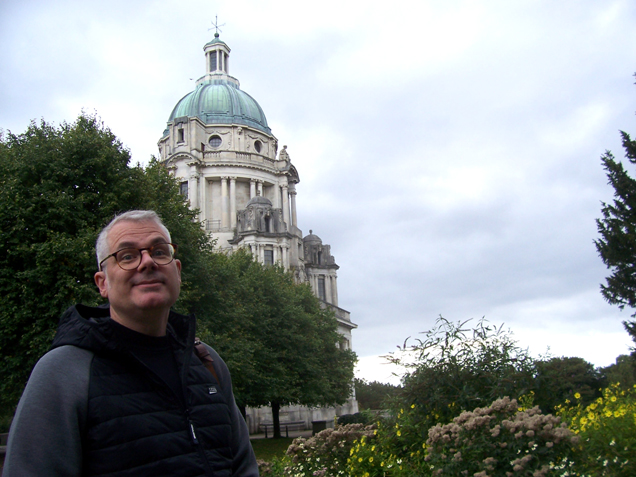
“They do The Hobbit here in the summer,” says Gordon Chapman-Fox, sitting on a park bench and taking a bite from a ham sandwich. “The Dukes Theatre puts it on. Those trees over there are The Shire, and the memorial itself is the Lonely Mountain, where the dragon lives.”
We’re in Lancaster, and we’ve got packed lunches. I’ve brought prawn cocktail crisps and a Wispa Gold. Behind us looms the Ashton Memorial, a towering green-domed Edwardian folly, while the trees of Williamson Park before us frame spectacular mist-shrouded views of an autumnal Morecambe Bay. If this is Middle-Earth, the elves talk like Thora Hird and eat hotpot for breakfast.
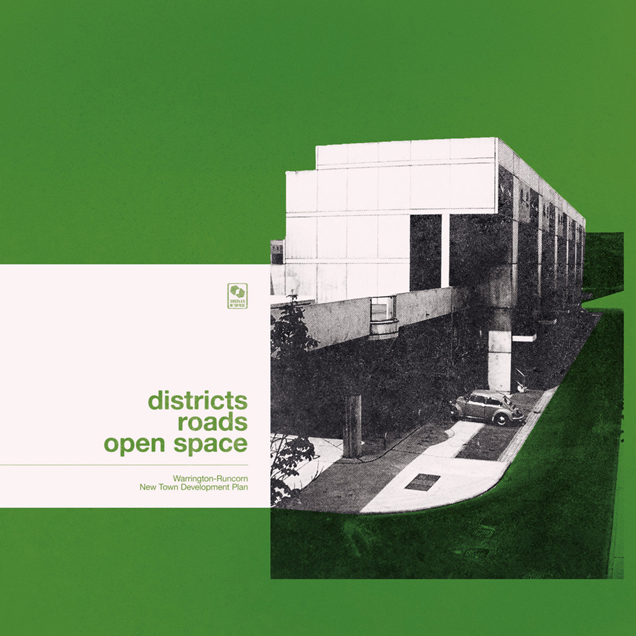
But the use of public spaces for creative leisure? Entirely on-message. Since 2020, in his slightly unwieldy guise as Warrington-Runcorn New Town Development Plan, Gordon has crafted three albums of affectingly utilitarian synth instrumentals. All concerned with the intricacies of 1970s Lancashire town planning, specifically the utopian dreams of the North-Western “New Towns”, with their concrete shopping arcades and Brutalist bus stations. The latest, Districts, Roads, Open Space, remains strikingly evocative of an era when ruddy-faced local councillors with combovers would loftily promise the hard-working families of Skelmersdale that, by the year 1995, they’d be whizzing to the shops on a monorail.
“The first album, Interim Report, 1979 , was very much based on buildings,” explains Gordon. “And the second, People And Industry, is pretty self-explanatory. But this album is more about the lives led within New Towns. And it coincided with a particularly low point during lockdown. I was feeling very isolated, quite lonely and adrift.
“And that seemed to tie in with how artificial the New Towns felt, with designated areas for shopping, leisure and work. Because human life just isn’t that structured. It’s far more messy and organic. In the 1970s, there was still a culture of men going out to work and their wives staying at home… and I just felt sorry for all those women trapped in their houses day after day. So it was a kinship through lockdown with what they must have gone through.”
The actual Warrington-Runcorn New Town Development Plan was real, resulting in the ambitious, concrete-fuelled 1970s expansion of both towns. And Gordon’s childhood was spent at the heart of a proposed development that – if ambitious plans had ever come to fruition – would have brought together three neighbouring outposts into a similarly sprawling metropolis. It was the beginning of his fascination.
“Preston, Leyland and Chorley were going to become Central Lancashire New Town,” he remembers. “The idea was abandoned, and only a few business parks and one new housing estate were built, but I knew kids that lived there. And a couple of hills away was Skelmersdale New Town… these places seemed exotic, but also quite alien and distant. You drive along a road, you come to a roundabout. You drive along another road, you come to another roundabout. You know, where is everything? You can see houses in the distance, but don’t know how to get to them.
“It felt futuristic, but artificial. Like the Moonbase from Space 1999.”
We’re walking up the hill now, to the cafe attached to the butterfly house. Cyclists, joggers and mums with mitten-wearing kids are eating scones around tables that rattle in the breeze. I’m keen to explore the chasm between the Space Age dreams of the 1970s town planners, genuinely determined to remove Northern families from the poverty of crumbling slums, and the eventual reality of piss-soaked concrete underpasses.
“There’s that famous photo of Ena Sharples, standing on a high-rise and looking out over the tenements of Salford,” says Gordon. “That photograph encapsulates so much. Runcorn had the Southgate Estate, the most Brutalist of the new estates, but it lasted barely thirteen years before it was demolished. For a council to do something so radical, then pull it down a decade later…” He shakes his head. “I think my music actually sits in that gap. Between the attempts to make things better and the fact that, in some cases, they actually ended up worse.”
What went wrong, I wonder?
“Well, the Southgate Estate was just bad design. They had one oil-based heating system for the whole complex, so the blocks near the centre were roasting and the rest were freezing cold! It might have looked fantastic to anyone who appreciates Brutalism, but the practicalities were appalling.
“And growing up, I’d often go to Preston on the bus. You can buy tea-towels of Preston bus station now: ‘Look, it’s a design classic!’ But I just remember the underground subway to the shopping centre. There’d always be homeless people sleeping in there, and a desperate, dire busker. And the floors had a rubber covering that stuck to your shoes because every liquid known to mankind had been spilt on it. There certainly wasn’t any appreciation of Brutalism in the 1980s and ‘90s. It was very much viewed as a mistake.”
It wasn’t always the case, though. Settling outside the cafe, I cite that great sociological case study, the 1976 film version of The Likely Lads. It perfectly encapsulates, I suggest, a seismic class difference when it comes to Northern views of Brutalist salvation. In one scene, Bob Ferris and Terry Collier stand amid the freshly-razed rubble of their terraced childhood homes. For the upwardly mobile Bob, already living in the middle class suburbs, the high-rise apartments rising from these ruins are “soulless concrete blocks”. For the resolutely working class Terry, the re-development can’t come soon enough. Here is a man justifiably tired of “padding down the yard to a freezing outside bog”.
“I think there was a lot of that feeling,” agrees Gordon. “People wanted to move forward. The Runcorn New Town masterplan was devised by Arthur Ling, who was Vice President of the Royal Institute of British Architects. And he was a committed communist. Not just a socialist, he was actually a member of the Communist Party. He very much saw Runcorn New Town as a way of improving the lives of ordinary people.”
Was it Thatcherism that failed the New Towns, then? I detect a sliver of anger running through the Warrington-Runcorn albums. Bitterness at these dreams of Northern working class redemption being failed by the incoming Conservative administration. As a waitress in a black tabard brings us a piping hot pot of tea, Gordon nods in agreement.
“Managed decline was a definite policy,” he says. “And will feed into the themes of the next album! We’ve had wave after wave of Northern Powerhouses and Levelling Up campaigns… they’re all just hot air and empty promises. So where the third album is alone and adrift, there’s a lot of anger in the fourth album. The treatment of the provinces, the New Towns and the North in particular. That’s the whole debate, really – did the New Towns fail, or were they failed? And in a lot of cases, I think it’s the latter. Through lack of investment.
“But I try to convey hope and despair simultaneously. And I do love Brutalism as a style. In the 1980s, we suddenly got housing estates that looked like the Dursleys’ house in Harry Potter… all trying to be rustic villages. The 1979 election of Thatcher feels like a turning point where we stopped looking forward and started looking backwards. Poundbury, built by the now King Charles just outside Dorchester… it’s horrendous. Very much a New Town estate, but a New Town for rich people, designed to look like Georgian architecture. There’s a town square with a bandstand, and it just makes me think of Trumpton.”
So what about the upbringing of the teeny Gordon Chapman-Fox? Mum was a primary school teacher with copies of the Come And Praise hymn book piled up on the piano stool, but it was his electrical engineer dad who provided a more profound musical education.
“He had a colossal record collection,” remembers Gordon. “All the original Beatles releases up until Magical Mystery Tour, when I think things got a bit too weird for him! But hearing Sgt Pepper as a five-year-old created such vivid pictures in my head. He had a huge classical collection too, which included Switched On Bach by Wendy Carlos. And also, crucially, he had Oxygène and Équinoxe by Jean-Michel Jarre. So I would put those on, get out my Star Wars figures and have the greatest fun.
“The electronic music from TV programmes like Chock-A-Block and The Great Egg Race would be filtered in, too. And anything the BBC Radiophonic Workshop was doing on Doctor Who. It all percolated through into my consciousness.”
Wasn’t that, I suggest, music borne from similarly utopian and altruistic ambitions as the New Town projects? It’s a conceptual leap, but go with me on this. The BBC, publicly-funded and with a remit unbound by commerce, decided it would be healthy to give ordinary kids a blast of the avant-garde. Experimental electronic noise, tape loops and the humming of wave oscillators, on BBC1 every Saturday teatime.
“Yeah,” laughs Gordon. “And crucially, they were only paying for one guy in a cupboard. Which is far cheaper than an orchestra. That was the whole idea behind the synth sounds on the Warrington-Runcorn albums! If a local authority was producing a promotional film about their proposed New Town development, they’d get one bloke with three synths and a four-track machine and say ‘Make us some music…’”
His first synth, he reveals, was bought in the 1990s. And employed in an somewhat unlikely musical setting.
“I was with a band called Narcosis, putting samples and noises into the grindcore!” he smiles. “But really, I got into electronic music in about 2000, when a mate got me a dodgy copy of a piece of software called Reason. And part of the appeal came from me being a control freak. I love being in a band, and bouncing ideas off each other, but sometimes I’d say ‘This song should do this!’ And no-one else would agree.”
Further alarming forays into grindcore were made during a stint as bassist with Lancashire noiseniks Mechagodzilla. There are recordings on Youtube that sound like angry elephants being pushed down flights of stairs. He has also, he bashfully admits, made a modest amount of commercial music for local TV adverts.
Come on, which ones? He’s clearly reluctant to say, but I prod him with the milk jug until he relents.
“Just over the hill there,” he says, vaguely wafting an arm in the direction of Carnforth, “there’s a caravan site. Holgate Holiday Homes. I’ve done them…”
Everything about Warrington-Runcorn New Development Plan feels perfectly formed, borne of Gordon’s own utopian ambitions for his music. The immaculate blocks of analogue, council-issue synths. The self-designed album artwork, redolent of local authority pamphlets stuffed into revolving display racks in pebble-dashed libraries. Live, he is accompanied by projections of smoke-filled local council meetings: Arthur Ling with his trimmed moustache, and the blocky text of ancient Granada TV adverts. Tellingly, the day job is designing graphics for the marketing department of Lancaster University, three miles up the A6 on a sprawling, modernist campus.
“The fact that I work at the university goes into the whole Brutalism mix,” he nods. “It’s not full-on concrete, but it’s still very 1960s. It’s almost a New Town in itself”.
So was the whole Warrington-Runcorn project, I wonder, borne from his frustration at his previous lack of musical success? He blithely claims his previous solo electronic incarnations – Heskin Radiophonic and Dublock – never sold more than 30 copies of any release. Was Interim Report, 1979 a deliberately contrarian “fuck you”? A project so achingly “specialist” that it surely wouldn’t sell at all… and so, in accordance with the bizarre laws of the universe, actually did?
“Definitely,” he smiles. “I make the music for a principle audience of me. Which may be egotistical, but if you’re not happy with your own music, why would anyone else like it? The whole theme of Warrington-Runcorn is exceptionally niche, so much so that I’ve even possibly painted myself into a corner.”
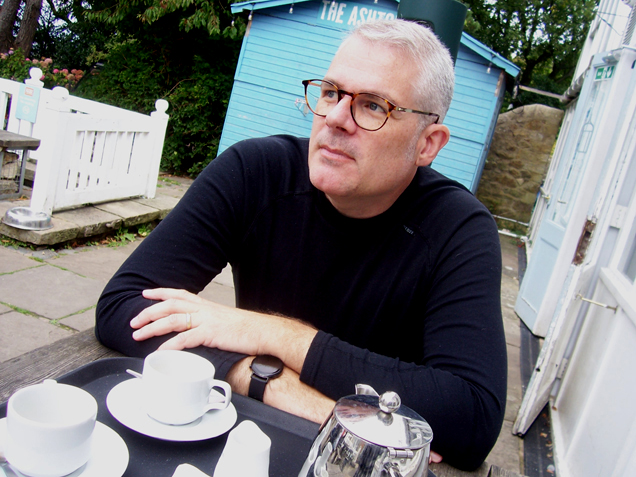
Still, the success has been a blast. There are plans for at least two more Warrington-Runcorn albums and a further LP under his own name. In Summer 2022, he played to a packed-out tent at the End Of The Road festival, and the Financial Times described the performance with appropriately minimalist concision as “one middle-aged man and his electronics set-up”. He laughs self-effacingly at the review.
“Part of me is still in a daze,” he admits. “To have played to 1000 people… it was amazing. I felt as confounded as I did when the first pressing of Interim Report, 1979 sold out in minutes. It was intimidating, so much bigger than anything I’d ever done before, and I think I looked up twice. During the first break in my set, I went over to the microphone to introduce myself… but I stumbled, nearly fell over, and just went ‘Ta!’
“Then I spent the next ten minutes thinking “You utter tit…’”
And with that, we drain the last of the tea and wander back down the hill. Just as in Middle-Earth, the road leads ever on and on. Not to Rivendell and Mordor, but to Dalton Square and the White Cross pub. And the musical dreams of a very Lancashire utopia.
Districts, Roads, Open Space is available here:
https://warrington-runcorn-cis.bandcamp.com/album/districts-roads-open-space
Electronic Sound – “the house magazine for plugged in people everywhere” – is published monthly, and available here:
https://electronicsound.co.uk/
Support the Haunted Generation website with a Ko-fi donation… thanks!
https://ko-fi.com/hauntedgen
 The Haunted Generation